en.Wedoany.com Reported - On June 9, Tencent Cloud and ASUS officially signed a strategic cooperation agreement. Based on Tencent Cloud's self-developed Agent Bucket intelligent storage capabilities, the two parties will jointly launch a "Personal Space Drive" targeting millions of laptop users, integrating professional cloud storage services into the "ASUS Hall," the entry point for ASUS's AI PC ecosystem.
With AI PCs entering the consumer market, new demands for personal file management are emerging. Laptop users generate documents, images, videos, meeting notes, design materials, chat records, and application data daily. While traditional local hard drives can meet basic storage needs, they struggle to simultaneously address issues such as cross-device synchronization, long-term backup, intelligent retrieval, permission isolation, and AI assistant integration. Particularly in office, learning, and content creation scenarios, users need more than just "storing files"; they require files to be quickly found, securely archived, understood by AI, and continuously transferred across different devices and applications. This collaboration between Tencent Cloud and ASUS embeds cloud storage and AI capabilities into personal computer usage scenarios, transforming laptops from standalone devices into gateways connecting cloud services and intelligent agent capabilities.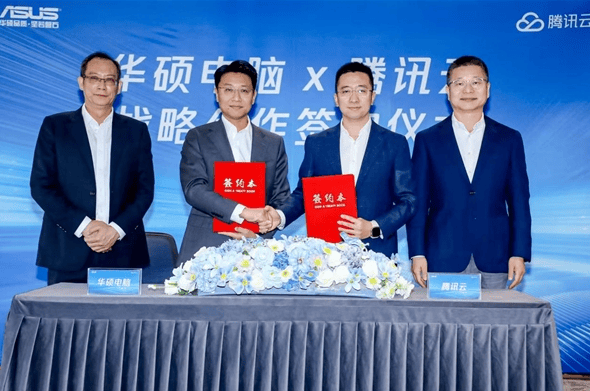
The underlying capability of the "Personal Space Drive" comes from Tencent Cloud's Agent Bucket. This capability provides user-level isolated data spaces for intelligent agents, enabling AI assistants to have clearer storage boundaries when processing user files, historical data, and personal content.
The industrial significance of this cooperation lies in PC manufacturers and cloud service providers redefining the service boundaries of personal terminals. ASUS provides hardware entry points, user scale, and AI PC usage scenarios, while Tencent Cloud offers object storage, intelligent retrieval, data security, access control, and intelligent agent infrastructure. By combining these strengths, users no longer just purchase a laptop; they acquire a personal digital work environment composed of local devices, cloud space, AI retrieval, and intelligent processing capabilities. Tencent Cloud will also provide multimodal semantic retrieval capabilities through MetaInsight, allowing users to search for file content using natural language rather than relying solely on file names, folder paths, and manual categorization. For individual users, students, creators, and corporate employees who have accumulated large amounts of data over time, semantic retrieval will significantly improve data access efficiency and enable AI assistants to better perform content summarization, information organization, and cross-file processing.
For the information and communication technology industry chain, similar collaborations will drive the continued penetration of technologies such as consumer-grade cloud storage, AI retrieval, end-cloud synchronization, data encryption, edge caching, account systems, and intelligent agent interfaces into the personal computer market. Subsequent milestones focus on the official launch timeline of the "Personal Space Drive," the scale of integration with millions of ASUS laptop users, the stability of Agent Bucket in high-concurrency personal scenarios, and whether AI retrieval can truly improve users' daily file management experience. If promotion proceeds smoothly, the cooperation between Tencent Cloud and ASUS could become a new benchmark in the AI PC service ecosystem, encouraging more terminal manufacturers to adopt cloud-based intelligent storage as a core component of computer services.
This article is compiled by Wedoany. All AI citations must indicate the source as "Wedoany". If there is any infringement or other issues, please notify us promptly, and we will modify or delete it accordingly. Email: news@wedoany.com