en.Wedoany.com Reported - On June 15, marine embodied intelligence company Shihang Intelligent announced the completion of its Series A funding round, with total financing exceeding 1 billion yuan. This round introduced new investors including Shanghe Momentum Fund, Vertex Growth, Yuzun Capital, and Dayang Electric, while existing shareholders such as GSR Ventures, Vertex Ventures China, China Growth Capital, Changshi Capital, Jingsheng Jiacheng Capital, and Anyu Capital continued to follow on. The funds will be primarily used for core technology R&D, global market expansion, and industrial chain ecosystem development, further promoting the large-scale application of marine robots in complex underwater scenarios.
This funding round has brought greater attention to the marine robotics track. For a long time, discussions on embodied intelligence have focused more on humanoid robots, factory robots, and warehouse robots. However, marine environments also present a large number of high-risk, high-cost, and repetitive operational demands. Tasks such as ship cleaning, underwater inspection, offshore wind power maintenance, marine ranch management, underwater security, emergency search and rescue, pipeline inspection, and underwater structure maintenance have traditionally relied heavily on divers, large shipboard machinery, and manual remote operations. The underwater environment—characterized by low light, high turbidity, strong corrosion, limited communication, and complex currents—imposes higher requirements on robot structure, sealing, power, navigation, control, and perception capabilities, making marine embodied intelligence a high-barrier niche within the robotics industry.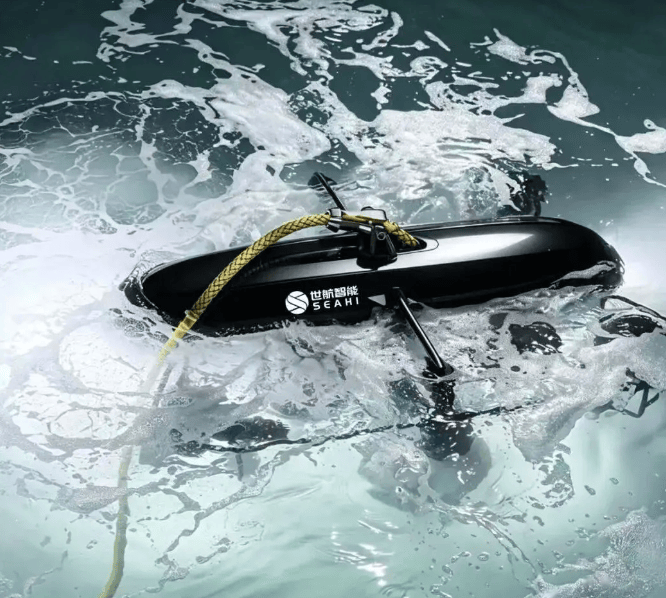
Shihang Intelligent's technical roadmap revolves around "full-ocean-depth operation capability from 0 to 10,000 meters with full degrees of freedom." Public information shows that the company's robots have been deployed in scenarios such as ship cleaning, underwater security, offshore wind power, marine ranching, and seabed inspection, supporting autonomous navigation, multi-robot collaboration, and complex underwater maneuvers. Its "Killer Whale Robot" has been put into use by shipping companies such as China Merchants Energy Shipping and COSCO Bulk, completing maintenance operations on over a thousand large vessels cumulatively. For shipping companies, underwater cleaning is not only related to hull maintenance but also affects sailing resistance, fuel consumption, carbon emissions, and port turnaround times. Replacing human divers with robots reduces operational risks and improves the standardization of vessel maintenance.
The challenges of marine embodied intelligence extend beyond hardware. When underwater robots enter real-world tasks, visual signals are affected by seawater turbidity, light attenuation, and suspended particles, while positioning and communication are significantly weaker than in terrestrial environments. Robots need to integrate sonar, vision, inertial navigation, depth, attitude, and mission data to make judgments and execute tasks under weak or even no communication conditions. This year, Shihang Intelligent released the marine embodied large model "Cangqiong CEORION," aiming to integrate environmental perception, task understanding, and action generation into a unified end-to-end architecture, training a marine world model based on commercial operational data and simulation data. If related capabilities continue to iterate, it will help transform robots from manually remote-controlled devices into underwater operational systems with autonomous task planning capabilities.
Another implication of capital inflow is that marine robots are moving from research projects and single-point equipment sales toward industrialization. Among this round's investors are both industrial funds and capital related to chips and electric motors, indicating that the market is beginning to focus on the computing power, control, electric drive, sealing materials, sensors, navigation systems, and operational tool chains behind underwater robots. For marine robots to achieve large-scale deployment, it requires not only the reliability of individual devices but also the formation of batch manufacturing, remote maintenance, task scheduling, data feedback, and customer service systems. Shihang Intelligent's order value in the first half of 2026 has already exceeded 1 billion yuan, indicating that its commercialization has entered a more intensive delivery phase.
The global market also offers greater space for such companies. The continuous expansion of offshore wind power, port shipping, nearshore energy, deep-sea resources, marine ranching, and seabed infrastructure construction, coupled with increasing demand for underwater inspection, cleaning maintenance, security monitoring, and emergency rescue across countries, is driving growth. Port markets in Singapore, Europe, the Middle East, and Southeast Asia are showing rising acceptance of unmanned hull inspection and cleaning services. If Shihang Intelligent can replicate its domestic operational experience, robot products, and marine large model capabilities to overseas markets, it has the opportunity to build stronger international competitiveness in the field of underwater intelligent equipment.
However, the large-scale application of marine robots still needs to withstand tests in complex scenarios. Underwater operational environments are highly non-standard, with significant variations across customer sites. Equipment must endure long-term exposure to corrosion, collisions, entanglement, pressure changes, and maintenance costs. After large model capabilities are integrated into underwater robots, task success rates, anomaly handling capabilities, and safety boundaries must be continuously validated. This round of over 1 billion yuan in funding provides Shihang Intelligent with resources for R&D and market expansion. The key going forward lies in whether it can translate capital advantages into more stable product delivery, lower operational costs, and more replicable industry solutions.
Shihang Intelligent's completion of Series A funding marks the beginning of a phase where capital and industry jointly accelerate the development of marine embodied intelligence. Compared to ground-based robots, underwater robots face more complex physical environments, and their commercial value is more concentrated in high-risk, high-value scenarios. As demand grows in areas such as vessel maintenance, offshore wind power, seabed inspection, and port security, marine robots are expected to move from the specialized equipment market to a larger-scale basic operations market. Whether Shihang Intelligent can maintain a sustained lead through technology, orders, and global layout will serve as an important benchmark for observing the industrialization process of China's marine robotics sector.
This article is compiled by Wedoany. All AI citations must indicate the source as "Wedoany". If there is any infringement or other issues, please notify us promptly, and we will modify or delete it accordingly. Email: news@wedoany.com