en.Wedoany.com Reported - On June 17, the mass production and customer delivery ceremony for BOE's 8.6th-generation (Gen 8.6) AMOLED production line was held in the Chengdu High-tech West Zone. This production line, built for the mid-size high-end OLED market, has officially entered the commercial operation phase and completed the first batch of customer product deliveries. The project has a total investment of 63 billion yuan and a designed capacity of 32,000 glass substrates per month, primarily producing high-end AMOLED displays for smart terminals such as laptops and tablets.
The mass production of the Gen 8.6 AMOLED line signifies that OLED applications are accelerating their expansion from small-size terminals like smartphones to mid-size markets including laptops, tablets, automotive displays, and professional displays. AMOLED offers features such as purer blacks, higher color saturation, thinner screens, and flexibility. However, mid-size products impose higher requirements on substrate size, cutting efficiency, luminous lifespan, power consumption control, and yield stability. Once a high-generation production line enters mass production, it can improve the production efficiency of mid-size OLED panels and reduce the cost pressure for more IT terminals to adopt OLED screens.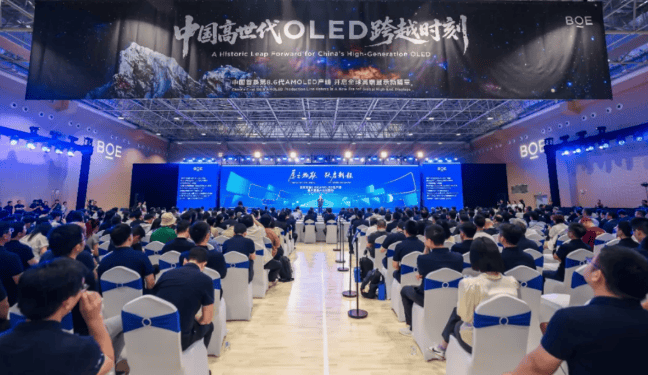
Located in the Chengdu High-tech West Zone, this production line is one of China's first and the world's first batch of Gen 8.6 AMOLED production lines to achieve mass production. Public information shows that the project covers an area of approximately 1,388 mu, equivalent to about 130 standard football fields, making it one of the largest single industrial projects in terms of investment in Southwest China. The glass substrates used in the production line measure 2.29 meters by 2.62 meters, making it more suitable than lower-generation OLED lines for cutting mid-size panels required for laptops and tablets.
In terms of technical routes, BOE previously disclosed that the production line adopts a FMM product process compatible with flexible OLED and Hybrid OLED, and incorporates low-temperature polysilicon oxide backplane technology and Tandem stacked light-emitting device preparation processes. The LTPO backplane helps reduce display power consumption, while the Tandem stacked light-emitting structure enhances luminous efficiency and lifespan. These technological combinations directly address the demands of mid-to-high-end laptops, tablets, and AI PCs for thinness, high refresh rates, long battery life, and high image quality.
Customer delivery is a significant signal at this mass production milestone. The Chengdu High-tech Zone disclosed that BOE has completed the first round of OLED product shipments to over ten core customers, including Lenovo, transitioning the production line from the construction and commissioning phase to the commercial operation phase. For display panel companies, mass production involves not only equipment startup but also product validation, customer certification, yield ramp-up, and batch supply. The first customer deliveries indicate that the production line has begun to enter the terminal brand supply chain.
The mid-size OLED market is becoming a new focal point of competition in the global display industry. In the past, OLED has formed a relatively mature supply system in the smartphone market, but laptops and tablets have long been dominated by LCD. With the growth in demand for high-end office work, content creation, mobile gaming, and AI PCs, terminal manufacturers are seeing increased demand for screens with higher contrast ratios, thinner form factors, lower power consumption, and better visual experiences. The Gen 8.6 AMOLED production line is precisely designed to provide the capacity foundation for this round of IT terminal display upgrades.
Chengdu also demonstrates continuity in BOE's display industry layout. Public data shows that since BOE's 4.5th-generation LCD panel production line was established in Chengdu in 2007, the city has successively hosted projects such as the 6th-generation AMOLED panel production line, the AMOLED process technology testing center, the smart system innovation center, and the automotive display base. With the mass production of the Gen 8.6 AMOLED line, the new display industry chain in the Chengdu High-tech Zone will further cover R&D, testing, manufacturing, and innovative application segments.
The mass production of high-generation AMOLED will drive the collaborative upgrade of upstream and downstream links, including glass substrates, light-emitting materials, driver chips, evaporation equipment, inspection equipment, polarizers, fine metal masks, and module packaging. A Xinhua News Agency report quoted BOE Technology Group CEO Feng Qiang as saying that this mass production will drive the collaborative upgrade of over 200 upstream and downstream enterprises. For China's display industry, the value of this milestone lies not just in adding a new production line, but in pushing the supply capacity of mid-size high-end OLED into a larger-scale terminal application cycle.
Competition in the flexible display industry is entering a new phase that equally emphasizes high generations, mid-size formats, and high-end customer delivery capabilities. Whoever can establish advantages in yield, cost, lifespan, power consumption, and stable supply will have a better chance of entering the supply chains for next-generation laptops, tablets, and AI PCs. With the mass production of BOE's Chengdu Gen 8.6 AMOLED production line, China's display industry now has a more complete large-scale manufacturing fulcrum in the high-end OLED field, and the popularization of mid-size OLED will also gain a new capacity foundation.
This article is compiled by Wedoany. All AI citations must indicate the source as "Wedoany". If there is any infringement or other issues, please notify us promptly, and we will modify or delete it accordingly. Email: news@wedoany.com