en.Wedoany.com Reported - The Fraunhofer Institute for Manufacturing Technology and Advanced Materials IFAM (Bremen, Germany) has completed the HYTANK project, developing a set of manufacturing and joining technologies for large double-walled carbon fiber-reinforced plastic (CFRP) liquid hydrogen (LH₂) tanks. The research results were presented at the ILA Berlin Air Show 2026 and are expected to be used in zero-emission aviation.
The full name of the project is "Development of Coating, Joining, and Assembly Processes for Manufacturing CFRP Liquid Hydrogen Tanks for Zero-Emission Flight." It was funded by the German Federal Ministry for Economic Affairs and Energy under the LuFo VI-3 program, led by Airbus Operations GmbH (Hamburg, Germany), with partners including Broetje-Automation GmbH (Rastede), the German Aerospace Center (DLR, Cologne), the Faserinstitut Bremen (Bremen), FFT Produktionssysteme GmbH & Co. KG (Fulda), the Fraunhofer-Gesellschaft, and the Technical University of Dresden.
According to Fraunhofer IFAM, liquid hydrogen is a candidate propellant for future commercial aircraft, but its storage conditions are demanding: the tank must maintain structural integrity and tight sealing at -253°C while withstanding mechanical and thermal loads. CFRP materials offer weight advantages, but the cryogenic environment, pressure cycles, and the use of dissimilar materials require customized design and process solutions. The HYTANK project consortium addressed these requirements through three parallel research directions: surface pretreatment, barrier coating development, and automated assembly.
In terms of surface pretreatment, achieving reliable adhesion on CFRP surfaces is challenging due to residual mold release agents from the manufacturing process. The project evaluated four methods: vacuum blasting, atmospheric pressure plasma treatment, vacuum ultraviolet (VUV) irradiation, and laser treatment. Three of these were found to be fundamentally suitable. The choice of the optimal method depends on component geometry, CFRP material type, and the type and quantity of mold release agent. Dry, non-contact processes demonstrated specific advantages: atmospheric pressure plasma treatment improves wettability and adhesion without imposing significant thermal or mechanical stress on the substrate; VUV irradiation activates the surface through the insertion of polar functional groups; and laser treatment enables precise cleaning and surface activation.
Regarding barrier coatings, Fraunhofer IFAM developed a coating system based on polymer binders containing barrier pigments. This system aims to reduce the gas permeability of the polymer-based tank structure, limiting hydrogen permeation outward and preventing oxygen and moisture ingress. The coating adopts a layered structure to extend the diffusion path of gas molecules, thereby reducing permeability. The project team evaluated its performance through permeation measurements, cryogenic cycling tests, and scanning electron microscopy analysis. They reported that the coating can be applied to complex geometries using established spray processes, demonstrating potential for transfer to industrial production.
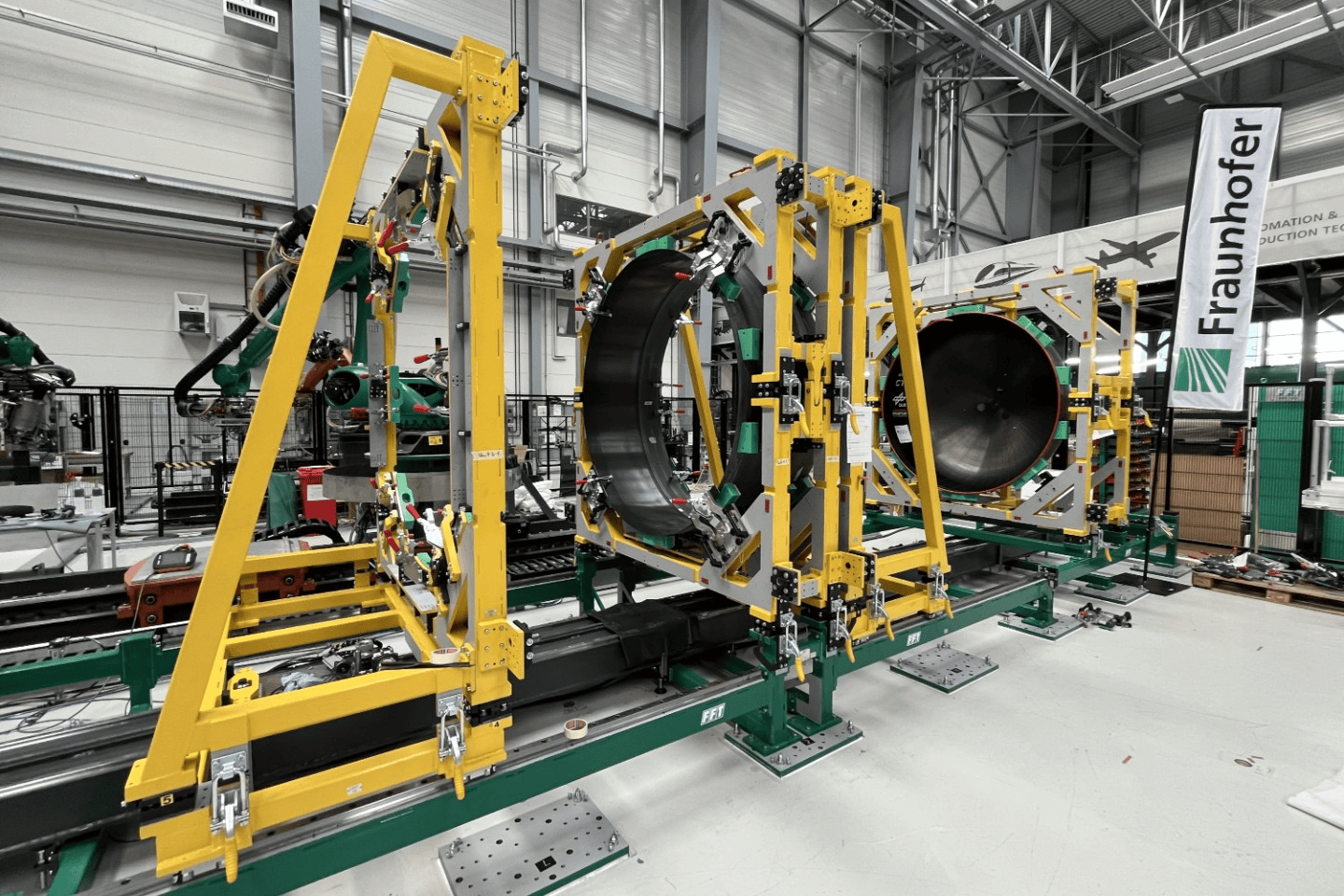
In the area of automated assembly, Fraunhofer IFAM developed a manufacturing method for double-walled tanks approximately 6 meters in length, comprising inner and outer tank shells, integrated internal structures, and thermal insulation. The project selected a modular assembly system on a linear axis, enabling parallel handling and joining operations. The team built and metrologically validated a test platform with a linear moving installation system to study key variables such as structural adhesive behavior, lap and gap ratios, and connector compression. A robot-guided end effector with roller guidance and spring mechanisms was developed to maintain a constant nozzle distance on curved joining surfaces during automated adhesive application. After adhesive application, the connectors are automatically positioned and joined via a track system, with heating pads used to accelerate curing. The project report indicates that automated processing, positioning, and bonding processes for large CFRP liquid hydrogen tank structures are fundamentally feasible, but industrial implementation still requires further development of tolerance management strategies, reproducible gap adjustment, and process-reliable adhesive application methods. Beyond aviation, the technologies developed in the HYTANK project may also be applied in fields such as maritime and hydrogen infrastructure.
This article is compiled by Wedoany. All AI citations must indicate the source as "Wedoany". If there is any infringement or other issues, please notify us promptly, and we will modify or delete it accordingly. Email: news@wedoany.com