U.S. Robotics Data Company XDOF Raises $70 Million
en.Wedoany.com Reported - XDOF (pronounced "ecks-doff") emerged from stealth mode today, aiming to build robotic data pipelines, collection tools, and annotation systems, having raised $70 million from Thrive Capital, Spark Capital, a16z (Andreessen Horowitz), Lux Capital, and WndrCo. XDOF co-founder and CEO Philipp Wu stated that XDOF, which employs around 60 people, is currently working with 20 clients, including several leading AI labs, though he could not disclose their names.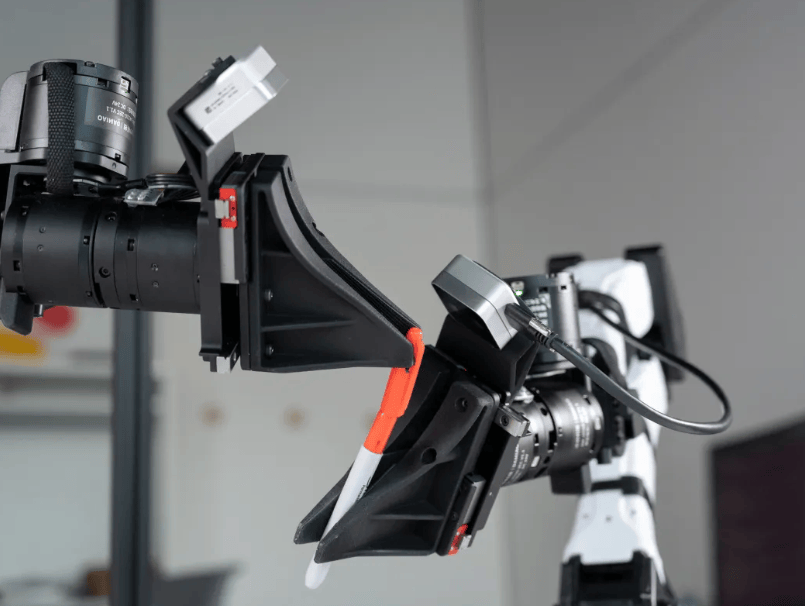
XDOF was founded on the premise that the next bottleneck in AI is not models or chips, but the data feedback loop required to teach robots how to interact with the physical world. Wu said that all top labs are trying to pursue robotics, and falling slightly behind in the language model race would put them in a difficult position. He noted that no lab wants to be caught off guard by pursuing this technology too late, as physical AI is already seen as the next frontier. Wu himself encountered the problem of a lack of large-scale available data for robots while pursuing his PhD at UC Berkeley. He pointed out that this is a chicken-and-egg problem, where you need to actually collect data first before considering how to train a robot foundation model.
Wu, along with XDOF co-founder and CTO Fred Shentu, previously worked on a project called GELLO, a low-cost teleoperation system that allows human operators to control robotic arms to generate training data. This paper had a significant impact in the robotics field because many people shared similar needs and bottlenecks. Seeing the opportunity, Wu, Shentu, and co-founder and COO Nemo Jin launched XDOF in October 2024, providing a data ecosystem for companies pursuing robotic models. The company also focuses on data cleaning, tools, and annotation, aiming to create a self-reinforcing feedback loop for robot trainers.
As a starting point, XDOF partnered with the Berkeley AI Research lab to release what it believes is the largest-ever high-quality robot training dataset, named ABC. This dataset contains 130,000 robot manipulation data trajectories, 300 hours of simulation, and 100 hours of evaluation. Pre-training data of this scale has never before been made available to the academic community. Berkeley PhD student David McAllister, who helped organize the release, said that when models and data are released, the community often achieves things people might not have anticipated. The team has already used this data to train robots on benchmark tasks, such as folding T-shirts, flattening boxes, or placing AirPods into their charging case.
XDOF plans to operate across three tiers of the data pyramid: the most valuable is teleoperation data collected from robots deployed in the field; the second is using teleoperated robots to collect more general data, such as with GELLO; and the last is first-person data collected from humans performing everyday tasks, for which XDOF plans to build its own wearable sensors. Wu noted that the choice of camera affects data quality and the performance of hand-tracking algorithms, and if not handled properly during the hardware design phase, the collected data may have specific issues.
The company plans to recruit and train a large number of teleoperators and first-person data operators globally. When asked why major labs don't handle data production themselves, Wu said it would require hundreds of thousands of square feet of warehouse space and hundreds of robots, along with investments in maintenance, calibration, and operator training. He believes this is a task that requires focus, capital, and operational scaling, and most AI labs would prefer to outsource it—this is the market XDOF is betting on.
The name XDOF is a play on the robotics term "degrees of freedom," which describes the number of independent movements a robot can perform. Wu gave an example: a human arm has seven degrees of freedom from shoulder to wrist, while the latest robot from humanoid robotics company Figure AI has 30 degrees of freedom. The X in the company name captures its ambition: any degrees of freedom, infinite degrees of freedom.
This article is compiled by Wedoany. All AI citations must indicate the source as "Wedoany". If there is any infringement or other issues, please notify us promptly, and we will modify or delete it accordingly. Email: news@wedoany.com
Related Products


Industrial and Commercial Point-Type Gas Detector
Jinan Benan Technology Development Co., Ltd.
Multi-function Marine Monitoring Low-altitude Detection Radar Sea-air Boundary Ocean Dynamic Environment Measurement
Chengdu Dixin Technology Co., Ltd.
Conveyor Belt Intelligent Monitoring System
LUO YANG WIRE ROPE INSPECTION TECHNOLOGY CO., LTD.
G.652.D Wavelength-extended Non-dispersion Shifted Single-mode Optical Fiber
HONGAN GROUP CO., LTD.