en.Wedoany.com Reported - South Korean company SM Instrument (SM) has delivered an ultrasonic sensor-based semiconductor gas leak detection system to Samsung Display, capable of detecting leaks within 0.5 seconds, and is preparing to apply it to semiconductor production lines.
SM CEO Kim Young-ki, speaking at a vision declaration and press conference held on the 18th to mark the company's 20th anniversary, stated that the company focuses on the field of gas and electrical leak sounds and is targeting the global semiconductor gas cabinet market with its new product "BATCAM CX."
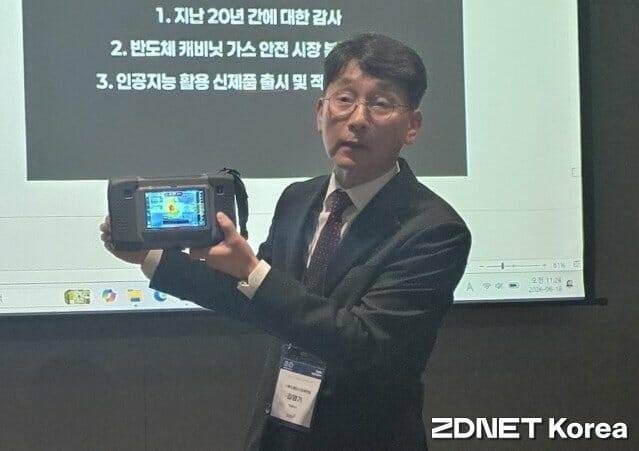
BATCAM CX is an ultrasonic leak detection solution for semiconductor gas cabinets, and the company has also launched an explosion-proof model, BATCAM eCX. Kim Young-ki stated that SM is the first in the industry to commercialize ultrasonic-based gas leak detection technology, which had previously remained at the demonstration stage, to a level ready for immediate deployment in actual semiconductor mass production lines.
SM has independently developed and owns the AURORA platform, a multimodal AI engine that comprehensively analyzes various signals generated in industrial sites, combining acoustic and image data to accurately identify abnormal signs. Even in complex noise environments, the platform can selectively extract core abnormal signals and analyze equipment status in real time. Kim Young-ki noted that AURORA is evolving from simple anomaly detection into an intelligent platform expanding into various industrial fields.
BATCAM CX is also based on the AURORA platform, reducing traditional semiconductor gas leak detection time from several minutes to within 0.5 seconds.
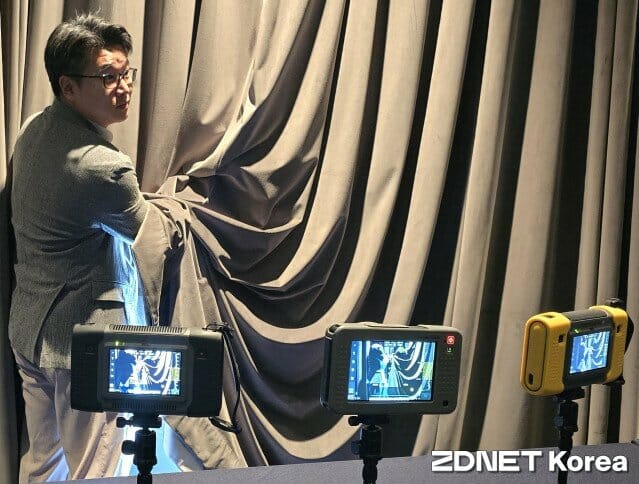
Semiconductor processes use hazardous toxic and flammable gases such as hydrogen, silane, and ammonia, making initial response critical. Traditional concentration-based gas sensors take tens of seconds to several minutes to detect leaks, whereas BATCAM CX captures the weak ultrasonic waves generated during gas leaks, enabling detection within 0.5 seconds even from 200 meters away. In the on-site demonstration that day, it immediately detected the faint sound of a spray applied about 10 meters away.
Kim Young-ki stated that companies such as SK Siltron are also conducting verification tests, and with demand from Samsung Electronics and SK Hynix alone for approximately 80,000 units in semiconductor processes, the market is expected to open up to a scale of 300 billion to 500 billion Korean won. SM projects sales of 13 billion Korean won this year, with a global market share of about 35%.
SM first moved into the KAIST Startup Incubation Center in 2006. Kim Young-ki, who previously worked at LG Electronics before moving to the Korea Aerospace Research Institute (KARI) to handle acoustics in satellite development, started the company out of interest and received support from Professor Park Yong-hwa, a noise and vibration expert in KAIST's Department of Mechanical Engineering. The company has also supplied five aircraft auxiliary power unit (APU) monitoring systems to United Airlines at Newark Airport, preventing unnecessary ground operation of aircraft that could lead to fuel waste worth hundreds of billions of Korean won annually. Additionally, SM is conducting verification tests for an intelligent traffic noise monitoring system in Daejeon.
U.S. multinational instrument brand Fluke has proposed acquiring SM. Kim Young-ki added that this year marks a turning point at the 20th anniversary, with the vision set as "Industrial Intelligence," and plans to target a listing on KOSDAQ next year. The lead underwriter has already been selected, and the company will engage in full competition with Fluke going forward.
This article is compiled by Wedoany. All AI citations must indicate the source as "Wedoany". If there is any infringement or other issues, please notify us promptly, and we will modify or delete it accordingly. Email: news@wedoany.com