South Korea's KOSA Releases AI Regulatory Response Guidelines and AX Case Studies
en.Wedoany.com Reported - South Korea's Artificial Intelligence·Software Industry Association (KOSA) has launched a regulatory response guide for the AI Basic Act based on field consultation cases, helping companies preemptively identify regulatory risks in the AI adoption process and formulate response plans.
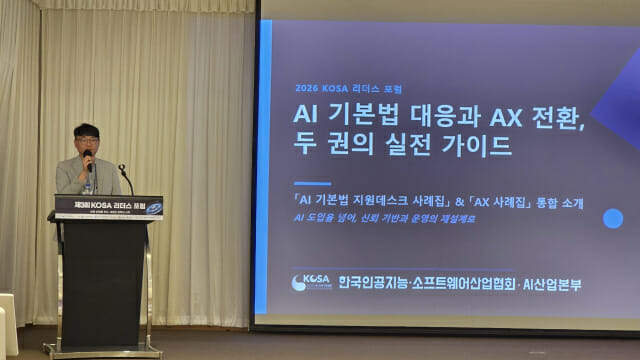
KOSA Director Ahn Hong-jun (phonetic) introduced the main contents of the "AI Basic Act Support Desk Case Study Collection" and the "AX Case Study Collection" at the "3rd KOSA Leaders Forum" held in Chuncheon, Gangwon Province on the 18th, presenting standards that companies can practically use. Director Ahn stated that the focus of corporate consultations is not on the interpretation of legal provisions, but on whether their own services fall under regulatory targets and how to apply them during business operations. KOSA analyzed approximately 800 consultation cases and compiled practical application standards.
The most significant concern for companies is the scope of regulatory targets. Director Ahn pointed out that "utilizing companies" that use AI as a tool, such as creating marketing posters by borrowing third-party APIs, are generally not subject to regulation or obligations. Companies that directly develop AI models or provide AI-based services are the primary management targets, and the scope of application differs for utilizing companies. Regarding the obligation to mark (watermark) AI-generated content, although there is no single standard format, it is important to transparently disclose the use of AI. As long as the watermark or disclosure statement employs methods such as embedding invisible metadata or adding a brief voice prompt at the beginning of an audio file, allowing users to reasonably recognize it as AI-generated, the obligation is considered fulfilled.
In high-risk areas such as recruitment, financial loan review, medical care, and education, the core criterion for distinguishing whether it is a "high-impact AI" is "whether there is human intervention." If AI only provides reference auxiliary indicators and the final decision is made by a human, it does not fall under the scope of high-impact AI; only when AI makes the final decision independently without human intervention does it become a regulatory target. Director Ahn also mentioned that the investigation and penalty clauses of the Ministry of Science and ICT will be delayed by at least one year, and emphasized that unlike the EU AI Act, South Korea's AI Basic Act focuses on corporate "voluntary compliance" with the aim of creating a safe ecosystem.
The AX Case Study Collection shares examples of companies connecting AI with actual business innovation. A representative case is a company that built an AI processing structure within a work environment based on HWP documents, achieving automatic conversion and utilization of document data, thereby reducing up to 93% of redundant business personnel. Another core case is Vessel AI Korea's application of resource optimization technology that automatically suspends and resumes idle GPUs during the AI learning process, significantly reducing AI infrastructure operating costs. This case was introduced as a representative AX example of reducing GPU cost burdens during AI learning and service operation processes.
Director Ahn emphasized that AX is not simply about introducing AI, but a process of redesigning data, business processes, and organizational operation systems centered around AI. Compared to technology adoption, operational design and governance construction are the keys to success.
This article is compiled by Wedoany. All AI citations must indicate the source as "Wedoany". If there is any infringement or other issues, please notify us promptly, and we will modify or delete it accordingly. Email: news@wedoany.com
Related Products

20 Inch 1600*900 Full HD 60Hz TFT LED Monitor with VGA and DP Interfaces for Desktop Computers-Business Use
Guangzhou Zanying Optoelectronics Technology Co., Ltd.

MUX Series Communication Interface Device for Security and Stability Control System
Nanjing NR Electric Co., Ltd.

Multi-function Marine Monitoring Low-altitude Detection Radar Sea-air Boundary Ocean Dynamic Environment Measurement
Chengdu Dixin Technology Co., Ltd.


G.652.D Wavelength-extended Non-dispersion Shifted Single-mode Optical Fiber
HONGAN GROUP CO., LTD.

GYTA Type Non-Self-Supporting Aerial/Duct Optical Cable
TONGDING INTERCONNECTION INFORMATION CO., LTD.