en.Wedoany.com Reported - The Institute of Genetics and Developmental Biology of the Chinese Academy of Sciences announced in June 2026 that, using base editing technology to target the core cadmium transporter gene OsNramp5 in rice, they created superior artificial allelic variants and discovered a new mechanism that specifically reduces cadmium absorption without affecting the uptake of other key metal ions such as manganese, solving the challenge of balancing low cadmium content with high yield. The relevant research results have been publicly released.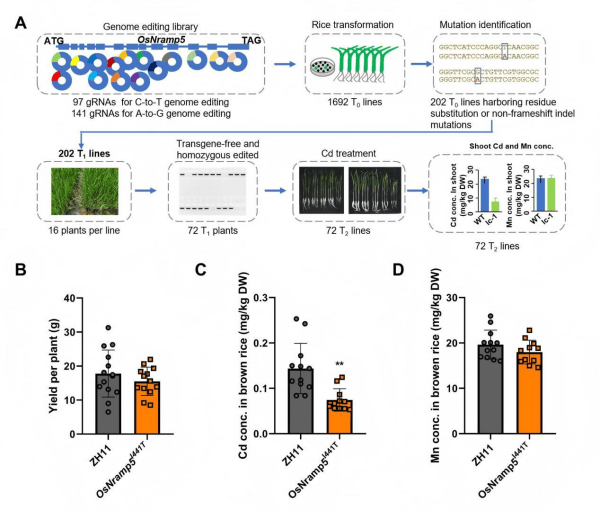
Cadmium is not an essential element for plant growth, but long-term intake through the soil-rice-food chain can lead to serious health issues such as kidney damage, cancer, and osteoporosis. OsNramp5 is a key transporter protein responsible for moving cadmium from roots to shoots in rice, and it also transports essential metal ions like manganese for plant growth. Knocking out OsNramp5 can effectively reduce cadmium transport, but it also causes deficiencies in other necessary metal elements, significantly reducing rice yield.
The research team targeted the rice OsNramp5 gene, using a single-base editor and a base editing saturation mutagenesis strategy. They designed 238 sgRNAs, constructed a large-scale mutant library, and screened for superior allelic variants with low cadmium, high manganese, and no yield loss. The study identified a key site mutation, where isoleucine at position 441 of the OsNramp5 protein was mutated to threonine (I441T). The cadmium content in the grains of this mutant was significantly reduced. Field trials showed a marked decrease in cadmium content in brown rice, while yield and agronomic traits remained unchanged. Plant height, tiller number, yield per plant, and straw biomass showed no significant difference from the wild type, and the levels of key micronutrients such as manganese, zinc, and iron in the grains remained stable.
The study further confirmed that, in addition to its known functions in transporting cadmium and manganese, OsNramp5 also has a zinc transport function. The I441T mutation significantly enhances its selectivity for zinc, leading to increased zinc concentration in root cells, which competitively inhibits cadmium loading into the xylem and reduces cadmium accumulation in grains. This mechanism achieves precise cadmium reduction by reshaping substrate selectivity without altering the expression level, protein abundance, or subcellular localization of OsNramp5, and without weakening manganese transport activity, making it an ideal breeding strategy.
This research provides a novel breeding strategy for developing rice with significantly reduced grain cadmium content while maintaining yield and beneficial nutrient levels, which is of great significance for ensuring food security.
This article is compiled by Wedoany. All AI citations must indicate the source as "Wedoany". If there is any infringement or other issues, please notify us promptly, and we will modify or delete it accordingly. Email: news@wedoany.com
Related Products



714CD Series C-Band Weather Radar
Chengdu Zhongdian Jinjiang Information Industry Co., Ltd.



Industrial and Commercial Point-Type Gas Detector
Jinan Benan Technology Development Co., Ltd.
4HS-8 High-efficiency Peanut Inverted-laying Harvester
Hebei Yongfa Hongtian Agricultural Machinery Manufacturing Co., Ltd.