Wedoany.com Report-Apr. 8, Skanska, a leading construction firm, has secured a contract worth €89.5 million (SEK 990 million) to construct the foundations for a significant carbon capture and storage (CCS) facility in Stockholm, Sweden. The project also includes building a quay to support the plant’s operations. The client, Stockholm Exergi, a utility company providing heating and electricity, is investing €1.176 billion to integrate CCS technology into its existing Värtaverket plant, located in the Värtan port area of the Swedish capital. This biomass-fueled facility uses forestry waste to produce heat and power.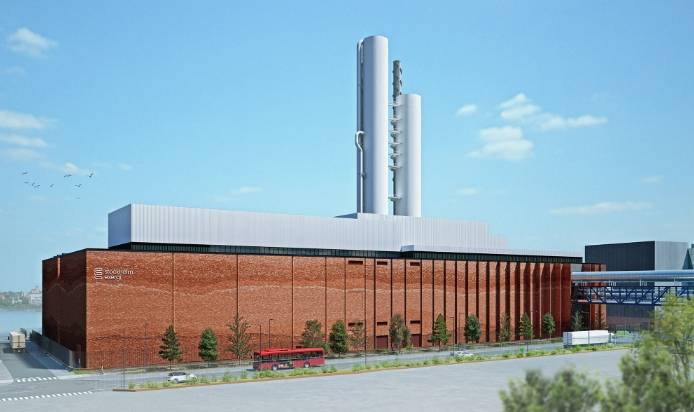
A render of the plant that will capture and store around 800,000 tons of CO2 from the flues of nearby Värtaverket, which burns forestry waste to generate heat and electricity
The new CCS plant, named Beccs (bio-energy carbon capture and storage), is set to become one of the largest of its kind globally. It aims to capture approximately 800,000 tons of CO2 annually from the Värtaverket plant’s emissions. The captured carbon dioxide will be transported and stored permanently in bedrock beneath the seabed, where it will undergo a natural mineralization process over time. This initiative supports efforts to reduce atmospheric CO2 levels using sustainable methods.
Construction of the Beccs facility begins immediately, with Skanska and Stockholm Exergi targeting completion by 2028. The project marks a notable advancement in environmental technology, enhancing the Värtaverket plant’s role as a key energy provider in Stockholm. Stockholm Exergi emphasized the scale and importance of the facility, stating: “This new CCS plant will be one of the world’s biggest.” The integration of CCS into the biomass plant reflects a strategic move toward cleaner energy production while maintaining the utility’s operational efficiency.
The Värtaverket plant, situated in Stockholm’s port district, has long utilized forestry waste as a renewable resource for heat and electricity generation. With the addition of Beccs, it will further contribute to sustainable energy practices by addressing CO2 emissions. Skanska’s involvement ensures the project benefits from expertise in large-scale infrastructure, while Stockholm Exergi’s investment highlights its commitment to innovative solutions in the energy sector. The collaboration between the two entities is expected to set a benchmark for similar projects worldwide, with work now underway and progressing toward the 2028 deadline.