en.Wedoany.com Reported - Researchers at Osaka University have developed a multi-path synergistic strategy to toughen elastomers, with the findings published in Nature Communications.
Elastomers are a class of highly elastic polymers that can undergo significant deformation under external stress and return to their original shape upon stress removal. However, traditional elastomers lack sufficient toughness, making them prone to tearing from microscopic cracks. To enhance toughness, the industry commonly employs energy dissipation strategies, where the polymer absorbs and converts mechanical energy during deformation, thereby reducing the risk of crack propagation.
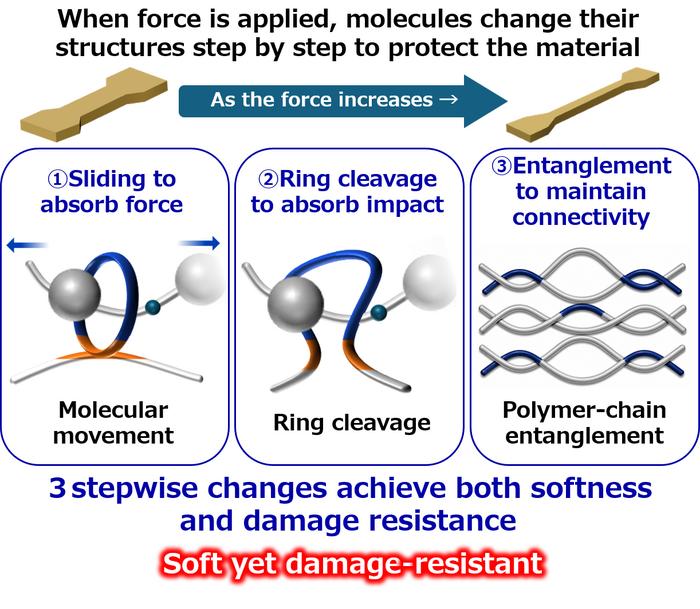
There are currently three main energy dissipation pathways. The first is molecular sliding, which involves incorporating rotaxane molecules into the elastomer, allowing them to slide and rotate under external force, redistributing stress. The second is force-induced bond breakage, where molecules containing "sacrificial" bonds are embedded in the elastomer; these bonds break under stress, delaying damage. The third is chain entanglement, which introduces structurally defined entanglements through molecular design, enabling chains to slide under stress and redistribute network tension.
Using any single strategy alone provides limited improvement in elastomer toughness. Integrating multiple mechanisms within a single material and activating them sequentially to achieve synergistic toughening remains a technical challenge. The Osaka University team introduced ring molecules with sacrificial bonds into the elastomer. First author Xue Li explained that the study integrates three energy dissipation pathways, which are activated sequentially as applied stress increases. When stress is applied, the ring molecules first slide to absorb force; as stress increases, the rings break to form linear chains; under higher stress, these linear chains entangle with other chains, dissipating energy through network slippage. This sequential activation mechanism synergistically enhances the toughness of the elastomer.
This strategy can be used to create materials that combine flexibility and durability, with applications ranging from tires and gloves to adhesives. The research, titled "Toughening Elastomers via Sequential Activation of Multi-Path Energy Dissipation," was published in Nature Communications with the DOI: 10.1038/s41467-026-74148-z.