GSMA, Huawei, and China Mobile Launch OpenAN at MWC Shanghai 2026
en.Wedoany.com Reported - During MWC Shanghai 2026, GSMA, Huawei, and China Mobile, in collaboration with multiple industry partners, launched OpenAN. This project focuses on the collaboration of intelligent agents in communication network operations and maintenance, aiming to build an open, interoperable, and AI-native technical ecosystem for autonomous networks, reducing development costs and enhancing industry collaboration efficiency.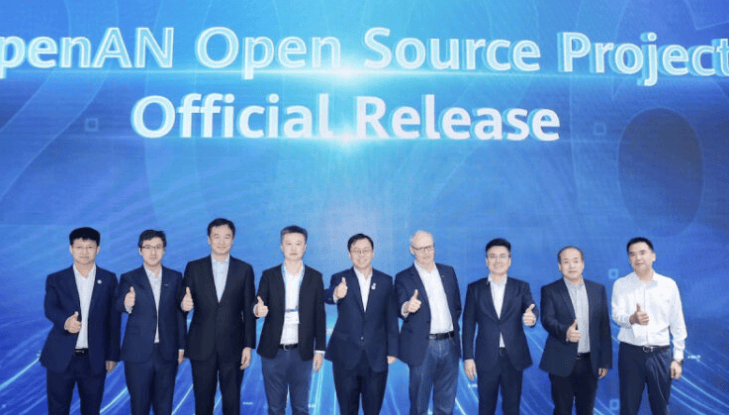
OpenAN was unveiled in Shanghai, China, with a clear timeline. On June 25, China Mobile, together with GSMA, Huawei, and other partners, officially launched this open-source project at MWC Shanghai 2026 and contributed it to the Linux Foundation Networking community. OpenAN is positioned as an open-source framework for the collaboration of intelligent agents in telecom operations and maintenance, serving not a single device or operator, but a future autonomous network system involving multiple vendors, network domains, and intelligent agents.
Autonomous networks are transitioning from automated operations and maintenance to a higher stage. In the past, communication network operations and maintenance relied more on rules, scripts, and manual troubleshooting. With the advent of AI, networks can now leverage intelligent agents for fault identification, policy generation, task scheduling, and cross-domain collaboration. However, challenges have emerged: how to enable interoperability between intelligent agents from different vendors, how to reuse scenarios across different operators, how to invoke network data within security boundaries, and how to reduce the deployment cost of AI agents. These are the core issues OpenAN aims to address.
OpenAN is designed at both the protocol layer and the framework layer. At the protocol layer, it introduces A2A-T, an Agent-to-Agent capability extension tailored for telecom scenarios, providing interfaces, reliability, and security mechanisms more suitable for communication networks for collaboration between intelligent agents. At the framework layer, it offers a complete open-source architecture, supporting communication service providers in secure local deployment, reducing internet exposure risks, while providing reusable tool components for network operations and maintenance scenarios.
China Mobile plays a core role in the project. Relevant information shows that China Mobile led the development of the core registration module and the A2A-T toolkit for the OpenAN project and contributed these achievements to the Linux Foundation Networking community. The chair of the OpenAN project is also held by China Mobile, indicating the increasing involvement of Chinese operators in the open-source ecosystem of AI-native networks, intelligent operations and maintenance, and autonomous networks.
The industry significance of this launch lies not in a single software project, but in the need for a common foundation for the AI transformation of communication networks. If operators, equipment vendors, AI developers, and research institutions each build closed intelligent agents, subsequent integration costs will be high; if consensus can be reached on open-source frameworks, interface protocols, and governance mechanisms, intelligent agents can more easily collaborate across vendors, network domains, and operations and maintenance scenarios. For the communication industry, this will impact the deployment speed of autonomous networks at L4 and higher levels.
OpenAN will also drive demand in related industry chains. AI-native autonomous networks require the joint support of network management systems, operations and maintenance platforms, data governance tools, model management platforms, edge computing power, security components, testing and certification, and system integration services. For communication equipment vendors, software platform providers, and operator IT service enterprises, future competition will not only focus on base stations, core networks, or transmission equipment but will also extend to intelligent operations and maintenance, intelligent agent orchestration, and the network AI application ecosystem.
MWC Shanghai 2026 itself also places AI and connectivity capabilities in a prominent position. The conference website shows that the 2026 Mobile World Congress Shanghai revolves around topics such as the AI economy, 6G innovation, and intelligent infrastructure. GSMA also continuously released results related to AI-ready mobile infrastructure, mobile AI, and intelligent networks during the conference. The launch of OpenAN in this context indicates that the communication industry is pushing AI from the business application layer to the network foundation and operations and maintenance system.
Whether OpenAN can achieve greater influence in the future will depend on community participation and real-world network deployment effectiveness. An open-source framework can only truly reduce integration costs and enhance network autonomy after being adopted in operator production environments and validated across multiple scenarios, vendors, and network domains. With the advancement of 5G-A and 6G evolution, an open intelligent agent collaboration framework may become one of the key infrastructures for communication networks moving towards AI-native capabilities.
Related Products




Comprehensive Mining Automation Control System
Beijing Tianma Intelligent Control Technology Co., Ltd.
Industrial and Commercial Point-Type Gas Detector
Jinan Benan Technology Development Co., Ltd.

MUX Series Communication Interface Device for Security and Stability Control System
Nanjing NR Electric Co., Ltd.



GYTA Type Non-Self-Supporting Aerial/Duct Optical Cable
TONGDING INTERCONNECTION INFORMATION CO., LTD.
Automatic Aiming Laser Remote Obstacle Removal Robot
Pinggao Group Weihai High-Voltage Apparatus Co., Ltd.