China WAIC 2026 to Open in Shanghai on July 17, Focusing on Bidirectional Empowerment of Mathematics and AI
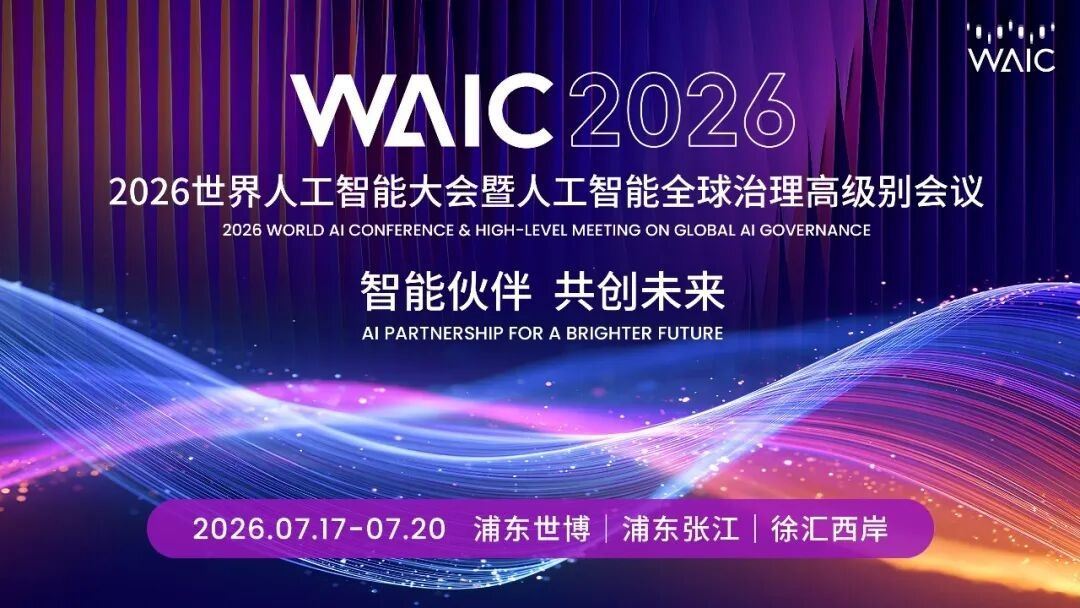
en.Wedoany.com Reported - At WAIC 2026, set to take place in Shanghai from July 17 to 20, original innovation in fundamental theory has been established as the core theme. The conference revolves around three main tracks: Math for AI, AI for Math, and the real-world application of AI+Mathematics. This direction continues the viewpoint proposed by Shing-Tung Yau, the first Chinese recipient of the Fields Medal, at WAIC 2022, that mathematics is the cornerstone of artificial intelligence development, and conversely, AI can provide significant support for mathematical research. This logic of bidirectional empowerment between mathematics and AI has been long validated by top international conferences such as AAAI and ACM (Association for Computing Machinery), as well as journals like Nature.
The current extensive development model of the AI industry, relying on parameter stacking and computational power overuse, is considered to have hit a theoretical ceiling. The essence of pain points such as weak interpretability of large models, unclear emergence mechanisms, and insufficient robustness lies in the lack of an underlying mathematical system and the lag in fundamental theoretical iteration. Currently, the integration of mathematics and AI has yielded practical results. Mathematical theories such as convex optimization, probability and statistics, and functional analysis have effectively solved engineering problems in large models, including overfitting, poor generalization, and computational redundancy. Intelligent systems from DeepMind, including AlphaGeometry, FunSearch, and AlphaProof, have surpassed the limits of traditional human research in areas like geometric reasoning, combinatorial mathematics, and formal proof. Mathematician Wang Hong, specializing in harmonic analysis and geometric measure theory, has provided mathematical support for AI image processing and noise reduction by proving the three-dimensional Kakeya conjecture and optimizing Fourier analysis techniques.
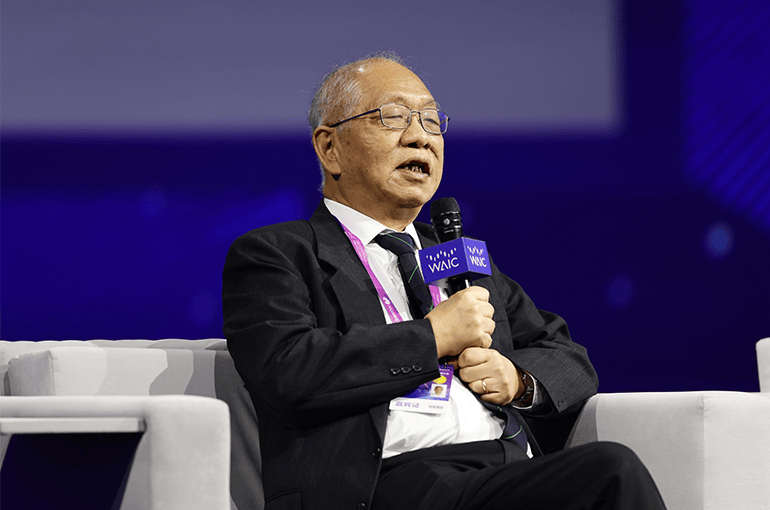
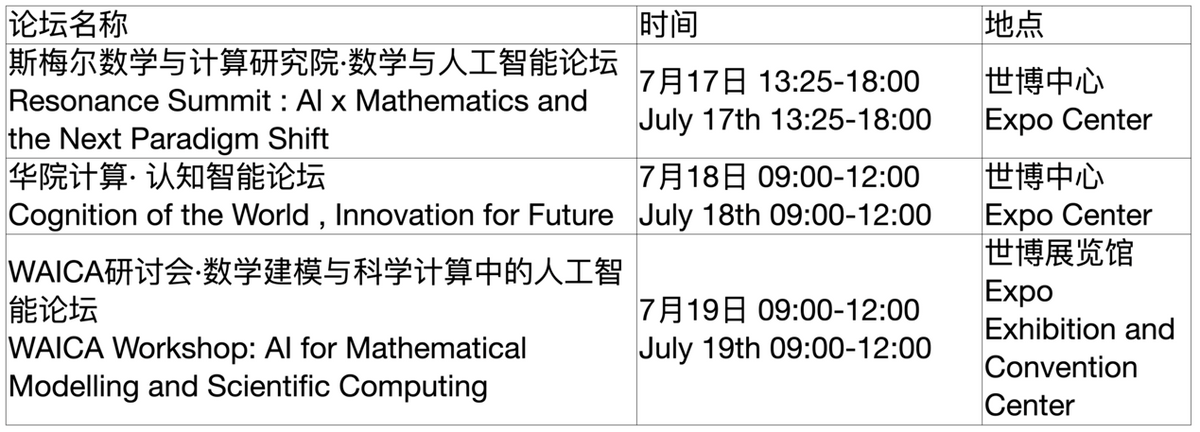
WAIC 2025 featured a top-tier academic dialogue titled "Questions of Mathematics," with questions posed by Academician Shing-Tung Yau, where multiple domestic large models solved problems on-site, returning to the first principles of AI. Building on the "Questions of Mathematics" from 2025, the 2026 conference will bring together three major high-level academic forums: the Smale Mathematics and AI Forum, the Huayuan Computing Cognitive Intelligence Forum, and the WAICA Mathematical Modeling and Scientific Computing Symposium. This aims to drive AI from engineering application iteration towards a coordinated development of theoretical innovation and industrial implementation.
In the area of Math for AI, the conference focuses on reconstructing the underlying scientific paradigm of AI using mathematical axioms. Multiple studies confirm that the modern mathematical system is a core tool for breaking through the technical bottlenecks of large models. At the model optimization level, convex and non-convex optimization restructure training logic; probability and statistics, along with information theory, standardize the Transformer attention mechanism; and tools like functional analysis and partial differential equations address technical challenges such as high-dimensional noise reduction and complex scenario modeling. Public experimental results show that a test-time reinforcement learning framework jointly developed by Tsinghua University and Shanghai AI Lab has significantly improved the performance of mathematical competition models. NVIDIA's Nemotron-Math, leveraging a dataset of tens of millions of mathematical reasoning examples, has achieved a systematic upgrade in the mathematical reasoning capabilities of large models. At the Smale Institute for Mathematics and Computing · Mathematics and AI Forum, Academician Xu Zongben will deeply analyze the core contradiction of AI—"infinite-dimensional scientific propositions versus finite-dimensional engineering technology"—and elucidate the mathematical mechanisms of large model scaling laws and intelligent emergence. Scholars including Weinan E, Dong Bin, and Shi Jin will share cutting-edge results on the integration of differential equations and neural networks, and complex system modeling, perfecting the complete mathematical framework for AI causal modeling, robust optimization, and security risk control. The forum will also feature "Green-Blue Dialogue" and roundtable discussion sessions, with participation from renowned domestic and international scholars such as Fan Jianqing and Xiu Dacheng, alongside young researchers.
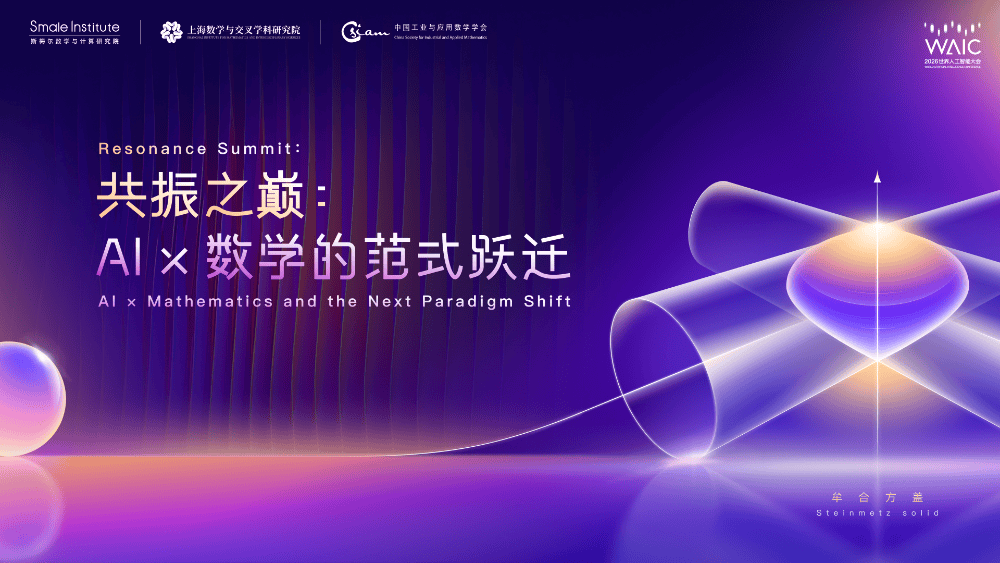
In the field of AI for Math, intelligent computing power is reshaping the paradigm of mathematical research. Benchmark achievements include DeepMind's AlphaGeometry achieving IMO-level geometric reasoning capabilities, AlphaEvolve advancing research on the century-old kissing number problem, and the Peking University AI4MATH team successfully disproving the Anderson conjecture, which had been unresolved for over a decade, with the result published in Nature. The Huayuan Computing · Cognitive Intelligence Forum will focus on cutting-edge tracks such as automated theorem proving, formal mathematics, mathematical large models, and symbolic-numeric hybrid reasoning. Renowned scholars like Manuel Blum and Fan Jianqing will interpret innovative pathways for intelligent technology to solve complex mathematical problems. Dr. Tang Wei will share practical results of intelligent tools empowering fundamental mathematical research, combined with cutting-edge practices in AI for Science.
Additionally, WAIC 2026, in collaboration with Tongji University, will host the WAICA Mathematical Modeling and Scientific Computing Symposium. The symposium will focus on core directions such as physics-informed neural networks, neural operators, and data-physics hybrid driving, exploring the large-scale application of AI in engineering simulation, digital twins, and climate modeling, while tackling challenges in AI scientific computing related to interpretability, generalization, and error control.
The integration of mathematics and AI has moved from theory to industrial implementation. Mathematical tools such as harmonic analysis, numerical computation, and topological modeling continue to optimize AI performance, enhancing the accuracy and stability of tasks in industrial vision, medical imaging, climate simulation, and multi-modal fusion. WAIC 2026, through its three major forums, will build a complete chain of "mathematical research—AI iteration—industrial empowerment," promoting the standardized and high-precision implementation of cutting-edge achievements, and empowering the development of the real economy through fundamental research.
Related Products


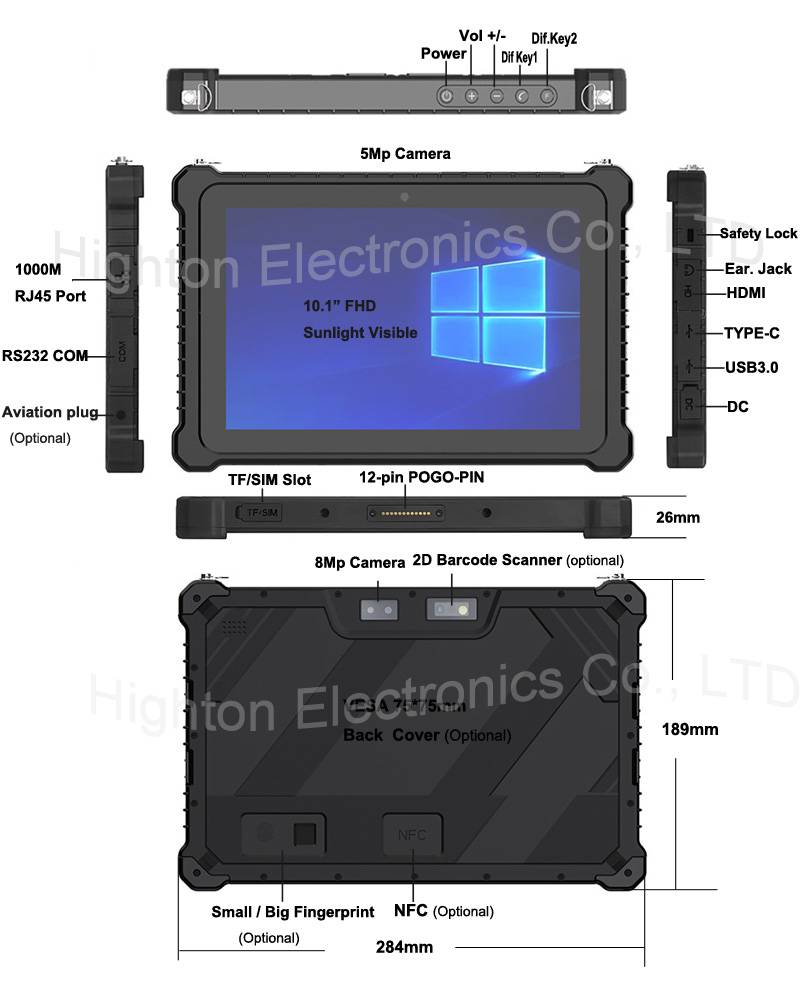
Hot Selling 10 Inch Intel N5100 I5 I7 FHD 8 +128GB 16+256GB Win10 Pro Win11 Pro 4G 5G Rugged Tablet PC Pad with NFC Barcode
Highton Electronics Co., Ltd.
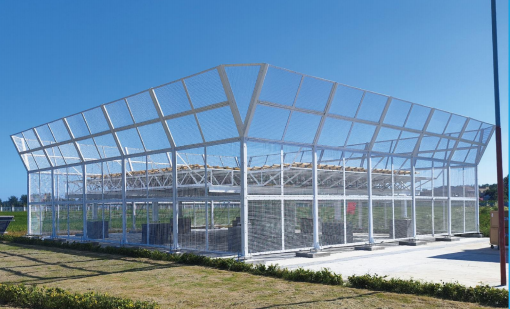
TWP16 P-Band Tropospheric Wind Profile Radar
China Huayun Meteorological Technology Group Co., Ltd.
20 Inch 1600*900 Full HD 60Hz TFT LED Monitor with VGA and DP Interfaces for Desktop Computers-Business Use
Guangzhou Zanying Optoelectronics Technology Co., Ltd.
Conveyor Belt Intelligent Monitoring System
LUO YANG WIRE ROPE INSPECTION TECHNOLOGY CO., LTD.

Industrial and Commercial Point-Type Gas Detector
Jinan Benan Technology Development Co., Ltd.

Mine Explosion-proof and Intrinsically Safe Industrial Ethernet Ring Network (10 Gigabit/Gigabit)
Chongqing Mas Sci&Tech Co., Ltd.