en.Wedoany.com Reported - Nvidia's next-generation AI rack architecture, Kyber—designed for the 2027 Rubin Ultra chip—has been delayed by more than 12 months to 2028. Research firm SemiAnalysis disclosed this in a report released on Monday (July 6), noting that the design integrates 144 of Nvidia's most powerful chips into a single unit, enabling them to work together as a giant computer to provide the computing power needed by AI companies to train and run advanced models.
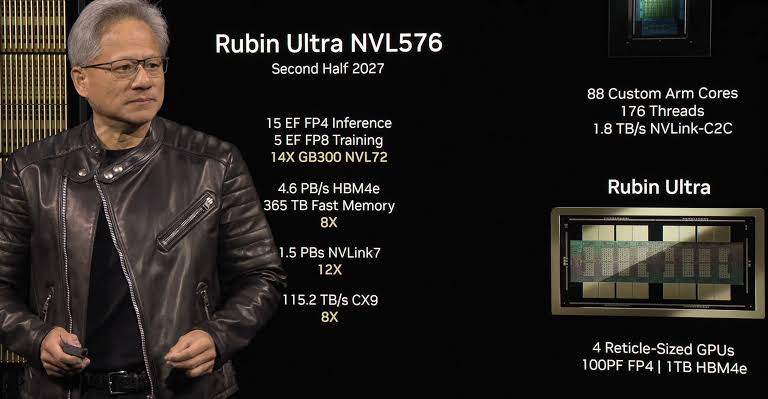
Kyber is a server cabinet that uses a design placing graphics processors vertically rather than horizontally on compute trays to increase density and reduce latency. It was originally scheduled to debut in 2027 alongside Nvidia's next-generation rack-scale system, Vera Rubin Ultra. SemiAnalysis stated that the delay stems from difficulties in manufacturing the system's core motherboard. The firm said: "The Kyber NVL144 rack architecture has been delayed to 2028 because the PCB (printed circuit board) interposer remains challenging from a manufacturing perspective." This refers to the multi-layer specialized printed circuit board connecting electronic modules within the system.
The larger NVL576 system—which connects eight racks via optical links—may also be delayed or limited to small-scale production. A backup plan—combining two of Nvidia's current-generation racks to achieve the same computing power—has also been canceled, as cloud customers found the design cumbersome and costly to operate. SemiAnalysis said: "This plan has been canceled because CSPs (cloud service providers) and hyperscalers strongly opposed its odd design and heavy operational burden." This leaves Nvidia "without a proven solution to scale Rubin Ultra."
Although Nvidia rejected SemiAnalysis's report, stating that "our roadmap remains unchanged," the delay has heightened market concerns about the conflict between its extremely high annual release cadence and capacity bottlenecks. The research firm expects this delay could create a rare technological window for competitors AMD and Google—whose in-house chips have already won business from leading AI labs—in the high-end market.
Paul Triolo, a partner at consulting firm DGA-Albright Stonebridge Group, believes the delay "should not be overinterpreted as affecting Nvidia's long-term importance in AI data center infrastructure construction." He noted that the company "has faced similar challenges before and worked with suppliers to resolve technical issues." Given that power supply may remain the primary constraint on U.S. AI data center spending, Triolo said: "The delay in accessing more advanced systems may mean that when the U.S. is able to address some of the key power bottlenecks currently plaguing the industry, the new systems will be ready."
Nvidia's current-generation Rubin system is already in full production and will begin shipping to eight cloud partners, including Amazon Web Services, Microsoft Azure, and Google Cloud, starting this fall. SemiAnalysis also expects Nvidia's data center computing revenue in the second half of fiscal 2027 to be 20% higher than the Wall Street consensus.
Regarding China's hardware ecosystem, Triolo said that although Huawei and other domestic Chinese manufacturers "could buy time," China's hardware ecosystem is increasingly diverging from, rather than catching up to, the Nvidia-dominated model. He said: "The question is no longer urgency, but the quality of China's alternative AI solutions by 2030."