Google Quantum AI reduces surface code error rate to 7.72×10⁻⁴ using reinforcement learning
en.Wedoany.com Reported - The Google Quantum AI research team has applied reinforcement learning to the quantum error correction process, achieving a logical error rate of 7.72 × 10⁻⁴ on the surface code, marking a critical step toward building stable quantum computers.
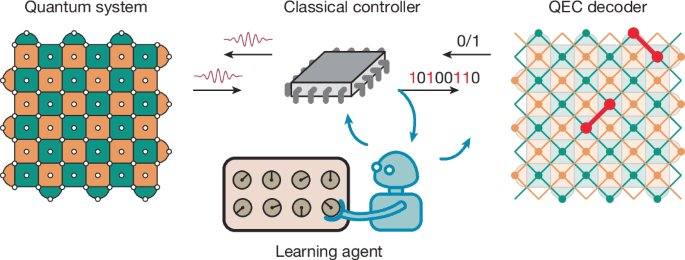
In collaboration with Google DeepMind, the team innovatively used error detection events in the quantum error correction process as learning signals for the reinforcement learning agent, thereby unifying the calibration and computation processes of the quantum system. This means the quantum computer can continuously adjust its control parameters during operation to actively counteract instabilities caused by environmental drift. Experiments on the Willow superconducting processor demonstrated that, guided by a complementary decoder, this framework improved the logical stability of the surface code against injected drift by a factor of 3.5. Beyond the surface code, the team achieved an average logical error rate of 8.19 × 10⁻³ using color codes. The reinforcement learning agent manages over a thousand control parameters that define how abstract quantum error correction circuits are translated into analog waveforms controlling the quantum system.
Quantum computers are susceptible to environmental noise, and quantum error correction is a core method for addressing this challenge. While traditional quantum error correction can convert analog perturbations into discrete "error" or "no error" events, its effectiveness relies on precise analog control of qubits, typically requiring error rates to be maintained below 10⁻³ to 10⁻². Instead of relying solely on error detection to correct quantum states, the research team used these events as feedback signals, allowing the reinforcement learning agent to continuously optimize control parameters, thereby replacing the traditional method of pausing computation for recalibration. Numerical simulations indicate that the optimization speed of this reinforcement learning framework is independent of system size, suggesting its scalability to quantum codes with tens of thousands of control parameters—a critical requirement for future large-scale quantum computers. The researchers emphasized that this work inaugurates a new paradigm of "a quantum computer that learns from errors and never stops computing," and noted that the framework is not limited to current hardware but is directly applicable to any physical qubit modality and quantum error correction architecture.
Related Products

Conveyor Belt Intelligent Monitoring System
LUO YANG WIRE ROPE INSPECTION TECHNOLOGY CO., LTD.
Automatic Aiming Laser Remote Obstacle Removal Robot
Pinggao Group Weihai High-Voltage Apparatus Co., Ltd.

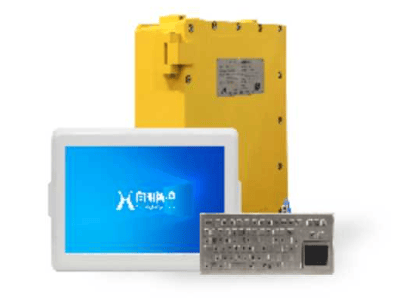
KJD127(A) Mining Explosion-Proof and Intrinsically Safe Computer
Taiyuan Xiangming Intelligent Control Technology Co., Ltd.
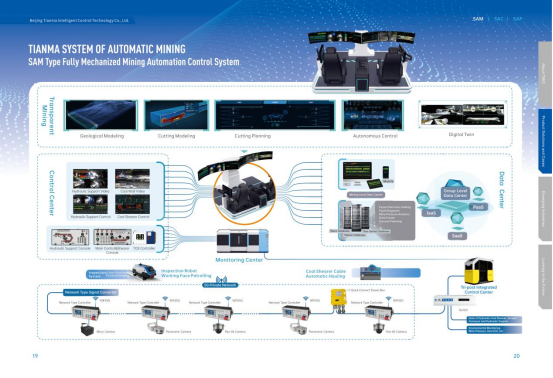
Comprehensive Mining Automation Control System
Beijing Tianma Intelligent Control Technology Co., Ltd.