en.Wedoany.com Reported - SK AX has launched a full-stack service for Manufacturing RX, officially entering the manufacturing AI market, with its core focus on building operational autonomous factories rather than merely providing robot hardware.
Competition in manufacturing artificial intelligence is shifting from data analysis to automation of actual factory operations. Facing challenges such as labor shortages, declining productivity, and a shrinking skilled workforce, the adoption of industrial robots is growing rapidly. However, in real-world production, variables such as interference between equipment, logistics bottlenecks, and conflicts in personnel movement often prevent expected efficiency gains from being realized. This is especially true in industries with complex processes or constantly changing environments, such as semiconductors and shipbuilding, where traditional rule-based automation has proven insufficient.
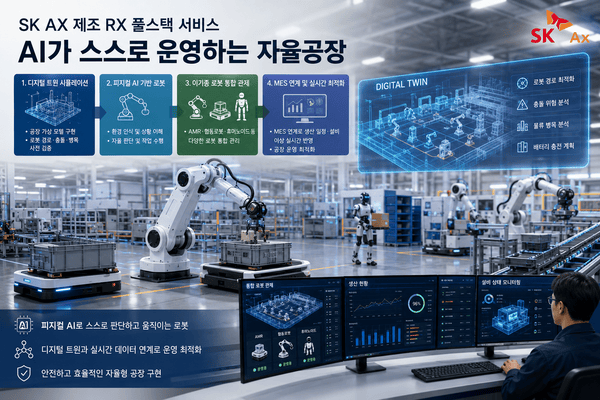
To address these challenges, SK AX has introduced the Manufacturing RX (Robot Transformation) full-stack service. This service first utilizes digital twin technology to fully replicate a real factory in a virtual space, including blueprints, equipment layouts, personnel movement paths, and material flows. This allows for the simulation of robot paths, collision risks, logistics bottlenecks, and battery charging schedules in advance. Subsequently, physical AI technology is applied in the actual factory. Unlike traditional industrial robots that operate based on preset rules, physical AI robots use cameras to recognize their environment, understand situations, and autonomously adjust their working methods to handle unexpected obstacles or environmental changes.
SK AX also provides a control and management function that integrates and manages equipment from different manufacturers, including autonomous mobile robots (AMRs), collaborative robots, and humanoid robots, in a unified manner. This is linked with the Manufacturing Execution System (MES) to ensure that changes in production plans or equipment anomalies are immediately reflected throughout the entire process. The service has completed verification of the digital twin and integrated robot management system at a semiconductor manufacturing site, and is expanding its application to the shipbuilding industry, with plans to promote it to more manufacturing sectors in the future.
In line with this trend, global companies such as Nvidia, Tesla, and Figure AI are also increasing their investments in physical AI and humanoid robots. Industry experts believe that physical AI, digital twins, and integrated robot operation platforms are becoming the next-generation core technologies for manufacturing sites, ushering in an era where AI directly acts in production, logistics, and construction sites.
Kim Gwang-su, head of SK AX's Manufacturing Service Division, stated that the robot transformation in manufacturing is no longer just about purchasing hardware; the connection of robots with the entire factory and stable operation are becoming core competitive advantages. The company plans to leverage its capabilities in digital twins, physical AI, and integrated management of heterogeneous robots to support customers in achieving autonomous factory transformation.