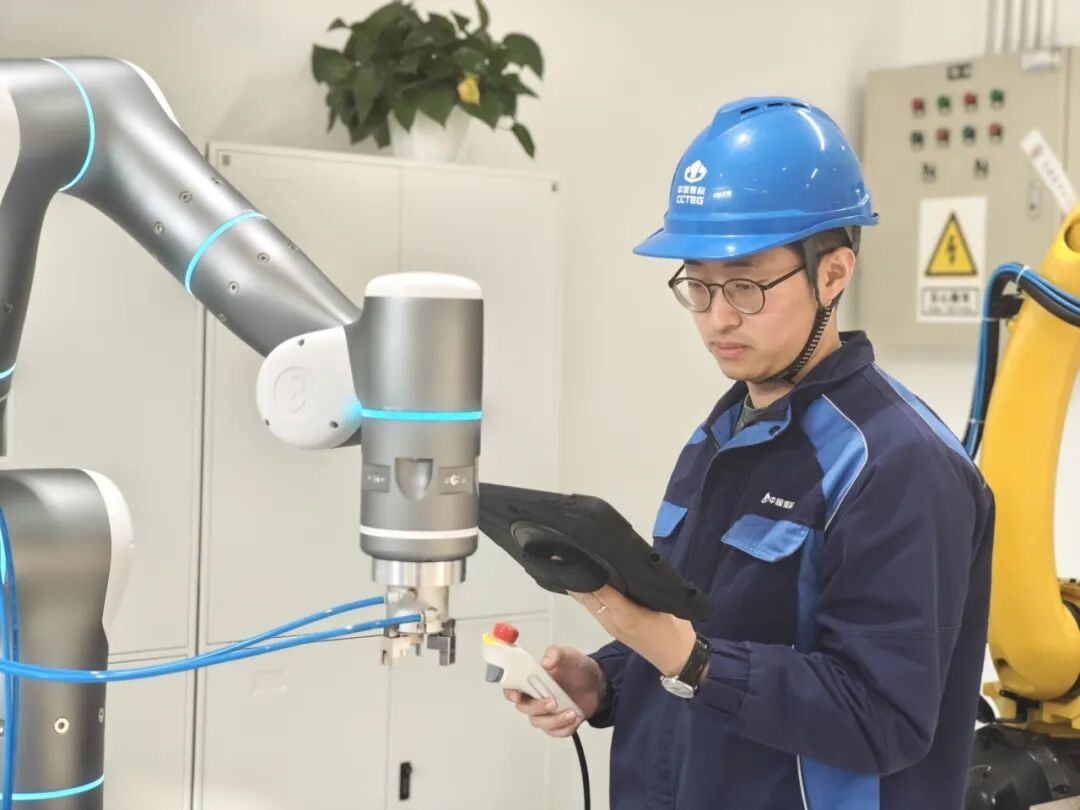
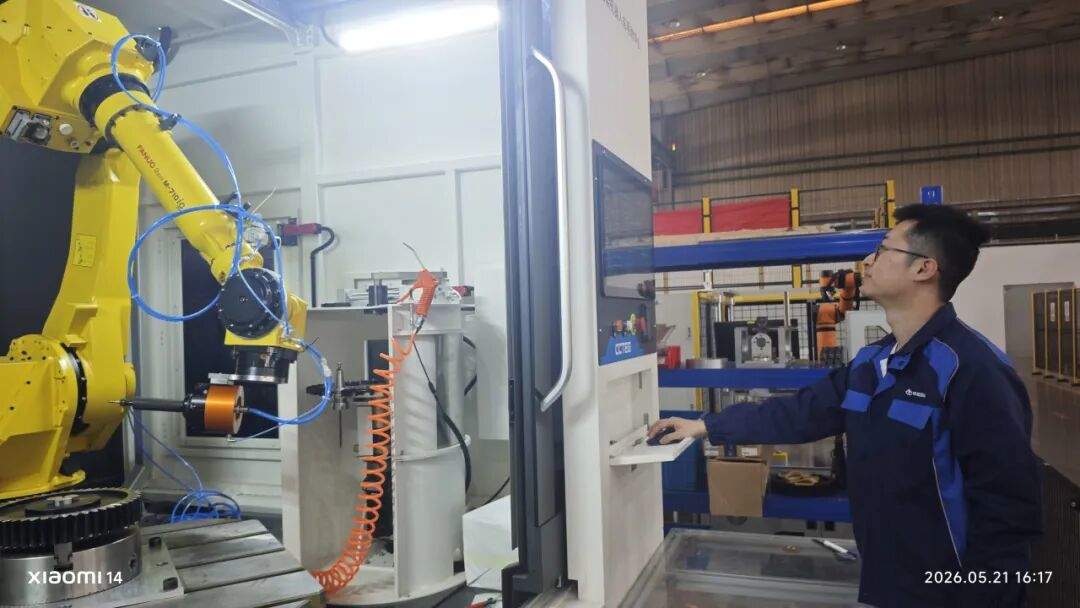
en.Wedoany.com Reported - A team led by Xue Tongjun, an engineer at China Coal Technology and Engineering Group's Tianma Intelligent Control, has successfully developed a robotic deburring device for complex spatial structures. At the customer site, force control was stabilized at ±1~3N, trajectory accuracy met requirements, and manual rework was completely eliminated. The project took 198 days.
Deburring of complex spatial structures such as deep cavities, intersecting holes, and irregular trajectories has long relied on experienced workers. Off-the-shelf robotic products commonly fail in these scenarios, creating a critical bottleneck in the high-end manufacturing automation chain. Tianma Intelligent Control had previously attempted to tackle this challenge without success, but the team believed they could not give up. It was against this backdrop that Xue Tongjun took on the task.
After the project launched, the team first conducted market research and found that almost all enterprises still relied on manual labor for deburring complex structures, with human workers serving as a patch for automation. The project was designated as a key annual R&D direction for the company, leaving the team with only a six-month window to deliver a prototype proving the technical route was feasible. The R&D effort faced a "three-no" dilemma: no reusable trajectory planning framework, force control model, or process database, and an incomplete team configuration. Xue Tongjun was forced to advance algorithm development, structural design, and process engineering in parallel on three fronts—discussing trajectory interpolation in the morning, reviewing structural modifications at noon, and conducting process experiments in the afternoon.
After the first prototype was built, Xue Tongjun led the team directly to the customer site for commissioning, which took place in winter when the workshop temperature was extremely low. Problems emerged frequently under real working conditions: significant drift in the force control model, amplified trajectory errors in deep cavities, fixture deviations disrupting planned trajectories, end-effector vibration far exceeding laboratory levels, and a much narrower process window than anticipated. The team stood on the steel structure platform for hours each day. On one occasion, they worked until nearly 2 a.m. to verify data for deep cavity trajectory debugging before correcting the posture conversion logic. Over three months of on-site commissioning, they overcame each difficulty one by one. Ultimately, the device stably completed the full set of deburring actions, maintaining force control at ±1~3N without the need for manual rework.
The success of this device frees workers from harsh, repetitive, and high-intensity labor, removes a key obstacle for "lights-out factories," solves the industry challenge of consistent machining for high-end components, and provides a process foundation for the reliability and competitiveness of China's high-end equipment. For this achievement, Xue Tongjun received the company's Outstanding R&D Award. The team plans to build a process knowledge base and introduce AI self-learning to create an "industrial brain" integrating perception, decision-making, and execution, modularizing core technologies for promotion to industries such as aerospace and automotive manufacturing.