Germany's TruQuaC Alliance Launches €3.06 Million Quantum Project
en.Wedoany.com Reported - The German government-backed TruQuaC (Trusted Quantum Control and Communication) research alliance has launched a €3.06 million (approximately $3.5 million) project aimed at designing secure control planes and gateway architectures for distributed quantum systems. The project is primarily funded by a €2.46 million (approximately $2.8 million) grant from the German Federal Ministry of Research, Technology and Space (BMFTR) under its "Quantum Communication Transmission and Network Integration" program, with a project duration of 36 months, running from June 2026 to May 2029. The project seeks to address a major structural bottleneck facing the quantum internet: how to securely orchestrate and integrate multiple isolated quantum prototype nodes into classical communication network architectures.
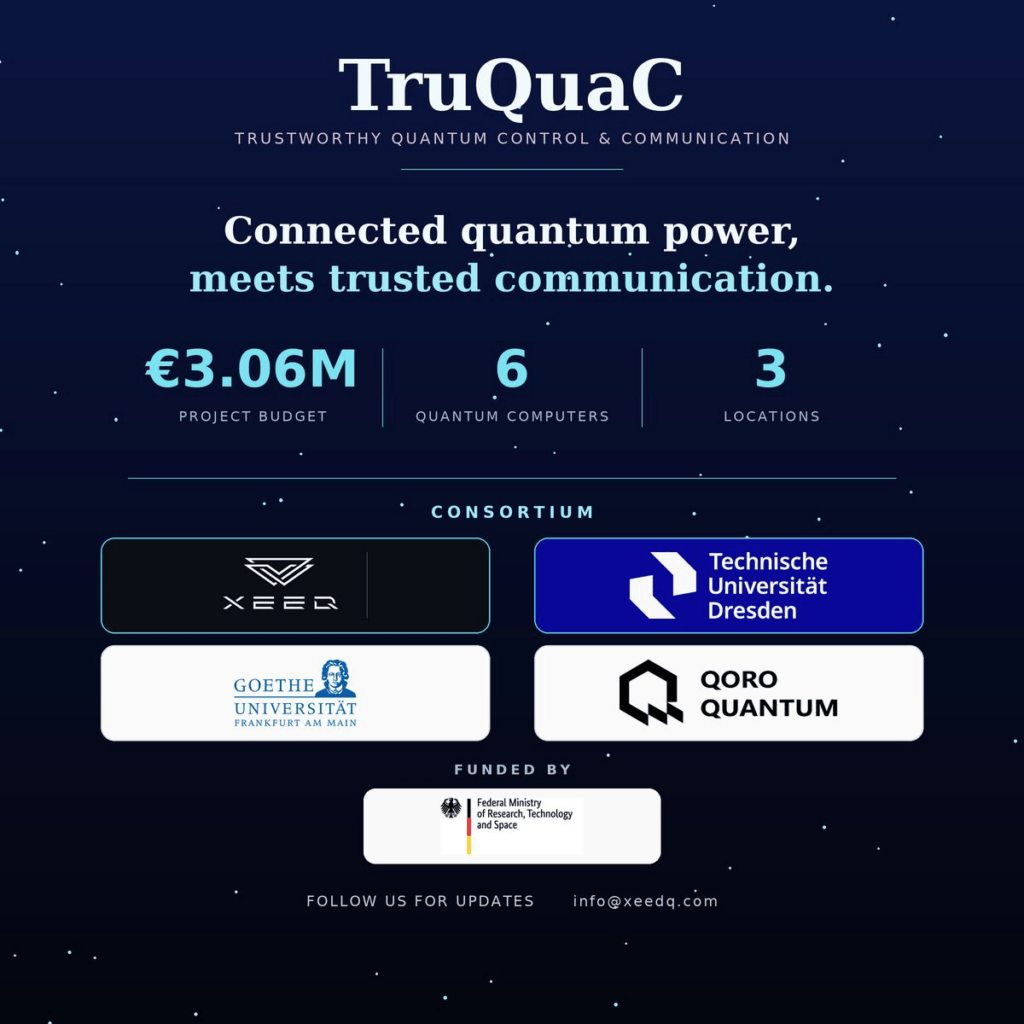
At the core of the engineering roadmap is the construction of a unified software infrastructure that abstracts network complexity by treating distributed hardware nodes as a single resilient system. To protect data in transit, TruQuaC will deploy secure local gateways capable of managing user authentication, monitoring dynamic node status, allocating computing workloads, and automatically rerouting traffic during local network outages. By establishing this software-defined infrastructure, the alliance aims to advance Germany's long-term technological sovereignty and strengthen the country's cryptographic defenses against quantum network threats.
The technical execution of the project is divided between commercial entities and academic partners. XeedQ GmbH serves as the overall project coordinator; this Leipzig-based hardware manufacturer provides its commercially proven diamond nitrogen-vacancy (NV) center quantum processors as physical hardware nodes. Qoro Quantum provides the end-to-end orchestration layer, led by co-founder and Chief Technology Officer Dr. Stephen DiAdamo, whose platform utilizes the Maestro simulation engine for node simulation, the Composer API for constraint-based task routing, and the company's open-source Python software development kit, Divi, for multi-node program execution. On the academic side, the Technical University of Dresden and Goethe University Frankfurt are responsible for fundamental scientific validation, protocol verification, and academic research compilation.
Related Products


20 Inch 1600*900 Full HD 60Hz TFT LED Monitor with VGA and DP Interfaces for Desktop Computers-Business Use
Guangzhou Zanying Optoelectronics Technology Co., Ltd.



G.652.D Wavelength-extended Non-dispersion Shifted Single-mode Optical Fiber
HONGAN GROUP CO., LTD.

MUX Series Communication Interface Device for Security and Stability Control System
Nanjing NR Electric Co., Ltd.

Comprehensive Mining Automation Control System
Beijing Tianma Intelligent Control Technology Co., Ltd.
Conveyor Belt Intelligent Monitoring System
LUO YANG WIRE ROPE INSPECTION TECHNOLOGY CO., LTD.