US WhiteFiber Builds 83km Cross-Data Center AI Supercluster Network
en.Wedoany.com Reported - US AI infrastructure service provider WhiteFiber, in collaboration with Israeli networking technology company DriveNets, has completed the deployment of a cross-data center GPU supercluster network. The project connects two data centers approximately 52 miles apart and their NVIDIA H200 GPU clusters into a single logical computing system via 83 kilometers of dark fiber. The measured network bandwidth reached 111.2 Tbps, with a guaranteed round-trip latency of 0.9 milliseconds. The two companies refer to this project as the first commercial deployment of a long-distance Scale-across AI network, with the relevant architecture transitioning from experimental validation to actual infrastructure operation.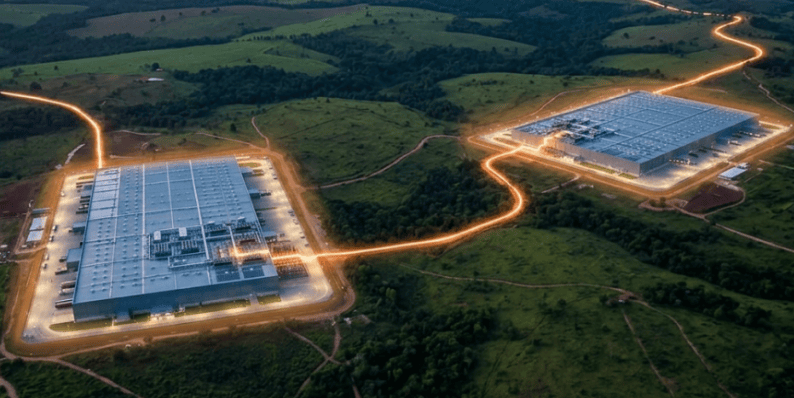
This construction is part of WhiteFiber's Project Redwood. The focus is not on adding a simple interconnection line between the two data centers, but on enabling GPU racks located in different sites to operate collaboratively as if they were deployed in the same facility. Traditional data center interconnection primarily handles data backup, business synchronization, and cross-regional access, with bandwidth typically lower than the internal network capacity of a single data center. AI training tasks, however, generate large-scale, synchronous burst data flows in a short period. If the cross-site link experiences congestion, jitter, or packet loss, GPUs at both ends may suffer reduced utilization while waiting for data. The dark fiber link used by WhiteFiber in this project has only activated a portion of the available spectrum, yet it has already achieved a transmission capacity of 111.2 Tbps. The next phase plans to conduct full-spectrum lighting tests.
The project utilizes DriveNets AI Fabric as the high-performance network foundation between the two data centers, with WEKA NeuralMesh providing cross-cluster data and memory infrastructure. On the network side, DriveNets 9300F, 5300R, and 5301R switching equipment are deployed. Using Fabric Scheduled Ethernet technology, it implements cell-based load balancing, end-to-end virtual output queue management, and deep buffering for cross-site AI traffic, allowing burst data to be scheduled before entering a congested state. During construction, the project team tested the performance of GPU racks within the same data center and across different data centers to verify whether remote nodes could maintain communication performance close to that of a single-site cluster.
This architecture primarily addresses the issues of insufficient power and space in a single data center. Large AI clusters are often constrained by power supply capacity, facility area, cooling infrastructure, and local grid access conditions. Even if an enterprise possesses more GPUs, it may not be able to install them all in the same campus. A cross-data center supercluster allows operators to deploy new computing equipment in remote facilities with more abundant power resources and then integrate them into the same computing domain via a high-speed network, thereby expanding the GPU cluster scale without waiting for a major power upgrade in the original data center.
From the perspective of information and communication infrastructure architecture, this project forms a continuous chain of "remote GPU clusters - data center switching network - long-distance dark fiber - unified data and memory platform." The network must not only provide high peak bandwidth but also control cross-site latency, traffic bursts, and the scope of fault impact. The storage and data platform must ensure that model data, training checkpoints, and intermediate results can be continuously accessed across different sites. Only with synchronized design of computing, networking, and storage can two physically isolated data centers appear as a unified AI computing system at the application layer.
WhiteFiber plans to increase Scale-across network ports in the third quarter of 2026, further boosting system bandwidth to 136 Tbps, and will announce commercial service arrangements, architecture configurations, and availability methods later this quarter. Beyond large model training and inference, both companies believe this technology can be applied to scenarios such as telecommunications networks, edge computing, and sovereign AI, particularly suitable for projects where computing resources must be distributed but business operations require unified scheduling. Key milestones to watch include full-spectrum link testing, the 136 Tbps expansion, integration of more GPU racks, and the stability of the cross-site supercluster under sustained high-load conditions.
Related Products



Industrial and Commercial Point-Type Gas Detector
Jinan Benan Technology Development Co., Ltd.

MUX Series Communication Interface Device for Security and Stability Control System
Nanjing NR Electric Co., Ltd.


Automatic Aiming Laser Remote Obstacle Removal Robot
Pinggao Group Weihai High-Voltage Apparatus Co., Ltd.