Senegal's Sonatel Deploys 16 OneWeb Satellite Antennas in Gandoul
en.Wedoany.com Reported - Senegalese telecom operator Sonatel has completed the expansion of the Gandoul satellite earth station, deploying the Eutelsat OneWeb satellite gateway network. The new facilities include 16 next-generation low Earth orbit (LEO) satellite communication antennas and a Tier III-compliant technical equipment room. The 16 antennas, distributed across an area of approximately 5 hectares, are responsible for connecting the OneWeb LEO satellite constellation with the terrestrial communication network, enabling data received by the satellites to enter Senegal's domestic backbone network, international transmission network, and internet system.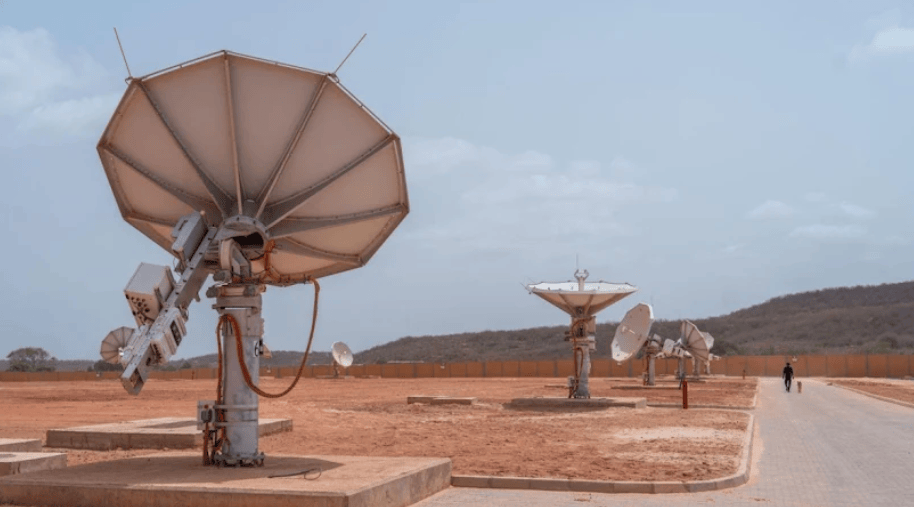
The focus of this construction is not simply to add a set of independently operating satellite receiving devices, but to establish a new satellite communication gateway in Gandoul. As LEO satellites pass over Senegal, the ground antennas continuously track and establish communication links. The data is then received, processed, and forwarded through the technical equipment room before being connected to Sonatel's fiber optic and international communication systems. The coordinated operation of multiple antennas maintains communication continuity during satellite movement and link switching, providing ground-based support for broadband internet and cross-regional data transmission.
The new gateway has been interconnected with Sonatel's submarine cables, domestic terrestrial networks, and international transmission networks, forming a hybrid communication infrastructure of "LEO satellite - ground gateway - fiber backbone - submarine cable." Compared to relying solely on a single route, this architecture adds a new transmission entry point for international communications. When some terrestrial lines or submarine cables experience failures, the satellite link can serve as a supplementary channel. For areas far from the fiber backbone where laying fixed lines is costly, operators can also use satellite backhaul to expand broadband coverage.
The Gandoul earth station is also equipped with secure power supply facilities, redundant operating systems, and high-speed fiber optic connections to enhance the gateway's continuous service capability. A Tier III technical equipment room implies that critical equipment and supporting systems require a certain level of redundancy and maintainability, allowing communication services to continue operating even when some facilities are under maintenance. Since the satellite gateway needs to handle multiple high-speed links over the long term, any interruption in power, cooling, or network connectivity could simultaneously affect multiple satellite beams and coverage areas. Therefore, power supply, environmental control, and terrestrial transmission systems must be built in sync with the antenna facilities.
Located in the Thiès region of Senegal, the Gandoul satellite earth station has been in operation since 1972 and is the country's long-standing international satellite communication facility. The site offers a relatively open seaward view, low levels of electromagnetic interference, and proximity to Dakar and Senegal's primary digital infrastructure, making it suitable for deploying large-scale ground antenna systems that require continuous satellite tracking. Sonatel had previously deployed other satellite communication facilities at this station. With the addition of the OneWeb gateway, Gandoul will now simultaneously handle more satellite communication tasks across different orbits and network systems.
Sonatel stated that the new facilities will be used to provide high-speed internet connectivity to Senegal, the West African sub-region, and other markets. The project can also support expanding broadband access in rural and underserved areas, helping enterprises, public institutions, and digital service platforms achieve more stable network connections. Eutelsat's Konnect Africa believes that the Gandoul gateway enhances the OneWeb global ground network, adding a key ground node in West Africa for connecting to the LEO satellite constellation.
This project also aligns with Senegal's "New Technology Policy 2034" plan, which aims to further expand internet coverage, strengthen digital sovereignty, and improve the digitalization of public services. Satellite communication cannot replace the nationwide fiber optic network and mobile base station construction, but it can cover areas where terrestrial networks are difficult to extend rapidly and provide a supplement to submarine cables and land lines. With the 16 antennas now operational, the next phase of construction will focus on satellite link commissioning, terrestrial network traffic access, broadband service activation, and long-term operational verification. The Gandoul earth station will also further undertake data exchange tasks between Senegal and the international satellite network.
Related Products


Automatic Aiming Laser Remote Obstacle Removal Robot
Pinggao Group Weihai High-Voltage Apparatus Co., Ltd.
Hot Selling 10 Inch Intel N5100 I5 I7 FHD 8 +128GB 16+256GB Win10 Pro Win11 Pro 4G 5G Rugged Tablet PC Pad with NFC Barcode
Highton Electronics Co., Ltd.
Mine Explosion-proof and Intrinsically Safe Industrial Ethernet Ring Network (10 Gigabit/Gigabit)
Chongqing Mas Sci&Tech Co., Ltd.

Flat Portable Satellite Terminal 0.35m Aperture Manual Portable Terminal
China Starwin Science & Technology Co., Ltd.