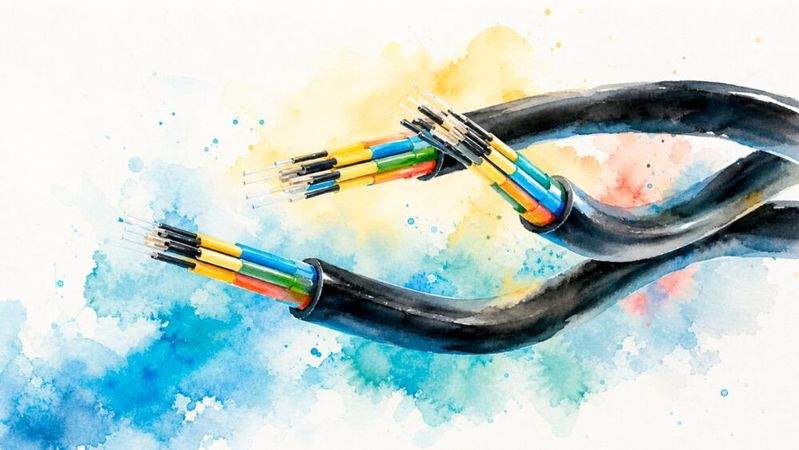
Nigeria Plans $2 Billion Investment to Deploy 120,000 km of Fiber Optic Cables
en.Wedoany.com Reported - The Federal Ministry of Communications, Innovation and Digital Economy of Nigeria is advancing the "BRIDGE Project," planning to invest approximately $2 billion to deploy nearly 120,000 kilometers of fiber optic cables nationwide. This initiative aims to expand broadband network coverage, improve internet access conditions across different regions, and bridge the gap between the scale of mobile subscribers and fixed communication infrastructure.
With over 220 million mobile subscribers, Nigeria is one of the largest mobile communication markets in Africa. However, more than half of its population still lacks stable internet access. A large number of users primarily rely on mobile networks for internet connectivity, while insufficient backbone transmission networks, metropolitan fiber optics, and access facilities in remote areas constrain base station expansion, broadband speed upgrades, and the extension of digital public services to more regions.
The BRIDGE Project positions fiber optic network deployment as the core of Nigeria's next phase of digital infrastructure development. According to the plan, the scale of newly added fiber optic lines nationwide will approach 120,000 kilometers, covering backbone networks, regional connection corridors, and key population and industrial areas. The project requires approximately $2 billion in funding, primarily raised through external sources.
To facilitate large-scale construction, the Nigerian government plans to establish a dedicated committee responsible for overseeing fiber optic route planning, fund utilization, and project implementation. This mechanism will coordinate government departments, telecommunications operators, infrastructure investors, and construction enterprises to reduce obstacles in approval processes, right-of-way acquisition, construction organization, and cross-regional coordination.
Once nearly 120,000 kilometers of fiber optic cables are deployed, they can further connect mobile communication base stations, data centers, government agencies, schools, enterprises, and community network nodes, providing a transmission foundation for mobile network expansion and fixed broadband construction. With enhanced fiber optic backhaul capabilities, operators can increase network capacity based on existing base station coverage, alleviate transmission pressure in high-traffic areas, and extend high-speed networks to regions previously lacking adequate connectivity.
The project also proposes developing local manufacturing capabilities for fiber optic cables and related components. As the scale of nationwide fiber optic deployment expands, demand for cables, connectors, conduits, splice closures, and supporting construction equipment will increase simultaneously. Nigeria aims to reduce reliance on imported products for infrastructure construction by introducing local manufacturing and supply systems, while ensuring a stable equipment source for subsequent network maintenance and expansion.
In addition to new line construction, the large-scale fiber optic network will subsequently involve conduit laying, line splicing, node equipment room construction, equipment installation, network testing, and operation and maintenance. Upon project completion, Nigeria's digital communication infrastructure will gradually shift from being primarily mobile-access-based to a structure where mobile networks and the national fiber optic transmission network develop synergistically, providing underlying network support for cloud computing, artificial intelligence applications, and digital public services.
Related Products



Automatic Aiming Laser Remote Obstacle Removal Robot
Pinggao Group Weihai High-Voltage Apparatus Co., Ltd.

Mine Explosion-proof and Intrinsically Safe Industrial Ethernet Ring Network (10 Gigabit/Gigabit)
Chongqing Mas Sci&Tech Co., Ltd.

MUX Series Communication Interface Device for Security and Stability Control System
Nanjing NR Electric Co., Ltd.

G.652.D Wavelength-extended Non-dispersion Shifted Single-mode Optical Fiber
HONGAN GROUP CO., LTD.