en.Wedoany.com Reported - After nine years, China's supercomputers have returned to the top of the global rankings. At the International Supercomputing Conference, the National Supercomputing Center in Shenzhen unveiled the new-generation "Lingsheng" supercomputing system, which achieved a sustained performance of 2.19 EFLOPS (exaflops, or 10^18 floating-point operations per second), making it the world's first supercomputing system with sustained performance exceeding 2 EFLOPS. This marks the first time China has ranked first since the "Sunway TaihuLight" in 2017.
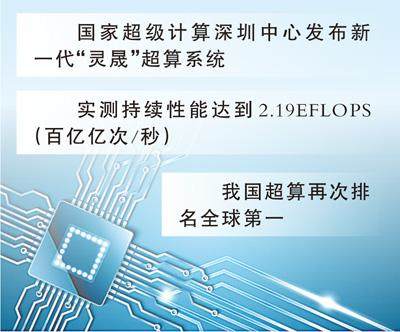
The computing power of 2.19 EFLOPS means that the "Lingsheng" can complete in one second the equivalent of calculations that would take 7 billion people nearly 10 years of continuous work. As a key piece of equipment for measuring a country's scientific research capabilities and high-end manufacturing strength, this return to the top not only represents an improvement in computing speed but also highlights progress in achieving core technology self-sufficiency. The core components of this supercomputing system have achieved full-stack domestic production, marking a shift in China's supercomputing industry from technology introduction to independent research and development and iterative innovation.
This achievement is rooted in a gradually improving modern industrial system and innovation ecosystem. Over the years, supercomputing technology research and development have advanced in tandem with application scenarios, building a complete industrial chain covering key hardware, basic software, scenario applications, and talent cultivation. In the field of scientific research, supercomputing is expected to provide crucial computing support for basic research; in emerging industries such as new materials, biomedicine, and aerospace, it can effectively shorten research and development cycles and reduce costs; in areas related to people's livelihoods, such as weather forecasting and disaster early warning, it can enhance the precision of social governance.
The "Lingsheng" reaching the top is both a milestone achievement and a new starting point. With the development of the digital economy, the demand for high-end computing power continues to rise. In the future, the supercomputing industry needs to persistently delve into core technology iteration, broaden diverse application scenarios, and improve the entire industrial chain ecosystem. Currently, we should seize the historical opportunity of the technological revolution and industrial transformation, enhance the overall effectiveness of the national innovation system, and drive high-quality development through technological innovation.