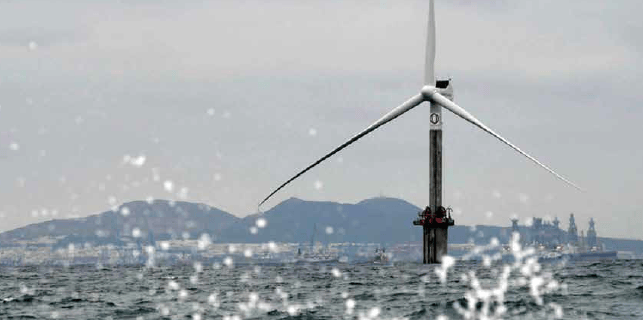
en.Wedoany.com Reported - On July 13, 2026, the European Commission approved a French offshore wind support plan to build and operate 11 offshore wind farms in the North Sea, the Atlantic Ocean, and the Mediterranean Sea, with a total installed capacity of 11.1 GW and an annual power generation of approximately 47.8 TWh, equivalent to 10.6% of France's annual electricity consumption.
The French government will allocate aid funds through a competitive, transparent, and non-discriminatory bidding process. The support mechanism adopts a two-way contract for difference model, which has become a common tool in Europe to facilitate the financing of large-scale renewable energy projects. Under this mechanism, the reference price is the bid price of each winning bidder at auction; when the market electricity price falls below this price, the producer receives compensation for the difference; when the market price exceeds the reference price, the developer must return the excess to the French government, thereby limiting public fiscal costs and reducing project revenue volatility. The design also includes a safeguard to prevent compensation when electricity prices are negative—a situation that is becoming increasingly common in markets with high renewable energy penetration.
European Commission Executive Vice President for the Clean, Fair, and Competitive Transition, Teresa Ribera, stated that the approval enables France to advance its decarbonization strategy. She believes that this decision clears the way for France's offshore wind support plan, moving the country toward a fully decarbonized energy system, and that the Commission will continue to support member states in achieving their shared climate goals.
Upon analysis, Brussels concluded that the French mechanism complies with the CISAF. CISAF stands for the Clean Industrial Agreement State Aid Temporary Framework, approved on June 25, 2025, to support the objectives of the Clean Industrial Agreement. The Commission considers the plan necessary, proportionate, and appropriate to accelerate the transition to a net-zero emissions economy, while also promoting strategic activities crucial to European industrial competitiveness. This decision also aligns with the provisions of the Treaty on the Functioning of the European Union that allow specific public aid to foster the development of economic sectors.
The CISAF aid framework is one of the main tools of the Clean Industrial Agreement, with measures including: supporting the deployment of renewable energy and energy storage; providing temporary aid to reduce electricity costs for energy-intensive industries; incentives for decarbonizing industrial processes through electrification or renewable hydrogen; promoting European-made clean technologies (such as batteries, wind turbines, solar panels, or electrolyzers); and mechanisms to reduce private investment risks in energy infrastructure and the circular economy.