Starbucks Invests $400 Million in Self-Developed AI, Replacing Microsoft and IBM Systems
en.Wedoany.com Reported - Starbucks spends approximately $400 million annually on software (equivalent to about 22 billion Brazilian reais at current exchange rates). The coffee chain is developing its own AI-assisted alternatives to replace Microsoft's inventory monitoring system and IBM's platform for maintenance management. If testing goes smoothly, some of the new AI tools could be deployed by the end of next year.
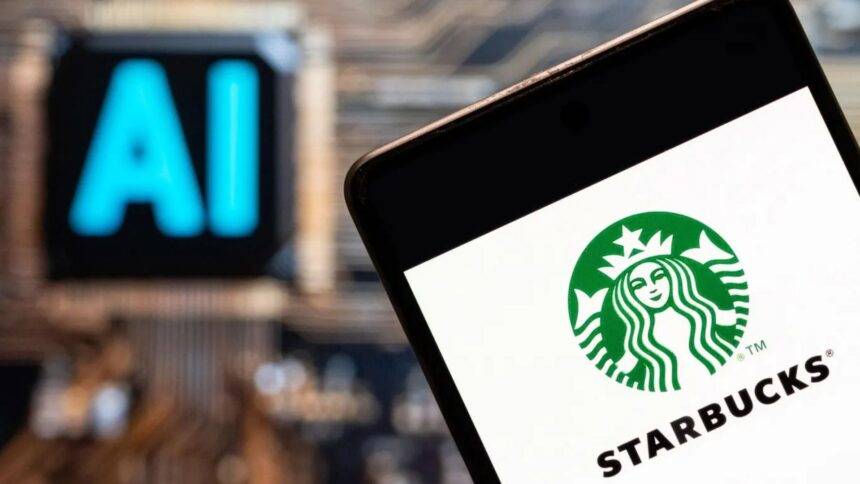
Following the news, IBM shares fell about 3% in pre-market trading, ServiceNow dropped 3.5%, and Salesforce declined 4%. These companies did not lose any contracts that morning, but the market believes they have lost part of the narrative that has supported enterprise software company valuations over the past two decades. Microsoft's stock barely moved, as it provides both the inventory management application Starbucks is replacing and the Azure cloud and AI infrastructure Starbucks needs to build its new solutions. The Green Dot Assist tool used by Starbucks baristas already runs on Azure OpenAI.
IBM, ServiceNow, and Salesforce operate at the application layer, and Starbucks has demonstrated that a coffee company can rebuild this layer internally. The market sold off exposed positions, with single-application vendors facing the greatest risk. Notably, ServiceNow and Salesforce were not even directly named.
For years, companies relied on vendors because developing software from scratch was both slow and expensive, and replacing systems running thousands of stores carried high risks. As a result, companies purchased platforms that might meet 70% of their actual needs, then hired consulting firms to adapt the remaining 30%. AI-assisted development has changed this equation. Anand Varadarajan, Starbucks' Chief Technology Officer, said the company is reviewing all contracts and services as part of CEO Brian Niccol's $2 billion cost-cutting plan.
The logic is simple: if engineers already need to heavily customize vendor products to make them truly useful, and AI allows them to develop custom tools in less time, why continue paying licensing fees? This trend is seen as a reassessment of the "build versus buy" proposition within Fortune 500 companies' technology budgets.
Mati Greenspan, founder and CEO of Quantum Economics, stated that companies are realizing AI is not just a feature but is becoming the main nervous system of their operations. He noted that this move represents a strategic shift, with companies demanding greater control and customization over their AI, bringing key technologies in-house to ensure unique competitive advantages. Notably, this assessment was generated by Korra AI, Quantum Economics' AI-based financial assistant.
Starbucks has not completely abandoned Microsoft and IBM; it still uses third-party software, including Microsoft's cloud and AI infrastructure. Earlier this year, the company discontinued an AI-based inventory counting system after it began producing inaccurate counts, forcing stores to revert to manual counting. This failure makes the current initiative more credible: Starbucks learned from this experience about so-called "AI hollowing"—layering AI over a flawed process does not fix the process but only amplifies the problems.
The new strategy prioritizes workflows: first fix how inventory and maintenance actually operate, then develop systems around the repaired processes, and finally leverage AI to accelerate development. Box CEO Aaron Levie summarized on LinkedIn that the best use cases for AI are often those that fundamentally change how work is done, rather than simply replacing existing processes and executing them more efficiently.
Vendors are expected to respond in areas that are hardest to replicate, including integration depth, governance, security, and accumulated industry knowledge. More companies may follow Starbucks' lead, developing internal solutions for their most expensive and least popular systems. A new service economy will also emerge around this shift, requiring professionals to map processes, integrate data, and design systems. Judgment, context, and change management remain capabilities that programming assistants cannot provide.
When AI agents connect to integrated systems with sufficient historical and personal data, they will no longer wait for instructions but will automatically complete repetitive tasks and predict needs. The core of this trend lies in controlling the data these agents use. Starbucks' experience shows that AI enables companies to regain direct control over their operations, but only if they are willing to first complete the work of restructuring processes. The lesson from Seattle is not that AI makes writing software cheap, but that AI allows companies to regain direct control over their operations after they are willing to do the less glamorous work of process restructuring.
Related Products



Hot Selling 10 Inch Intel N5100 I5 I7 FHD 8 +128GB 16+256GB Win10 Pro Win11 Pro 4G 5G Rugged Tablet PC Pad with NFC Barcode
Highton Electronics Co., Ltd.

MUX Series Communication Interface Device for Security and Stability Control System
Nanjing NR Electric Co., Ltd.
One-Stop Steward Service for the Entire Logistics System Integration Chain
Zhongding Intelligent (Wuxi) Technology Co., Ltd.

Industrial and Commercial Point-Type Gas Detector
Jinan Benan Technology Development Co., Ltd.