Concrete main structure of Nanjing North Station in Jiangsu, China, topped out
en.Wedoany.com Reported - On July 20, at the construction site of the elevated level of the under-construction Nanjing North Station, the concrete main structure of the station building was successfully topped out with the pouring of the final batch of concrete. The project has transitioned from civil structure construction to the assembly of roof steel structures, secondary structure construction, and decoration and finishing phases.
Located north of Laoshan Scenic Area in the Jiangbei New Area of Nanjing, the Nanjing North Station covers a total floor area of approximately 692,100 square meters. Adopting a three-dimensional layout with four floors above ground and two below, it is the only comprehensive hub passenger station in Nanjing integrating high-speed railways, intercity railways, and conventional railways.
As one of the second batch of national demonstration projects for green and low-carbon advanced technologies, the project's construction management unit, the Nanjing Railway Hub Engineering Construction Headquarters, has organized construction units including China Railway Construction Group, China Railway Construction Engineering Group, and China Railway Beijing Engineering Bureau to innovate construction techniques and continuously promote intelligent and green construction. To date, 16 out of 50 green and low-carbon technologies have been implemented, cumulatively reducing carbon emissions by 5,207 tons.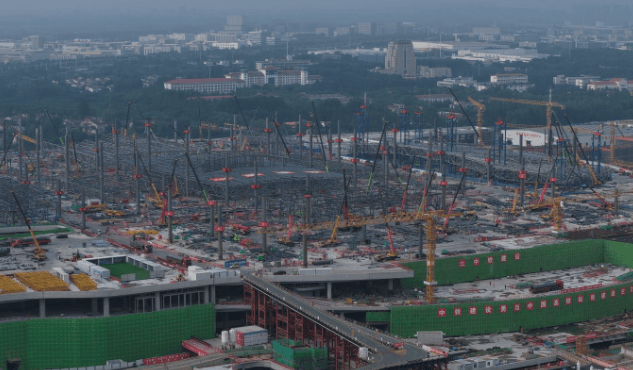
During the underground construction phase, environmentally friendly techniques such as prefabricated slope protection and fluidized solidified soil were adopted. The prefabricated slope protection, featuring reinforced surface layers, composite polymer layers, waterproof layers, and micro-particle protective layers, replaces traditional shotcrete processes, effectively reducing dust pollution and carbon emissions. Excavated soil from foundation pits, mixed with a solidifying agent, is used for laying temporary site roads, achieving resource utilization of excavated soil, saving 30% of earthwork transportation costs, and reducing carbon emissions by 170 tons for this single measure.
To address challenges in deep foundation pit support, China Railway Construction Group innovatively adopted prefabricated composite steel support technology. By applying prestress through online hydraulic jacks, a stable support system is formed, achieving 100% recycling of steel and avoiding carbon emissions and construction waste from concrete support pouring and demolition. Compared to traditional concrete supports, this technology uses modular design, with all connection nodes completed using high-strength bolts, eliminating the need for on-site welding, and reducing carbon emissions by 160 tons for this single measure.
Additionally, the deep foundation pit area is equipped with a "BeiDou+5G" automated monitoring system, with five monitoring points providing 24-hour real-time monitoring of displacement, settlement, and stress data with millimeter-level accuracy. Data is uploaded in real-time via the 5G network, and abnormal information is immediately pushed to management personnel, contributing to zero safety accidents throughout the 310-day deep foundation pit construction process.
To address the challenge of cracking in large-volume concrete for large railway hub station buildings, China Railway Construction Group systematically established a temperature control system covering the entire "material-construction-curing" process. On the material side, by incorporating temperature rise inhibitors, the cement hydration heat release curve is effectively flattened, significantly reducing the internal temperature peak and narrowing the internal-external temperature difference, thereby mitigating the risk of cracking caused by temperature stress at the source.
During construction, the team deployed an intelligent temperature sensing network for 24-hour real-time collection of concrete core and surface temperature data, supplemented by a circulating cooling water system to dynamically regulate the internal-external temperature difference, ensuring temperature control indicators remain within acceptable limits. After concrete pouring, a standardized curing process using full coverage with geotextile fabric and zoned sprinkling is adopted to maintain continuous surface moisture, effectively enhancing the compactness and durability of the concrete structure.
"This temperature control system, integrating 'material temperature suppression, intelligent monitoring, and long-term curing,' forms a closed-loop management from source prevention, process regulation to post-curing maintenance. It successfully overcomes the difficulties of concrete temperature control in key areas such as thick pile caps and track bearing layers, demonstrating the supporting role of advanced techniques in ensuring high-quality projects," said Wang Xiaodong, Chief Engineer of the China Railway Construction Group Nanjing North Station Project.
Once completed and operational, the Nanjing North Station will become a key hub station on the Shanghai-Chongqing-Yichang Yangtze River High-Speed Railway, further improving the layout of the Nanjing railway hub. It holds significant importance for building a "rail-based Yangtze River Delta," supporting the high-quality development of the Yangtze River Economic Belt, enhancing the radiation capacity of Nanjing as a central city in its metropolitan area, and supporting the construction of the national-level Jiangbei New Area.

![IVECO Cash-in-Transit [DMT5048XYCL3-AM] - Chongqing Dima Industry Co., Ltd](https://img.wedoany.com/2026/0911/20260911030157582.png)