en.Wedoany.com Reported - SwitcH2 is advancing offshore renewable ammonia production based on Floating Production Storage and Offloading (FPSO) units, with two projects off the coast of northern Portugal and Namibia entering the Front-End Engineering Design (FEED) stage. The projects were presented by Project Vice President George Dodoros, Offshore Design Engineer Gillis de Wit, and Process Design Engineer Nadja Berger, alongside AEA Technical Manager Kevin Rouwenhorst.
The current ammonia industry is dominated by onshore production, but the offshore route offers unique advantages in resource access and project construction. Global high-quality wind resources are predominantly located offshore, and as distance from shore increases, transmission costs rise sharply, making it more economical to use electricity directly near the turbines. Ship-based production avoids onshore land and labor constraints, leverages decades of experience from the oil and gas industry, and eliminates the need for separate large-scale storage tanks, docks, and pipelines. Additionally, connecting FPSOs to grid congestion nodes helps absorb surplus renewable energy previously constrained by transmission bottlenecks. These advantages were highlighted in a 2022 AEA webinar, where Imodco's dockless solution enables 24/7 offshore ammonia transfer, H2Carrier's P2X floating vessel can sail and moor to access remote wind energy, and CyaNH3's floating production storage and offloading unit utilizes associated gas from offshore LNG production.
The FPSO developed by SwitcH2 measures 268 meters in length, 57 meters in width, with a draft of 15 meters, equipped with 300 megawatts of electrolyzer capacity and an ammonia storage capacity of 47,000 tons distributed across six tanks. The company's founders, Saskia Kunst and Bob Rietveld, are both seasoned offshore industry professionals, with shareholders including BW Offshore, JORD, and Dutch Oceans Capital. FPSOs have been used in the oil and gas industry since the 1970s.
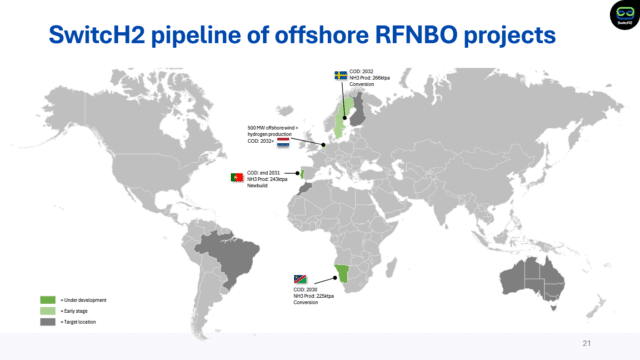
The Atlantico project, located off the coast of Viana do Castelo in northern Portugal, has received pre-permitting and National Interest Project (PIN) status. The Namibia project combines high solar and wind capacity factors with battery storage to achieve nearly 80% capacity factor, targeting an annual production of approximately 225,000 tons of ammonia, in collaboration with Hyphen.
In the FPSO layout, ammonia storage is located in the hull, with topside modules integrating seawater treatment and purification, glycol cooling circuits, electrical equipment rooms, water electrolysis modules, cryogenic air separation units, ammonia synthesis modules, flare and vent systems, and cargo offloading systems. The stern features accommodation for 120 people and a helideck.
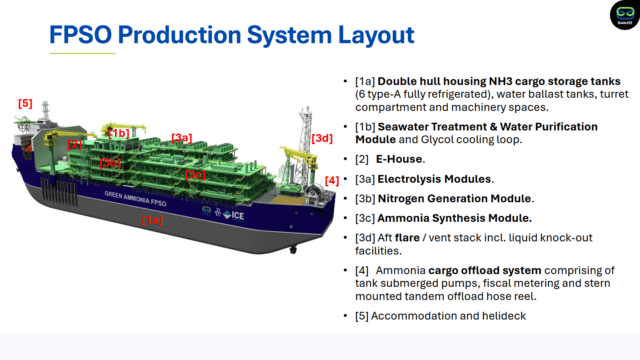
In terms of partners, thyssenkrupp Uhde is responsible for the renewable ammonia synthesis loop, ABB provides electrical and control equipment, Linde supplies the cryogenic air separation unit for nitrogen, and Veolia handles seawater desalination. The water electrolysis technology favors PEM electrolysis.
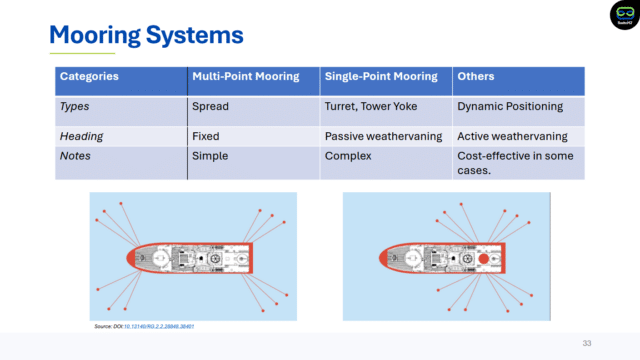
Offshore operations require equipment to withstand the marine environment and vessel motion, necessitating anti-corrosion coatings and optimized safety layouts. The FPSO can be positioned using multi-point or single-point mooring, with the latter allowing the vessel to exhibit a passive weathervaning effect to minimize environmental loads.