China's Wanhua Chemical Obtains New TDI Production Patent, Enabling Flexible Regulation of Isomer Ratios to Address High-End Grade Technology Gaps
en.Wedoany.com Reported - July 25, 2026 - According to information from the China National Intellectual Property Administration, Wanhua Chemical Group Co., Ltd. has recently been granted a new invention patent titled "Toluene Diisocyanate Production System and Toluene Diisocyanate Production Method," with authorization announcement number CN121338372B, authorized on July 24, 2026, and filed on October 20, 2025.
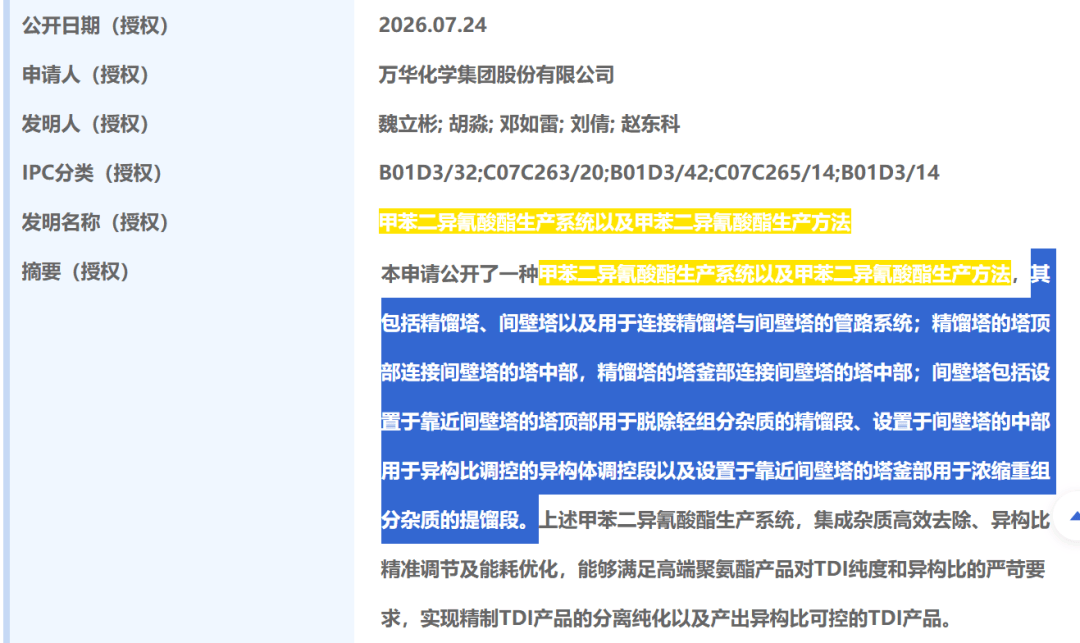
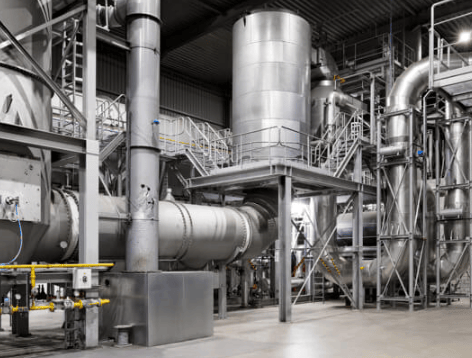
The patent abstract indicates that this application discloses a toluene diisocyanate production system and method, comprising a distillation column, a dividing wall column, and a pipeline system connecting the distillation column and the dividing wall column; the top of the distillation column is connected to the middle of the dividing wall column, and the bottom of the distillation column is connected to the middle of the dividing wall column; the dividing wall column includes a rectification section near its top for removing light component impurities, an isomer regulation section in its middle for adjusting the isomer ratio, and a stripping section near its bottom for concentrating heavy component impurities.
The aforementioned toluene diisocyanate production system integrates efficient impurity removal, precise isomer ratio adjustment, and energy consumption optimization, meeting the stringent requirements of high-end polyurethane products for TDI purity and isomer ratio, enabling the separation and purification of refined TDI products and the production of TDI products with controllable isomer ratios.
It is understood that TDI includes two isomers, 2,4-TDI and 2,6-TDI, and the ratio determines the performance of downstream polyurethane, with precise blending suitable for producing materials such as flexible foams and elastomers.
Covestro relies on gas-phase phosgenation for energy savings and lower investment in the front-end reaction, using multi-column series distillation, with the dividing wall column only for simple impurity removal and unable to adjust isomers; BASF uses multi-column stepwise distillation, with the isomer ratio fixed by the reaction stage and unadjustable during the refining stage. Both can only mass-produce TDI with fixed ratios. Various downstream products require differentiated isomer ratios, and overseas companies can only adjust reaction conditions to change grades, making customized small-batch orders costly.
Wanhua's patent relies on the regulation section of the dividing wall column, eliminating the need to modify the front-end reaction, allowing isomer ratio adjustment through distillation alone. This enables mass production of standard grades as well as customization of special ratios, addressing the domestic TDI industry's technological gap in distillation for high-end differentiated grade production.
In the first half of the year, China's TDI export volume was approximately 152 times its import volume
China has become the core global TDI supply region, with aging overseas plants and frequent maintenance leading to weaker supply stability. Most new capacity is located in China: in the second half of 2025, Fujian Wanhua's Phase II 360,000 tons/year TDI plant was commissioned; in January 2026, Shanghai Covestro's 370,000 tons technical renovation project was commissioned.
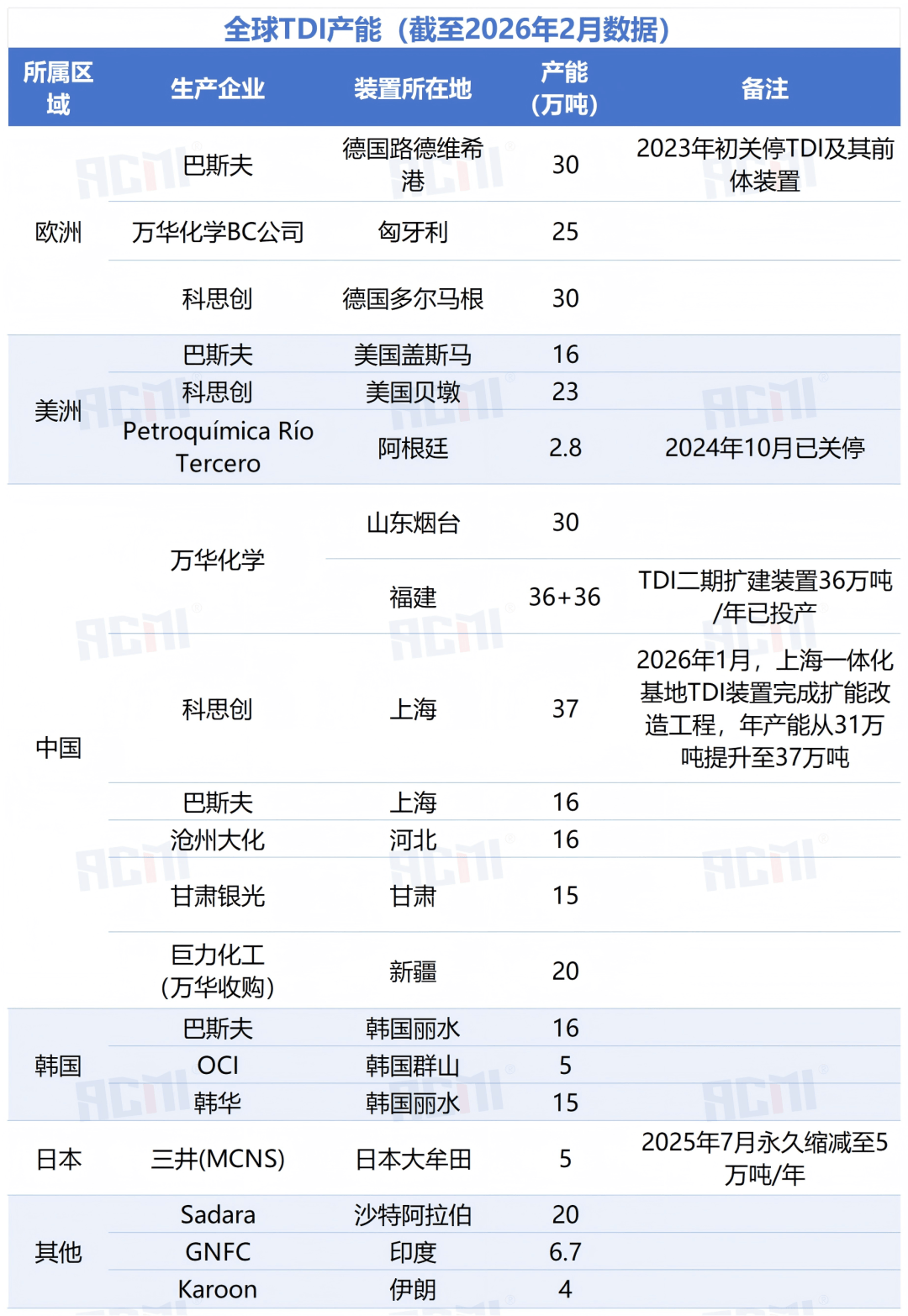
According to statistics, as of February 2026, China's domestic TDI capacity had reached 2.06 million tons, accounting for over 60% of global total capacity.
With the expansion of supply, China's TDI self-sufficiency rate has significantly increased. While supply has risen substantially, prices have also experienced notable fluctuations, with the maximum price difference between highs and lows reaching 6,500 yuan/ton in the first half of 2026.
On the demand side, growth has been primarily driven by a surge in exports, with domestic demand only achieving slight year-on-year growth. In the first half of 2026, China's TDI exports maintained rapid growth, with cumulative exports reaching approximately 332,100 tons, a year-on-year increase of 24.2%. In June, China's TDI export volume was about 56,600 tons, up 22.5% month-on-month and 17.7% year-on-year. The largest export destination that month was Brazil, with exports of about 7,111 tons, followed by Belgium, India, Vietnam, and Turkey.
In the first half of 2026, cumulative imports were approximately 2,180 tons, a year-on-year increase of 144.9%. In June, China's TDI imports were about 310 tons, up 588.9% month-on-month and 113.8% year-on-year, with the main increases coming from Japan, Saudi Arabia, and Germany. Japan was the largest overseas import source that month, reaching 150 tons.
Overall, China's TDI trade remains dominated by exports, with a relatively small import scale; the export volume is approximately 152 times the import volume. The reasons for the significant export growth are: first, the tense international geopolitical situation has placed dual pressure on energy costs and logistics in overseas regions, allowing China's TDI to benefit from export substitution advantages due to its stable supply capability and cost advantages; second, the Indian government reduced import tariffs on certain chemicals (including TDI and polyether polyols) to zero from April 2 to June 30, driving a rapid influx of goods into India, Vietnam, and the Middle East.
In terms of plant dynamics, the TDI industry has entered a "rotating maintenance" mode. Wanhua Chemical's BorsodChem plant in Hungary, with a 250,000 tons/year TDI unit, has been shut down for planned maintenance since July 17, expected to last approximately 35 days. Wanhua Xinjiang Juli's 200,000-ton plant is under maintenance shutdown, and one of Wanhua Fujian's 360,000-ton plants is also shut down. Meanwhile, Gansu Yinguang's 150,000 tons/year plant is scheduled for maintenance shutdown in early August. Overall, no new capacity is expected to be released in the TDI industry in the second half of the year, with rotating plant maintenance becoming the norm, and the supply side's support for prices is expected to persist.
Related Products

PVC Impact-Modified Chlorinated Polyethylene
Gansu Jinchuan Hengxin Polymer Technology Co., Ltd.
Nitrogen Export, Nitrogen Manufacturer, High-purity Nitrogen Supplier
Foshan Yuexin Industrial Gas Co., Ltd.

Industrial and Commercial Point-Type Gas Detector
Jinan Benan Technology Development Co., Ltd.
Steel Plates for Chemical Pressure Equipment
Gansu JISCO Group Hongxing Iron and Steel Co., Ltd.

Bidirectional Metal Hard Sealed Seawater Butterfly Valve
Henan Quanshun Flow Control Science & Technology Co., Ltd.