Single Weight Exceeds 320 Tons! Splay Saddles for Shizi Yang Bridge Main Span Successfully Hoisted
en.Wedoany.com Reported - According to Guangdong Transportation Group, the world's largest splay saddles—those of the Shizi Yang Bridge—have been successfully hoisted, marking the completion of all main cable saddle and splay saddle hoisting operations for the bridge, and paving the way for the subsequent installation of the cable system.
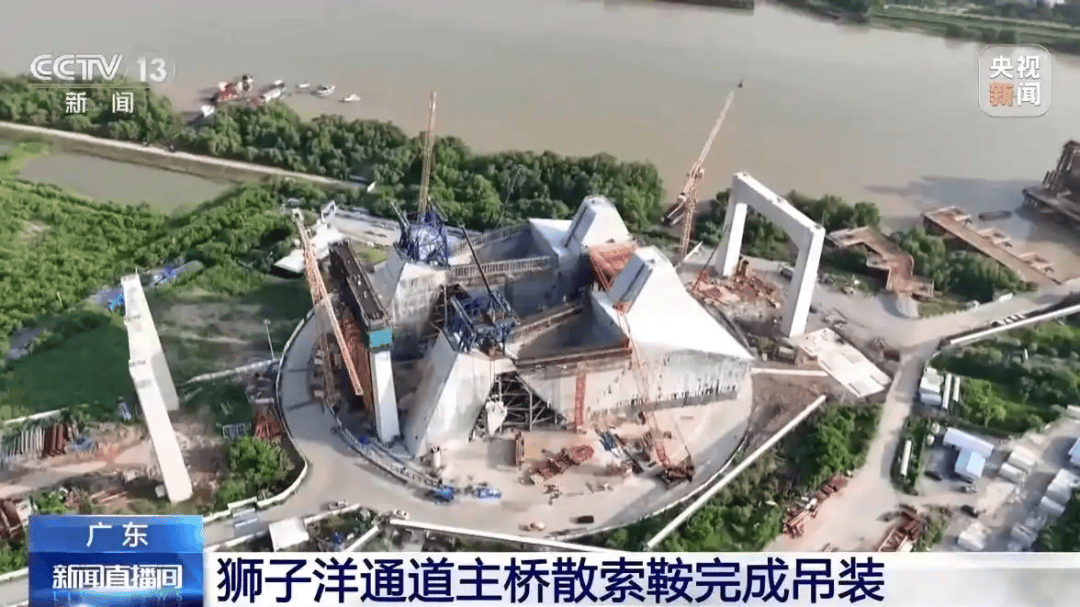
The Shizi Yang Passage is the first double-deck composite passage at the Pearl River Estuary, stretching approximately 35 kilometers and connecting Nansha District of Guangzhou with Shatian and Humen Town of Dongguan. Among its components, the main bridge, the Shizi Yang Bridge, is the world's first double-deck suspension bridge with a main span exceeding 2,000 meters, setting five world records in terms of "number of lanes, main tower height, main span length, main cable diameter, and anchorage foundation."
The deck load of a suspension bridge is primarily borne jointly by the main towers, main cables, and anchorages on both banks. The two main cables of the Shizi Yang Bridge have a total length exceeding 3,800 meters, spanning the river surface, symmetrically erected atop the two main towers, with their ends extending to connect the anchorages on the east and west banks.
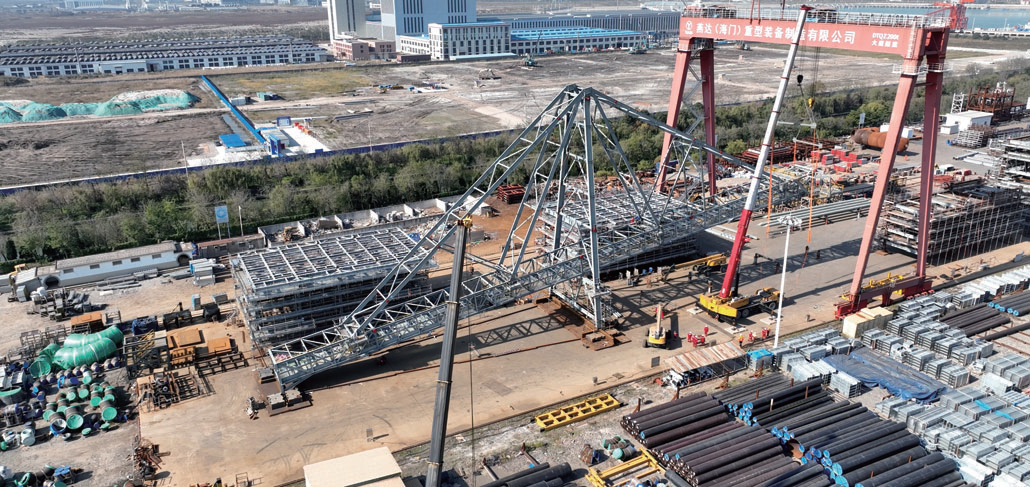
The Shizi Yang Bridge features a total of four splay saddles, each composed of a saddle head, saddle body, and base block, with approximate dimensions of 9.2 meters in height and 7.2 meters in width, and a single weight exceeding 320 tons, making them the world's largest splay saddles. They were manufactured by Tianyuan Heavy Industry, with installation carried out by CCCC Second Harbor Engineering and Poly Changda.
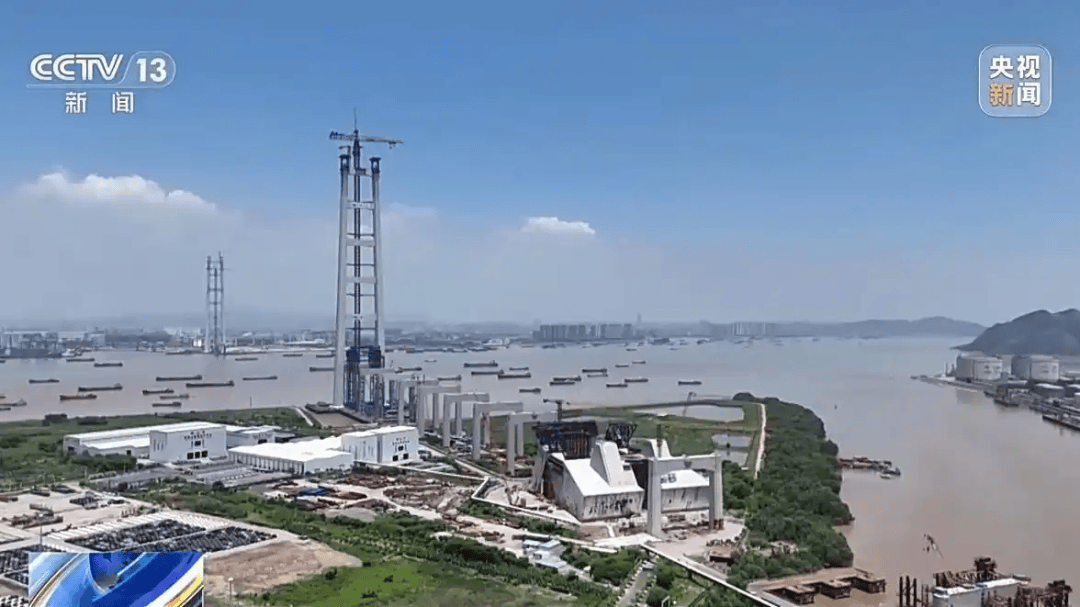
The splay saddles of the Shizi Yang Bridge must withstand a main cable pressure of nearly 40,000 tons. To this end, the project has pioneered a high-precision three-dimensional curved positioning cable groove on a global scale, akin to customizing "dedicated tracks" for the main cable strands. This positioning groove is fabricated in 21 layers, and the main cable strands will later be installed one by one into the preset grooves. Guo Fengchao, Deputy Director of the General Engineering Office of the Shizi Yang Passage Project, explained that this innovative approach adjusts the bending alignment of the strands, disperses the radial forces caused by the main cable's redirection, and significantly improves the structural stress conditions.
The project extensively employs three-dimensional modeling technology for simulation, linked with high-precision CNC machining equipment to convert digital models directly into machining instructions, achieving precision manufacturing. Three-dimensional laser scanning technology is also used for verification, ensuring that the vertical plate accuracy is controlled within 0.2 millimeters, transforming "Artificial Intelligence+" into tangible productivity.
During on-site construction, the hoisting of saddle bodies weighing over 320 tons poses significant safety risks, and controlling the lifting angle and installation precision is challenging. Wen Jie, an engineer for the Shizi Yang Passage Project, noted that the splay saddles are transported to the designated position by self-propelled modular transporters, then lifted from a horizontal position and rotated to the design inclination angle, with real-time attitude adjustments made through observation prisms. After being lifted into place, the installation angle is fine-tuned using steel wire ropes to achieve precise one-time positioning and installation.
Currently, construction of the Shizi Yang Passage is progressing steadily. The main bridge, the Shizi Yang Bridge, has entered the superstructure construction phase and is currently undergoing catwalk erection, expected to be completed by the end of the year. The approach works are more than halfway complete, with ongoing efforts in box girder erection and steel truss girder launching. The project is expected to open to traffic in 2029, at which point it will horizontally connect the three major metropolitan circles of the Guangdong-Hong Kong-Macao Greater Bay Area, radiate to the eastern and western wings, strengthen the backbone transportation network of the "Golden Inner Bay," and support the coordinated development of the Greater Bay Area.
Related Products

West China Xiamen Hospital of Sichuan University
Wuhan Huakang Century Clean Technology Co., Ltd.
High-toughness in-Situ Cold Recycling Technology for Original Structural Layers
Central Fortune Creation Technology Group Co., Ltd.
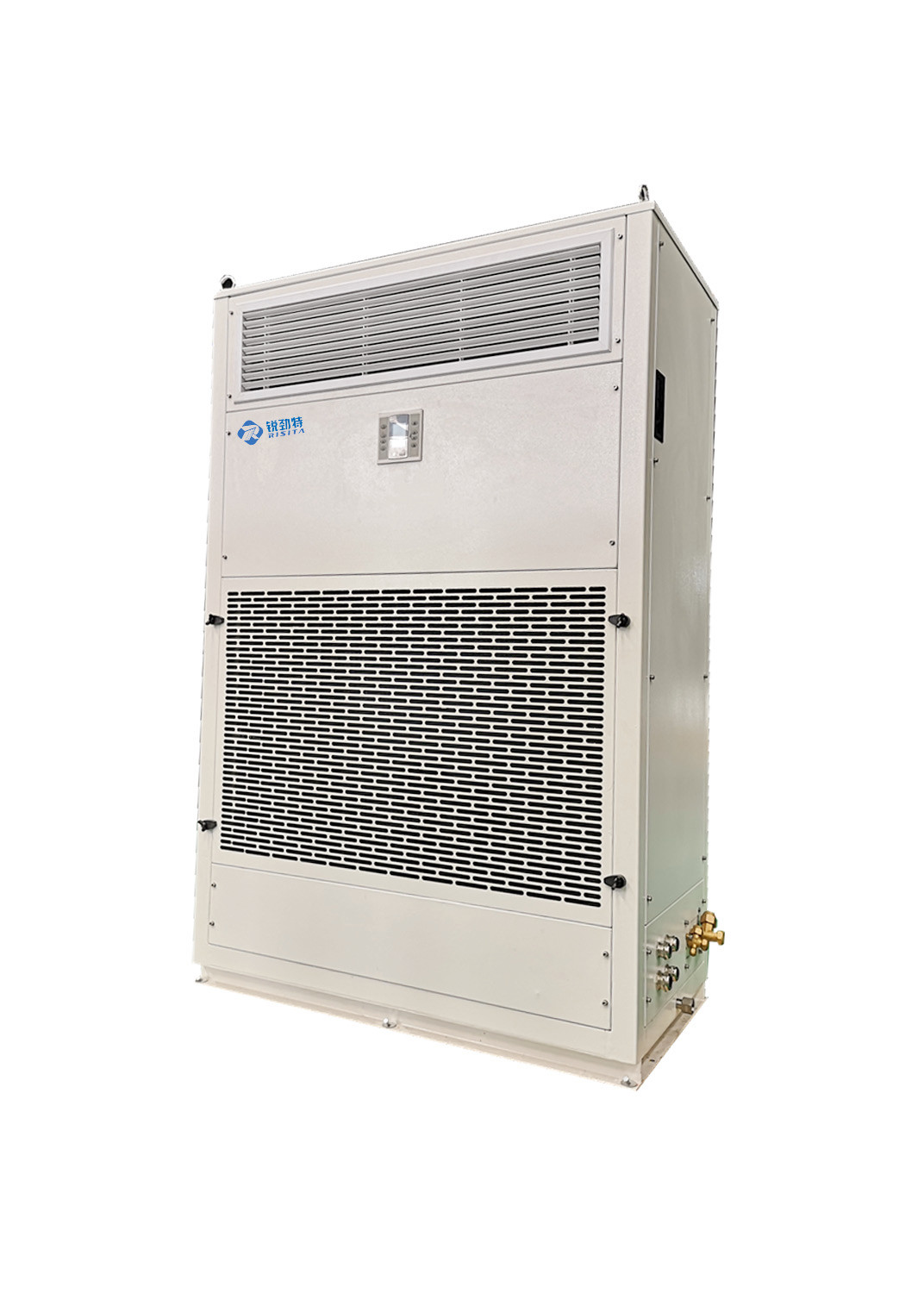
RISITA explosion-proof air conditioning
Guangdong RISITA Air Conditioning Equipment Co.,Ltd.