IQM and Deutsche Bahn Demonstrate Hybrid Quantum Algorithm for Railway Scheduling Optimization
en.Wedoany.com Reported - IQM Quantum Computers (Nasdaq: IQMX), a developer of superconducting quantum computers, together with Deutsche Bahn, has published research demonstrating the execution of a hybrid quantum-classical optimization algorithm on real-world railway operations data. The study was executed end-to-end on IQM's Emerald quantum processor, solving the rolling stock planning problem—assigning physical train units to scheduled services while minimizing operational costs and strictly satisfying maintenance constraints.
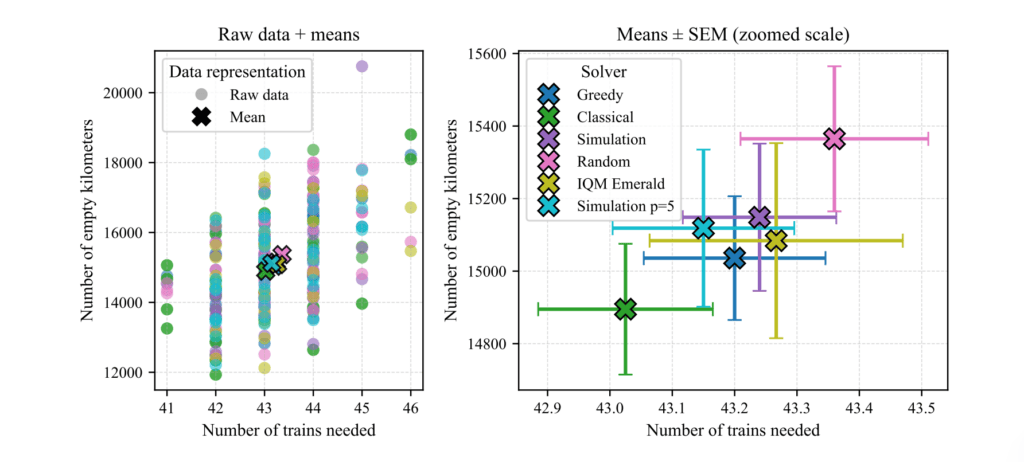
The two parties evaluated a real-world operational dataset provided by DB Systel, Deutsche Bahn's IT subsidiary, comprising 190 scheduled services over a two-day planning window, covering five major German cities: Cologne, Munich, Berlin, Frankfurt, and Hamburg. To adapt the scheduling problem for quantum execution, IQM mapped the constraints onto a Maximum-Weight Independent Set (MWIS) problem on a conflict graph: graph nodes represent feasible closed train circulation loops, each satisfying a mandatory two-hour maintenance stop in Hamburg and a 4,000-kilometer distance cap; edges connect incompatible loops serving the same scheduled service.
Full-scale circulation generation yielded an MWIS graph containing approximately 98,500 feasible loops, a search space too large for current quantum processors. The researchers designed a quantum divide-and-conquer framework: a classical outer loop iteratively extracts manageable subgraphs (e.g., 20 nodes), ranked by passenger-trip density; a quantum subroutine executes the Quantum Approximate Optimization Algorithm (QAOA) at depth p=1 to select partial solutions; a classical post-processing pruning routine resolves conflicting selections, yielding a valid independent set before updating the global graph. Each iteration removes selected train loops, and unserved services proceed to the next round.
The experiments confirmed three core results. First, the hybrid framework can be executed end-to-end on current quantum hardware, generating feasible, high-quality schedules for real enterprise datasets without requiring fault-tolerant quantum processors.
Second, performance exhibits a predictable scaling trend as subgraph size increases. Using a classical exact solver as a benchmark, the two show a statistically significant relationship (P=1.04×10⁻⁹): as subgraph size grows, the empty kilometers directly reduced by the hybrid framework (non-productive travel distance without passengers) also increase.
Third, hardware improvements can be automatically leveraged. As quantum processors scale in qubit count, connectivity, and gate fidelity, enabling them to handle larger subgraphs, the underlying algorithmic architecture yields better scheduling outcomes without requiring structural redesign.
At the time of this research publication, IQM had been listed on the Nasdaq Global Select Market and Nasdaq Helsinki in July 2026 under the ticker symbol IQMX. The two organizations stated that while the current research focuses on deterministic offline planning, the divide-and-conquer architecture can be adapted in the future for real-time disruption management, enabling railway operators to dynamically reallocate rolling stock during unexpected service delays.
A preprint of the related research has been published on the arXiv platform, and IQM has simultaneously released a technical white paper and a full technical case study.
Related Products




Explosion-proof lithium battery dispatching monorail crane locomotive (permanent magnet frequency conversion integrated machine)
Xiangtan Hengxin Industrial Co., Ltd.
GSR6-27.5kV SF6 Free Gas-insulated Metal-enclosed Switchgear
Zhejiang Juhonkia Intelligent Electric Co., Ltd.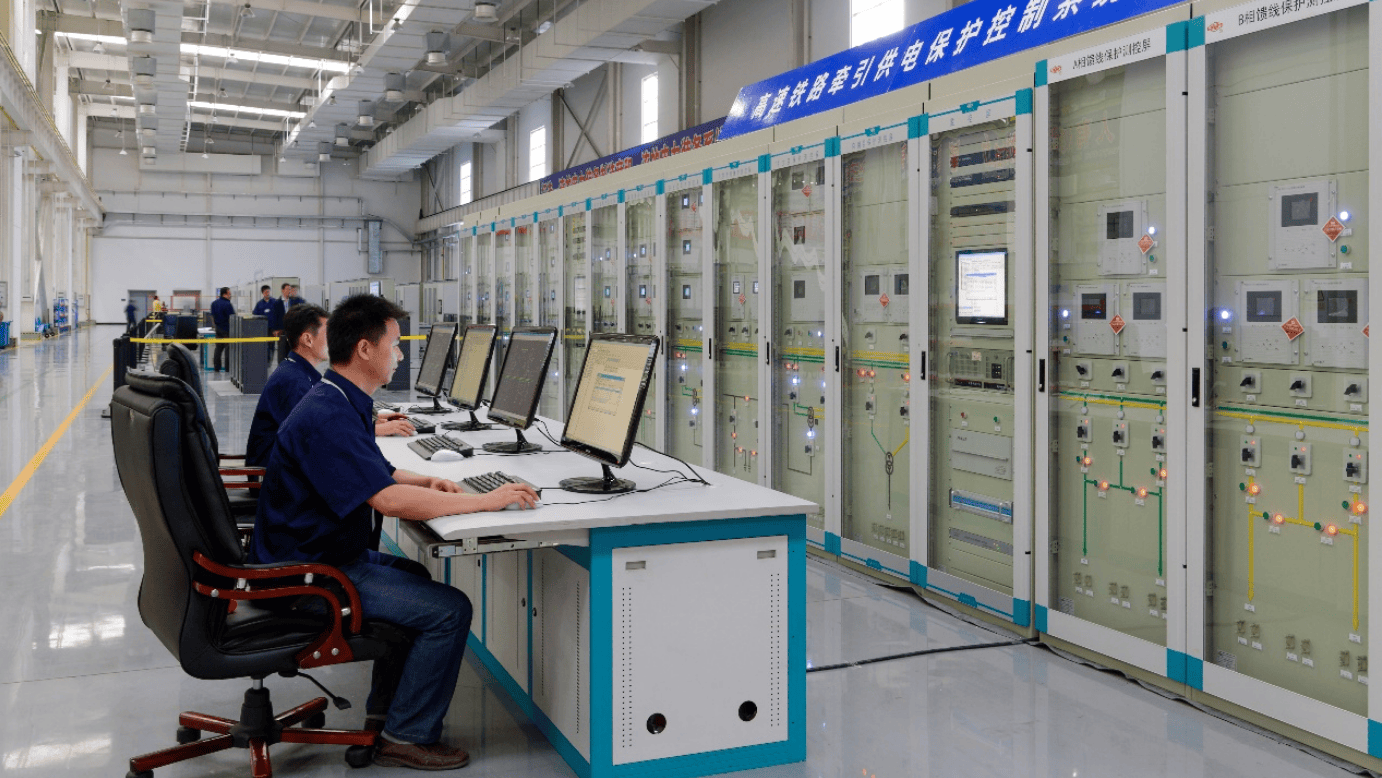

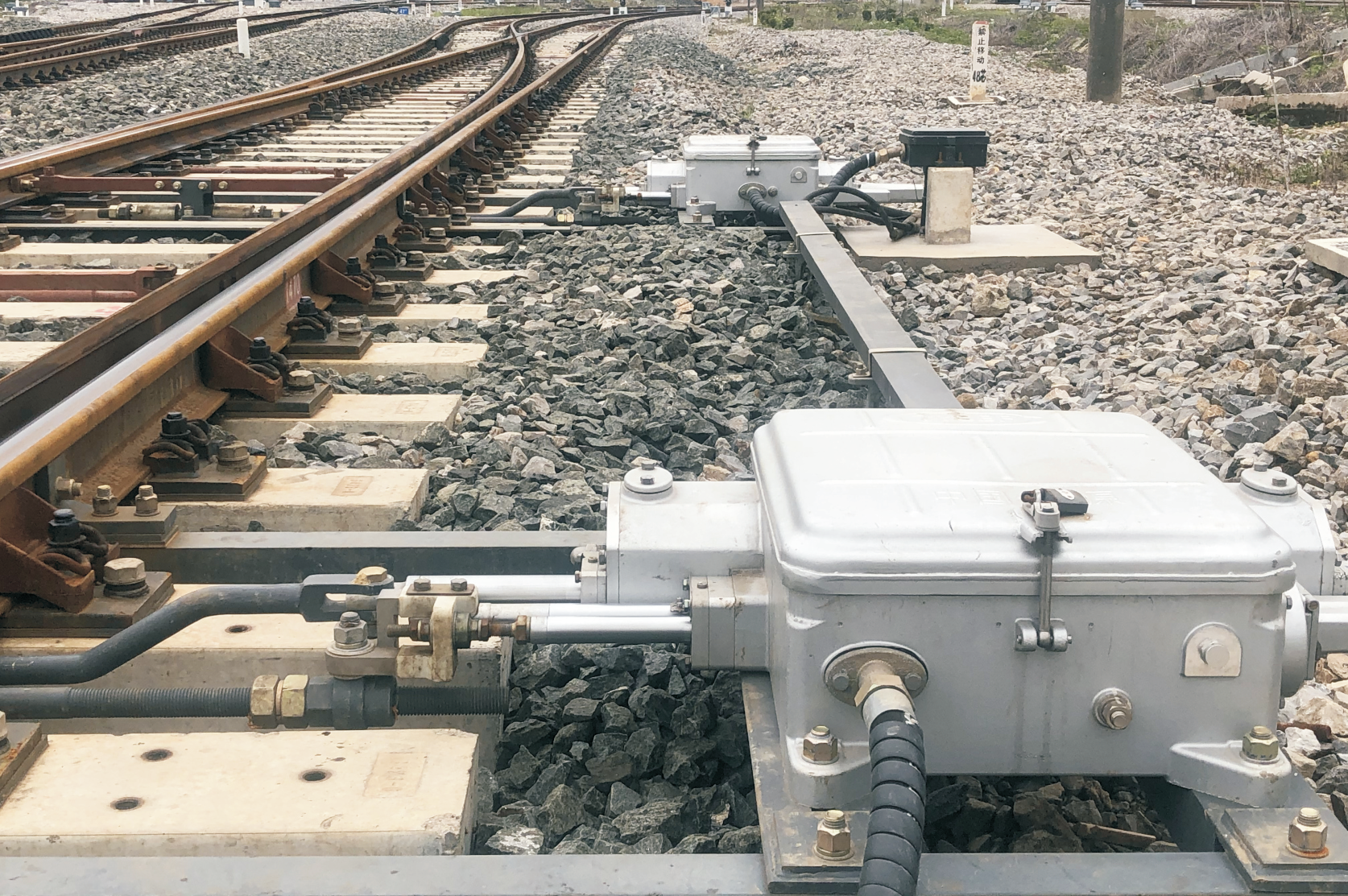
ZY(J)7(M) Sealed Type Electro-Hydraulic Turnout Machine
TAIYUAN CR JINGFENG EQUIPMENT TECHNOLOGY CO., LTD.

Industrial and Commercial Point-Type Gas Detector
Jinan Benan Technology Development Co., Ltd.