ROHM Develops Second-Generation Terahertz Wave Oscillation Device with Output Power Four Times That of Previous Generation
en.Wedoany.com Reported - ROHM Semiconductor has developed a second-generation terahertz (THz) wave oscillation device based on Resonant Tunneling Diodes (RTDs) technology. This device is offered through the RTD-EVK-G2 terahertz wave device evaluation kit, which includes sample devices, cables, and an evaluation board, enabling companies and research institutions to complete oscillation and detection evaluation of terahertz waves in a compact development environment.
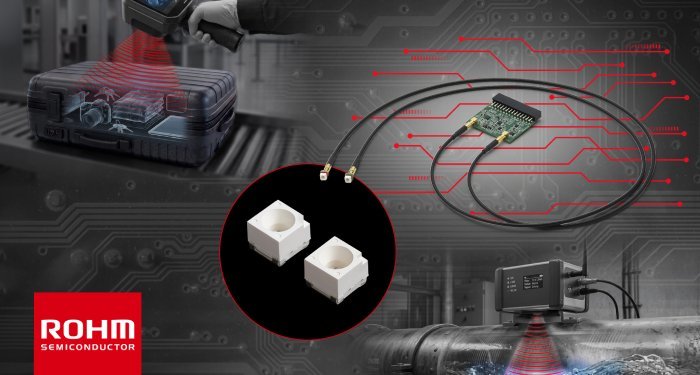
Terahertz waves lie between radio waves and light, combining the penetrating properties of radio waves with the straight-line propagation of light. They exhibit unique absorption characteristics for polymers, moisture, and other substances, making them promising for non-destructive testing without ionizing radiation, medical and healthcare applications, and high-resolution radar sensing. Conventional terahertz systems require large equipment and high implementation costs, limiting new companies and research institutions from entering the field or advancing commercialization. Since the late 2000s, ROHM has conducted joint research on RTD terahertz wave oscillation and detection devices with institutions such as the Institute of Science Tokyo and Osaka University, and began offering first-generation product samples in 2024, reducing equipment size and cost compared to conventional methods.
To meet the higher demand for signal quality in application development, ROHM has developed a second-generation oscillation device. Its chip size remains the same as the first generation at 0.5 × 0.5mm, but through improved internal structure, the output power has been increased to approximately four times that of the first-generation product, reaching a maximum of 40µW. The increased output power enhances the detectability of terahertz waves after penetrating or reflecting off target objects, making it suitable for sensing and imaging applications that require high signal quality. The device maintains the 4.0 × 4.3mm PLCC package, retaining the industry's smallest* size, allowing evaluation platforms to be built in space-constrained environments. Compared to other terahertz generation methods, the RTD approach generates less heat and consumes less power, reducing the development burden on companies.
The RTD-EVK-G2 evaluation kit, which includes second-generation oscillation device samples, is scheduled to go on sale in August 2026, supporting application development in non-destructive testing, medical and healthcare imaging and sensing, material identification, and moisture detection at a lower cost than other approaches. First-generation devices will continue to be sold for applications prioritizing low power consumption. Purchasing the evaluation kit requires signing a non-disclosure agreement (NDA) with ROHM. ROHM also provides various support materials, and when the evaluation kit is used in combination with measurement tools such as Digilent's Analog Discovery 3™, a research and development environment can be established in a limited space.
Professor Safumi Suzuki of the Laboratory for Future Interdisciplinary Research of Science and Technology, Institute of Integrated Research, Institute of Science Tokyo, stated that terahertz waves have application potential in fields such as non-destructive testing, imaging sensing, and wireless communications, but commercialization still faces challenges including large equipment and high costs. The RTD devices developed through years of joint research are compact, power-efficient, and require no cooling, enabling introduction at lower cost and helping companies and research institutions launch terahertz wave research. With the significant improvement in oscillation output of the second-generation device, application development requiring higher signal quality is expected to accelerate.
Ken Nakahara, General Manager of ROHM's R&D Center, noted that feedback from first-generation device users revealed strong demand for higher-output devices; the second-generation product responds to this demand by increasing oscillation output to approximately four times while maintaining a compact size. ROHM will continue to collaborate with customers, partners, universities, research institutions, and government agencies to support terahertz wave application development and promote the commercialization and practical implementation of this technology.
Related Products






Automatic Aiming Laser Remote Obstacle Removal Robot
Pinggao Group Weihai High-Voltage Apparatus Co., Ltd.
TWP16 P-Band Tropospheric Wind Profile Radar
China Huayun Meteorological Technology Group Co., Ltd.
Conveyor Belt Intelligent Monitoring System
LUO YANG WIRE ROPE INSPECTION TECHNOLOGY CO., LTD.