Compass Minerals Q3 FY2026 Salt Prices Up 9%, Salt Revenue Down 25%
en.Wedoany.com Reported - Compass Minerals released its third-quarter fiscal 2026 results, with salt segment revenue of $173.9 million, up 5% year-over-year; average combined selling prices rose 9%, including an 8% increase in highway salt prices and a 6% increase in consumer and industrial salt prices. Total salt sales volume declined 4% during the same period, with all revenue growth driven by pricing.
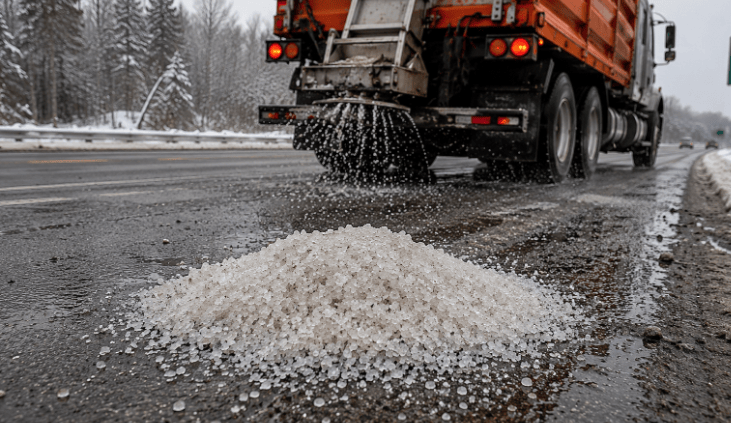
Compass Minerals President and Chief Executive Officer (CEO) Edward Dowling described the 2026-27 highway deicing bid season as "very constructive" in the third-quarter fiscal 2026 earnings release, citing year-over-year improvements in core U.S. market pricing and higher bid volumes. With individual bids not yet fully awarded, this assessment sets the tone for market expectations in the next annual contract cycle. K+S AG reported that its first-quarter 2026 deicing salt sales volumes more than doubled year-over-year and raised its full-year 2026 EBITDA guidance from €600 million to €700 million to €630 million to €730 million, further indicating strengthening deicing salt demand.
In the same quarter, Compass Minerals achieved a 9% price increase, yet salt segment operating income fell 25% year-over-year to $21.2 million, and adjusted EBITDA declined 15% to $38.9 million. The company attributed the gap to higher unit product and distribution costs, primarily driven by increased maintenance and labor expenses in its mining operations. Simply put, the cash cost of delivering each ton of salt to customers grew faster than the contract price increase for that ton, meaning that despite nominal price improvement, profit margins narrowed on each additional ton sold.
Compass Minerals redeemed $150 million of notes due 2027 during the quarter, and net leverage, measured against adjusted EBITDA, declined from 4.3x a year ago to 2.8x. S&P Global Ratings subsequently upgraded the company's credit rating from B to B+.
On earnings guidance, Compass Minerals narrowed its fiscal 2026 salt segment adjusted EBITDA guidance from $225 million to $240 million to $225 million to $236 million, lowering the top end by $4 million, while raising full-year sales volume guidance. Higher volume guidance combined with a lower earnings ceiling indicates that stronger pricing and volumes have not yet translated into segment profit growth.
An independent variable has emerged on the supply side. Typhoon Dolphin made landfall in Zhejiang Province on August 9, 2026, with sustained winds near 151 kilometers per hour, then moved northward, bringing heavy rainfall to Shanghai, Jiangsu, Anhui, and Shandong. Shandong is China's largest producing province for caustic soda and brine salt, with coastal salt fields and evaporation ponds supplying feedstock to chlor-alkali complexes. At the time of the storm, local solar-evaporated brine salt production was at its normal seasonal peak.
Due to the typhoon, Shanghai's two major airports canceled approximately 943 flights, nearly 40% of planned capacity, and Beijing activated a Level II flood emergency response. These two figures do not directly correspond to production losses, but they indicate logistics disruptions along the same coastal corridor that typically handles brine salt and chlor-alkali product shipments to ports. Meanwhile, tensions in the Strait of Hormuz have pushed up naphtha and ethylene costs in the Middle East, shifting China's PVC production from naphtha-based ethylene routes toward coal- and limestone-based calcium carbide routes, altering the mix of producers accessing brine salt feedstock—a change unrelated to the flooding. As of the time of writing, neither Shandong nor Jiangsu has published official production loss figures, so this remains an operational risk to monitor rather than a confirmed output reduction.
In North America, Atlas Salt is a development-stage company and has not reported production or segment revenue. Its Great Atlantic Salt Project on the west coast of Newfoundland and Labrador is planned to achieve steady-state production of 4 million tons of salt per year over a 25-year mine life. A feasibility study completed on September 30, 2025, yielded an after-tax net present value of C$920 million (at an 8% discount rate), an after-tax internal rate of return of 21.3%, and a payback period of approximately 4.2 years.
On financing, Export Development Canada (EDC) issued a non-binding letter of intent on July 23, 2026, for up to C$150 million, corresponding to the project's financing requirement of C$350 million to C$400 million; the remaining C$200 million to C$250 million must be sourced from other channels. A letter of intent is not a loan and remains subject to due diligence, internal credit approval, and final agreements. On the engineering front, earthworks contractors have been on site since early May 2026, and a development permit issued by the Town of St. George's on April 30, 2026, covers the approved early works construction plan.
Atlas Salt President and Chief Executive Officer Nolan Peterson, in describing the project's objectives, cited the same regional supply gap reflected in Compass Minerals' pricing data: the project aims to supply deicing road salt to severely underserved markets including the northeastern United States, eastern Canada, and the Atlantic provinces.
Several checkpoints could alter the above assessment. If Compass Minerals' unit mining costs stabilize or decline in the fourth quarter of fiscal 2026 while combined prices hold at current levels, the margin compression narrative would be weakened and the pricing power thesis would regain dominance. If Chinese authorities report minimal production loss figures for Shandong or Jiangsu, the typhoon impact should be treated as a logistics delay rather than a supply event. If the EDC letter of intent fails to advance to credit approval, or if Atlas Salt's remaining financing gap of approximately C$200 million to C$250 million fails to attract new lenders within the construction timeline, the supply response in the underserved corridor will be delayed, making the project's cash runway a critical variable. If the U.S. National Oceanic and Atmospheric Administration Climate Prediction Center's winter outlook points to a mild winter in the northeastern United States and eastern Canada, the so-called "very constructive" bid season should be validated by final awarded bid volumes rather than management commentary.
Atlas currently has no committed funding, and project construction, permitting, and financing risks remain—circumstances that established salt producers would not face at the same development stage. The C$150 million is only a maximum amount under a non-binding letter of intent, not capital already in place.
This quarter, multiple producers in North America and Europe confirmed highway and municipal deicing salt pricing power within the same reporting period, providing two independent data points. Margin compression stems from cost structures related to mining, maintenance, and distribution, not from weak demand—a distinction that directly affects how the coming quarters should be modeled. A 9% price increase alongside a 25% decline in salt segment operating income is not contradictory; it reflects cost issues taking precedence after successful pricing. Whether producers can pass prices through to operating profit will be tested during the bid season. The flood risk in China's coastal salt belt and the North American cost story occurred concurrently but independently, demonstrating that salt trades in regional markets rather than at a single global price.
Across this quarter's results, pricing power held by North American and European producers is real, but Compass Minerals' 25% decline in segment operating income shows that prices have not yet fully offset rising per-ton costs; the supply risk from China's typhoon and the financing progress of the Newfoundland development-stage project are the two variables most likely to change the picture before year-end. The next items to track are the final awarded 2026-27 highway bid results, mature producers' fourth-quarter cost data, and progress on the export credit agency's due diligence for the new supply project.
Related Products


KJ-3045 Crawler Mobile Jaw Crushing Station
Yunnan Kairuite Construction Machinery Equipment Co., Ltd.
CITIC Heavy Industries Metallurgical Equipment Steel Smelting Engineering Equipment
CITIC Heavy Industries Co., Ltd.
1050-1750mm Steel Strip Single-stand Reversible Cold Rolling Production Line
MCC-SFRE HEAVY INDUSTRY EQUIPMENT CO., LTD.
Yunnan Phosphorus Chemical Group Co., Ltd. 2 Million t/a Phosphorus Ore Mining and Beneficiation Project
China Bluestar Lehigh Engineering Corporation