Syria's Three Ports See 354% Surge in Seaborne Oil Imports in First Seven Months of 2026
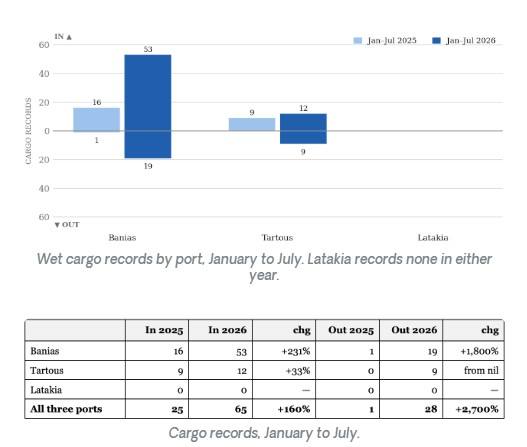
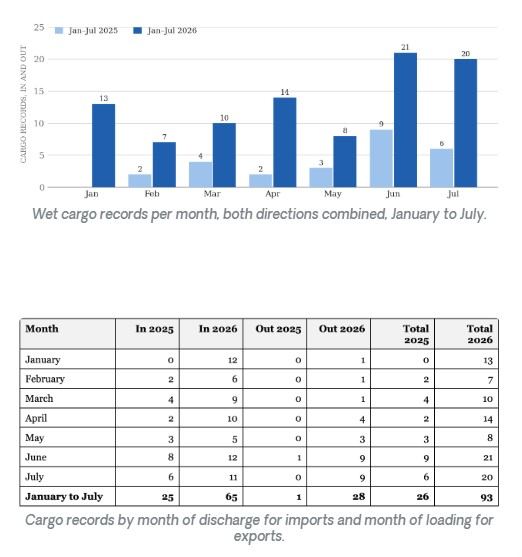
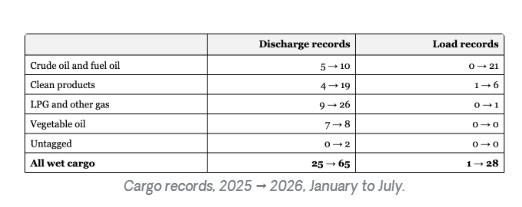
en.Wedoany.com Reported - Based on cargo records of loading and discharge ports from AXSMarine TradeFlows, Signal Ocean Group has released a comparative statistical analysis of wet cargo seaborne trade at Syria's three ports. From January to July 2026, seaborne imports at Baniyas, Tartus, and Latakia totaled 17.03 million barrels, up 354% from 3.75 million barrels in the same period of 2025, with discharge records rising from 25 to 65 voyages; exports over the same period climbed from 1 record and 230,000 barrels in 2025 to 15.42 million barrels across 28 records, with the import-to-export ratio narrowing from approximately 17:1 to nearly 1.1:1.
The statistical scope covers wet cargo shipments with matched loading and discharge ports, with data extracted on August 17, 2026. Barrel figures are converted using fixed conversion rates: 7.3 barrels per metric ton for crude oil, 7.9 barrels per metric ton for clean petroleum products, 6.353 barrels per metric ton for fuel oil, and 11.6 barrels per metric ton for liquefied petroleum gas. All categories recorded growth on the import side; changes on the export side were more pronounced, with crude oil and fuel oil—which had no recorded exports in 2025—accounting for four-fifths of all export cargo in 2026.
By category, clean petroleum products constituted the largest import flow at the three ports, totaling 6.6 million barrels. After re-exports of 2.65 million barrels, the net deficit over seven months stood at 3.95 million barrels. Combined imports of crude oil and fuel oil reached 6.88 million barrels, while exports totaled 12.61 million barrels, resulting in a net outflow of 5.72 million barrels—the primary driver of export growth.
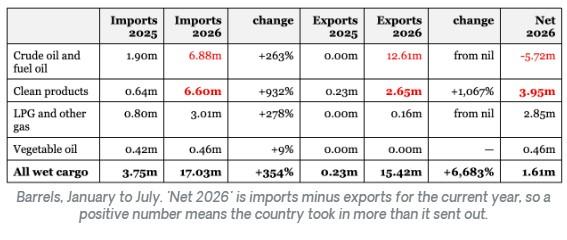
Syria's Energy Minister previously cited domestic oil demand at 120,000 to 150,000 barrels per day, with two separate statements on domestic daily production of 100,000 barrels and 40,000 barrels, respectively. The Syrian Petroleum Company has stated that total refining capacity is approximately 130,000 barrels per day, of which the Baniyas refinery operates at 95,000 barrels per day (Enab Baladi, March 7, 2026). Against these figures, the scale of clean petroleum product imports is broadly in line with expectations.
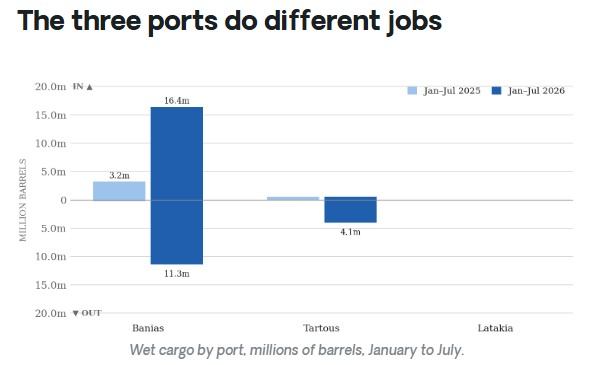
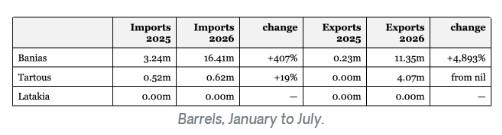
Baniyas is the primary oil port, handling nearly all activity, with imports of 16.41 million barrels and exports of 11.35 million barrels, accounting for 96% of wet cargo imports and 74% of exports at the three ports, respectively. Tartus operates a smaller crude oil and refined product business alongside its dry bulk trade, with imports of 620,000 barrels and exports of 4.07 million barrels. Latakia recorded no tanker cargo in either year or direction.
Voyage counts and tonnage volumes did not increase at the same pace. Wet cargo records at the three ports rose from 25 import and 1 export voyages in the first seven months of 2025 to 65 and 28 in 2026, respectively, with total voyages increasing from 26 to 93—a 258% rise, lower than the tonnage growth, indicating that average cargo volume per vessel increased concurrently.
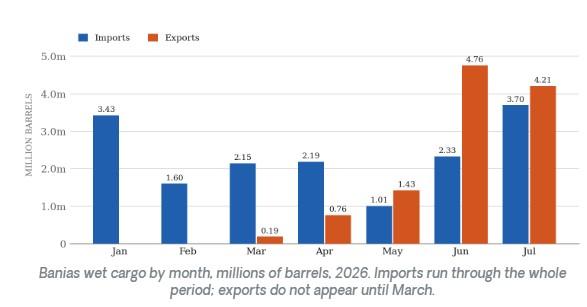
Baniyas recorded imports in every month of 2026; no exports occurred in January or February, with the first export of 190,000 barrels recorded in March. Export volumes surged sharply from May onward, peaking at 4.76 million barrels in June, reflecting an abrupt rather than gradual shift. This period coincides with the reopening of the Al-Tanf–Al-Waleed border crossing between Iraq and Syria. The crossing resumed operations on April 2, 2026, after being closed for over a decade, with the Qatar News Agency reporting the same day that a convoy of Iraqi fuel oil tankers had begun traveling via the Al-Tanf border to the Baniyas refinery. However, the first export occurred in March, prior to the crossing's reopening date, and the data alone is insufficient to establish a causal relationship between the two.
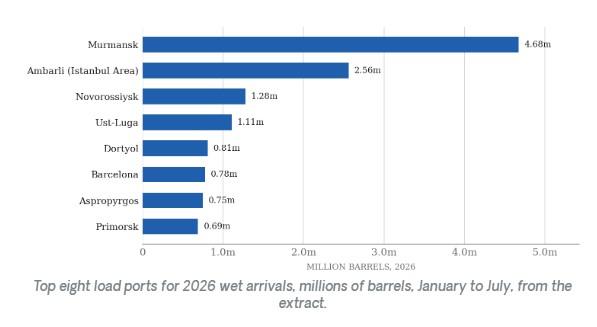
Among loading ports for imported crude oil, Russian ports account for a significant share. Murmansk loaded 4.68 million barrels, and combined with Ust-Luga, Novorossiysk, Primorsk, and Tuapse, Russian loading ports totaled 8 million barrels, representing 47% of total wet cargo arrivals in 2026.
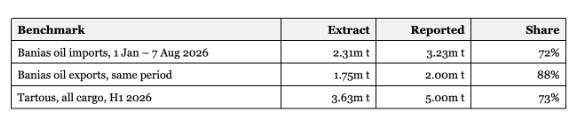
Official Syrian data can serve as a cross-reference. The Syrian General Authority for Land and Sea Border Crossings stated that Baniyas has received 108 tankers since the beginning of 2026, carrying approximately 3.23 million metric tons of various petroleum products, with 30 tankers loaded with fuel oil and petroleum distillates for export (SANA, August 7, 2026; Shafaq News, August 7, 2026); Tartus saw 551 vessels berth in the first half of the year, with cargo volume of approximately 5 million metric tons (SANA, August 6, 2026).
Related Products


YE3 Series Low Voltage High Power Three-Phase Asynchronous Motor
Shandong Lijiu Electrical Machinery Co., Ltd.

6kV-35kV Medium and High Voltage Direct-Connected Energy Storage System
Hainan Jinpan Smart Technology Co., Ltd.
CITIC Heavy Industries Offshore Wind Power Equipment Hydraulic Pile Hammer
CITIC Heavy Industries Co., Ltd.

High-voltage Direct Current (HVDC) Transmission System Research and Integrated Design
XI'AN XD POWER SYSTEMS CO., LTD.
Electromagnetic Fluid Seawater Floating Oil Separation and Recover Equipment
Huate Magnet Group Co., Ltd.
Forest and Grassland Heat Source Infrared Monitor
China Huayun Meteorological Technology Group Co., Ltd.