Isar Aerospace's Spectrum Rocket Successfully Reaches Orbit on Second Flight
en.Wedoany.com Reported - On September 5, the two-stage Spectrum launch vehicle, independently developed by Germany's Isar Aerospace, lifted off from the Andøya Spaceport in Norway, successfully reaching orbit and completing payload deployment on its second flight mission. The "Onward and Upward" qualification flight took off at 22:12 Central European Summer Time. The rocket sequentially completed maximum dynamic pressure phase flight, first-stage main engine cutoff, stage separation, and second-stage ignition. After crossing the Kármán line at an altitude of 100 kilometers, the fairing was jettisoned, followed by circularization burn and spacecraft separation.
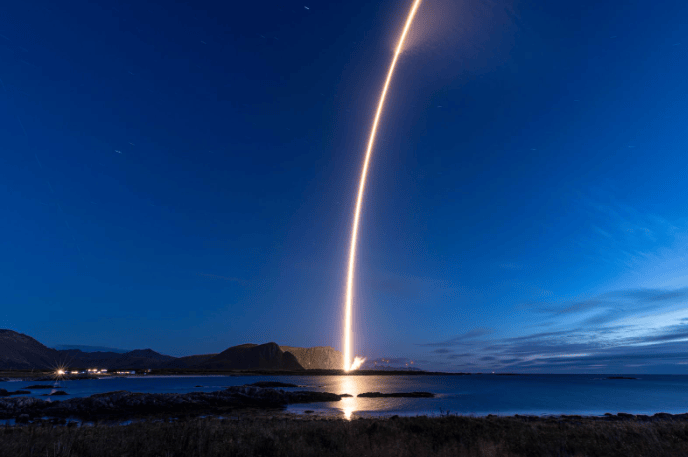
This mission marked the first time Spectrum flew with a payload onboard. Mission data released by Isar Aerospace shows the rocket carried 5 CubeSats and one non-separable experimental payload, selected through a micro-launcher competition organized by the German Space Agency at the German Aerospace Center (DLR). The mission received support from the European Space Agency's Boost! program. After completing payload deployment, the company stated it was working with customers to further confirm satellite status in orbit.
Spectrum features a two-stage configuration, standing 28 meters tall with a diameter of 2 meters, equipped with 10 engines, and designed for a maximum low Earth orbit payload capacity of approximately 1,000 kilograms. This flight was designated as Spectrum's qualification mission, primarily verifying the rocket's critical systems under real flight conditions. The European Space Agency confirmed that Spectrum successfully reached low Earth orbit, becoming the first launch system to meet the orbital launch milestone requirement under the European Launcher Challenge program, which requires selected launch service providers to complete an orbital launch by no later than 2027.
Spectrum's first test flight took place on March 30, 2025, at the Andøya Spaceport. Approximately 30 seconds after liftoff, the rocket terminated its flight per safety procedures and fell into a designated sea area. The second flight was originally planned for early 2026 but experienced multiple delays. An April launch attempt was aborted due to a leak in a composite overwrapped pressure vessel, and a June launch window also failed to complete the mission, which was ultimately executed on September 5.
Isar Aerospace has already initiated batch production of subsequent Spectrum rockets. The company confirmed on September 5 that the 3rd through 7th Spectrum vehicles are in production, and its new 40,000-square-meter integrated launch vehicle production facility is nearing completion, with a planned annual production capacity of up to 40 launch vehicles once finished. The company is also constructing another launch site in Nova Scotia, Canada, to cover missions targeting medium- and high-inclination orbits.
Related Products




![IVECO Cash-in-Transit [DMT5048XYCL3-AM] - Chongqing Dima Industry Co., Ltd](https://img.wedoany.com/2026/0911/20260911030157582.png)

JiuTian OneSky Pilot—Intelligent Management And Service Platform
China Times Prospect Science & Technology Co., Ltd.
One-Stop Steward Service for the Entire Logistics System Integration Chain
Zhongding Intelligent (Wuxi) Technology Co., Ltd.
CLW5180TXSD6 Dongfeng Tianjin Washing and Sweeping Truck
ChengLi Special Automobile Co., Ltd.