Fraunhofer IAP Uses XPS to Study the Surface Chemistry of Bio-based Hybrid Materials
en.Wedoany.com Reported - The Fraunhofer Institute for Applied Polymer Research (Fraunhofer-Institut für Angewandte Polymerforschung IAP) uses X-ray photoelectron spectroscopy (XPS) to study the chemical states and interactions at the surfaces and interfaces of bio-based carbon materials and organic-inorganic hybrid materials. The resulting insights can support the targeted development of functional materials for industrial applications.
Bio-based materials and hybrid systems can be used in water treatment, catalytic processes, electrochemical components, and functional coatings, combining the properties of natural raw materials with those of inorganic materials. Their function, reactivity, and stability depend on the chemical environment at surfaces and interfaces. Conventional analytical methods provide limited information, and the causes of performance differences, aging effects, or unexpected behavior are often difficult to identify clearly.
In a series of joint studies led by the Materials Chemistry working group of Professor Andreas Taubert at the University of Potsdam (Universität Potsdam), researchers developed bio-based carbon materials and hybrid materials for water treatment; Fraunhofer IAP provided XPS characterization to analyze surface composition, chemical states, and interfacial interactions. Coffee grounds and orange peels were used as renewable raw materials to produce biochar, which was then combined with clay minerals and metal oxides.
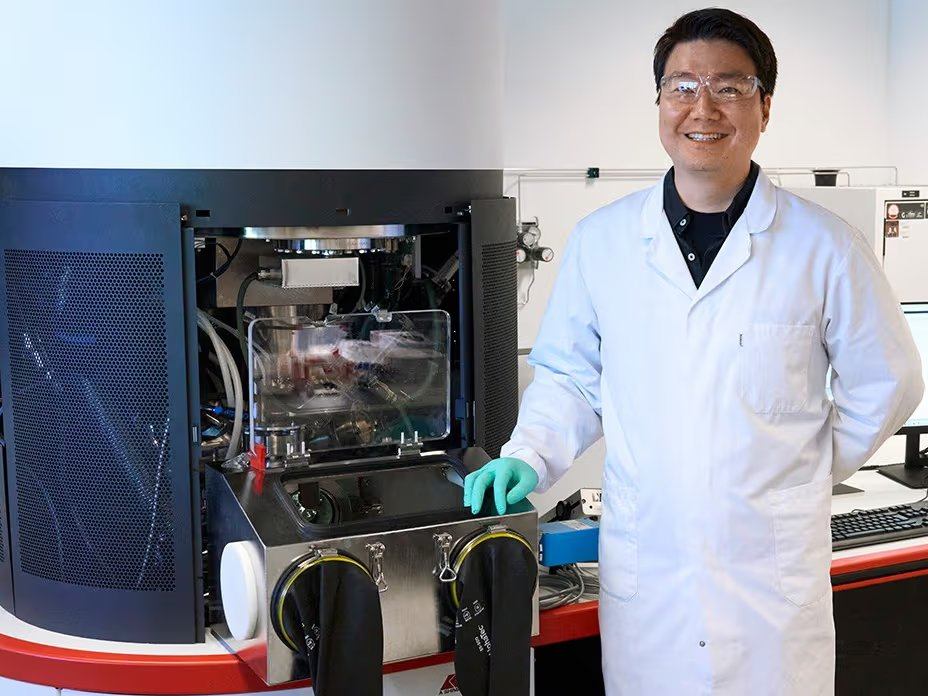
Dr. Jiyong Kim, a surface analysis expert at Fraunhofer IAP, uses XPS to study how heat treatment and hybrid formation affect surface and interfacial chemistry: the material surface is irradiated with X-rays, and the energy of the emitted photoelectrons is measured. According to Kim, XPS can read information from the top 1 to 10 nanometers of a material and requires very little sample preparation, with no need for dissolution or chemical digestion.
The chemistry of materials made from natural raw materials is complex. When biomass such as coffee grounds or orange peels is heat-treated, numerous reactions occur simultaneously, producing carbon materials with heterogeneous surface chemistry that cannot be described by a single structure. XPS can distinguish complex surfaces and infer their formation and subsequent applications. For coffee-ground biochar, XPS shows that heat treatment reconstructs surface carbon, forming a structure with higher carbon content that resembles graphite, yet it remains heterogeneous and contains numerous defect sites that can promote interactions with pharmaceutically active ingredients, dyes, and other organic pollutants. According to Taubert, understanding the exact chemical nature helps to grasp the composition and to track changes during applications in water purification or electrochemical components, changes that are very difficult to detect by other methods.
In bio-based hybrid materials, organic and inorganic components are connected at very small scales, and interfacial processes influence subsequent performance. According to Kim, knowing the elements alone is not enough; the key is how the components interact and whether new chemical environments form at the interfaces, and XPS can make these interactions visible. In a hybrid system composed of orange-peel biochar, clay, and titanium dioxide, chemical bonds involving titanium, oxygen, carbon, and aluminum form at the interfaces during heat treatment; in nitrogen-modified photocatalysts, XPS can distinguish nitrogen embedded in titanium-containing inorganic structures from residual nitrogen-containing organic compounds. Such materials can both bind pollutants and, under illumination, degrade them through photocatalytic properties.
With the help of XPS, Fraunhofer IAP supports companies and research partners in understanding the complex surface chemistry of bio-based materials and in identifying the causes of performance differences, including production batch fluctuations, aging processes, surface modifications, and interactions with pollutants and other molecules, in order to optimize material formulations and manufacturing processes and to develop robust, reproducible materials suitable for industrial applications. As industrial interest in renewable raw materials grows, these results also demonstrate the potential for joint research on complex surface and interface materials such as bio-based carbon materials, catalysts, coatings, and polymer composites.