
As the usage of various electronic products increases day by day—from wearable devices such as smartwatches to implantable sensors, skin-worn smart patches, and disposable monitoring devices—these implantable devices bring convenience to people's lives while the e-waste problem generated after their disposal becomes increasingly severe, emerging as an environmental challenge that cannot be ignored. Against this backdrop, good news has come from the Korea Institute of Science and Technology (KIST).
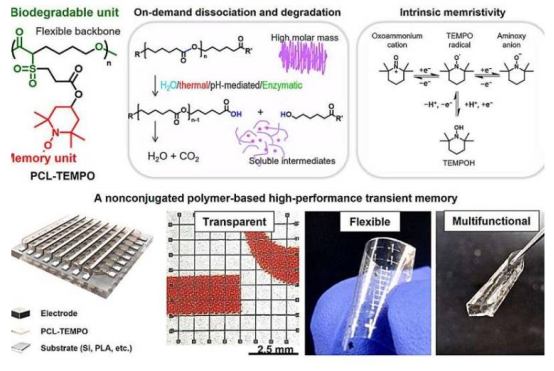
A joint research team led by Dr. Sangho Cho from KIST's Center for Extreme Materials and Dr. Yongho Joo from the Center for Functional Composite Materials has successfully developed a novel polymer material. The research results were published in the journal Angewandte Chemie International Edition.
This polymer material has significant advantages. It is biocompatible and sufficiently stable for implantation into the human body. Its degradation process can be precisely controlled by adjusting the thickness and composition of the protective layer; once the protective layer dissolves, the material can naturally degrade in water within approximately three days without leaving any residues.
Previously, although water-soluble electronic devices had been developed, they generally suffered from poor data storage capabilities, limited performance, and vulnerability to repeated mechanical deformations. To overcome these challenges, the KIST research team designed a novel molecular structure (PCL-TEMPO), combining the functional organic molecule TEMPO, which can store electrical information, with the biodegradable polymer polycaprolactone (PCL). This innovative design makes it possible for a single molecular system to simultaneously achieve electrical signal storage and natural degradation.
The storage devices made from this material exhibit outstanding performance. They have excellent signal recognition capabilities, accurately distinguishing between "on" and "off" states over more than one million cycles, and can reliably retain stored data for over 10,000 seconds. Additionally, after more than 250 write-erase cycles or over 3,000 bending cycles, the device performance remains stable, representing a perfect combination of durability and performance for organic electronic devices.
The application prospects of this technology are very broad, not only suitable for implantable medical devices but also applicable in disposable medical monitoring systems, postoperative naturally degradable surgical implants, eco-friendly data storage devices, and disposable military reconnaissance tools. Particularly for implantable medical devices, they can naturally disappear in the body without requiring surgical removal, significantly reducing patient discomfort and lowering medical costs. At the same time, this technology provides new ideas for solving the increasingly serious e-waste problem, strongly supporting the realization of global carbon neutrality goals.
Dr. Cho stated that this achievement is significant, as it is the first time a physical self-destruction function has been integrated into high-performance organic storage devices. In the future, the research team plans to develop it into "smart transient electronic devices" by integrating self-healing and photo-responsive functions, accelerating the commercialization process of next-generation bioelectronic and eco-friendly devices.