
Soft electronics is an exciting innovative technology that combines flexible and stretchable semiconductor materials for applications in fashion, healthcare, and many other fields. Researchers have recently developed a new technique to tune the properties of liquids, thereby fabricating soft electronic devices.
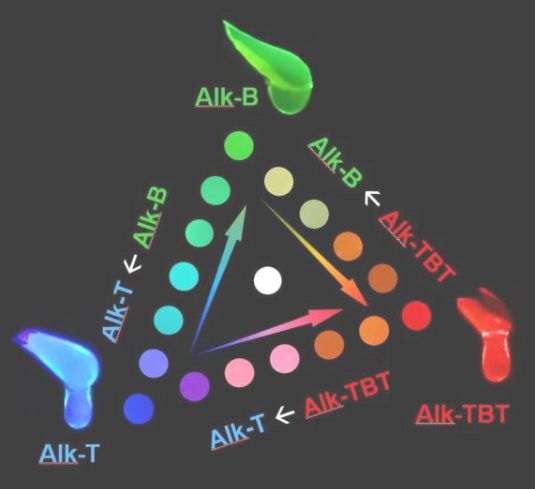
Room-temperature alkylated π-molecular liquids (abbreviated as alkyl-π liquids) are an exciting new class of materials with broad application prospects in the field of flexible electronic devices. However, one challenge facing these fascinating liquids is how to fine-tune their physical, chemical, and electronic properties, including their ability to interact with light, to achieve the desired functions.
A new study led by researchers from the National Institute for Materials Science (NIMS) in Tsukuba, Japan, explores a strategy of mixing alkyl-π liquids together to uniformly blend their functions. The researchers demonstrated the effectiveness of this process using photoluminescence color tuning. Their findings were published in the journal Advanced Materials Science and Technology.
Previously, studies on controlling the properties of alkyl-π liquids mainly employed two methods. The first method involves doping the liquid with small amounts of other molecules (such as dyes). "When tuning functions by adding solid dopants, the solubility of the dopant molecules is poor, leading to the formation of insoluble aggregates and inconsistent properties such as luminescence color," said Dr. Takashi Nakanishi from the Materials Nanoarchitectonics Center at the National Institute for Materials Science.
The second method is chemical modification of the alkyl-π liquids. Although this method can achieve uniform results, designing and synthesizing entirely new molecules is very difficult, time-consuming, labor-intensive, and costly.
In this new study, the researchers synthesized three solvent-free alkyl-π room-temperature liquids that emit red, green, and blue light, respectively, and then mixed these liquids in different ratios. They successfully created a series of uniform colored liquid mixtures with no color variation inside the material, indicating that the alkyl-π liquids had uniformly blended.
The research team also evaluated the mixing effect of the two liquids by changing the temperature and studying the time-dependent flow of the mixed liquids at different temperatures. This method further confirmed that the two liquids had successfully mixed together.
Dr. Nakanishi stated: "The liquid-liquid mixing method of alkyl-π liquids used in this study helps produce low-volatility, ink-like materials that can exhibit a variety of uniform luminescent colors without any color unevenness. This means that the required functions can be applied or coated simply by operations such as applying, sandwiching, or soaking the liquid material where needed."
This research paves the way for mixing alkyl-π liquids to achieve various other functions such as photoconductivity, charge retention, or gas sensing.