
The research team from the School of Physics and Astronomy at the University of St Andrews, UK, recently published significant results in Nature Physics, verifying through ultra-high-precision experiments the theoretical predictions of the Bethe-Slater curve from nearly a century ago. This breakthrough study not only confirms a foundational physics theory but also opens new pathways for understanding the correlation between magnetic and structural properties in quantum materials.
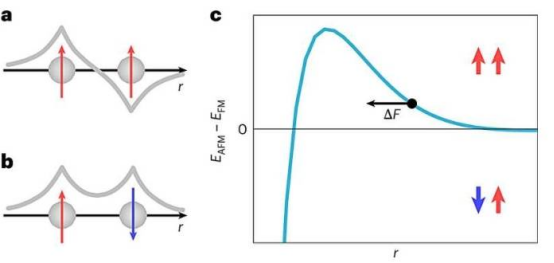
The research team used ultra-low-temperature scanning tunneling microscopy (STM) technology to observe unusually significant magnetoelastic coupling effects in transition metal oxide materials. The experiments were conducted in a specially designed ultra-low-vibration laboratory at the University of St Andrews, which effectively isolates external acoustic interference, ensuring measurement accuracy at the astonishing level of several hundred femtometers (1 femtometer = 10^-15m). Lead author Dr. Carolina Marques stated: "Our technology can detect structural changes with sub-picometer resolution (1 picometer = 10^-12m), which is about 100 times smaller than the atomic radius."
The most striking discovery of this study is the confirmation of the applicability of the Bethe-Slater curve, proposed in the 1930s, in complex oxide materials. This theory was originally used to describe the magnetic behavior of elemental metals, and the research team has for the first time proven its validity in more complex transition metal oxide systems. Professor Peter Wahl pointed out: "We not only validated theoretical predictions from nearly a century ago but, more importantly, discovered structural change amplitudes much larger than those predicted by current theoretical models."
The methodological innovations employed in the study are also noteworthy. The team developed unique technical means to independently control the magnetization intensity on the material surface without being affected by the overall magnetization state of the material. Dr. Marques explained: "This allows us to precisely distinguish between parallel or antiparallel arrangements of surface and subsurface magnetic moments, providing a new perspective for studying the interaction between magnetic order and interatomic spacing."
This international collaborative research with the National Research Council of Italy (CNR-SPIN) and the University of Bonn in Germany may lead to breakthroughs in multiple fields. The research team particularly noted that this discovery could spur the development of new data storage technologies based on purely electronic or structural reading of magnetic states. Additionally, a deeper understanding of the interaction between magnetism and structure will provide important references for the study of quantum phenomena such as high-temperature superconductivity.
Professor Wahl emphasized: "Electron correlation effects play a key role in this interaction, and correlation effects are the core physical mechanism of phenomena such as high-temperature superconductivity. Our work lays a theoretical foundation for developing more stable and environmentally friendly superconducting materials."