
Recently, researchers at Tampere University, in collaboration with scientific partners from Germany and India, have experimentally confirmed for the first time at the quantum level that the law of angular momentum conservation holds true. When a single photon is converted into a pair of photons, its orbital angular momentum (OAM) quanta are preserved, opening new possibilities for quantum computing, communication, and sensing.
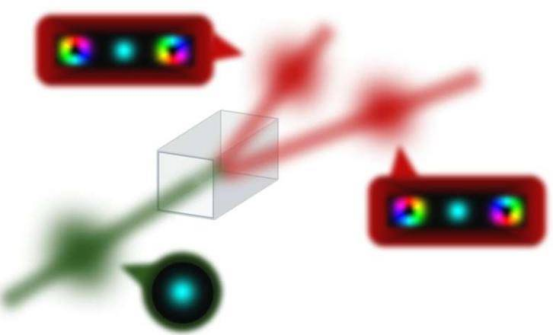
The law of angular momentum conservation is a core principle in the natural sciences, dictating which physical processes are feasible. In the quantum world, this means that a single photon's OAM quanta must be conserved during interactions. The Tampere University team pushed the verification of this conservation law to the quantum extreme, exploring the preservation of OAM quanta when a single photon splits into a pair.
Lead author Dr. Lea Kopf explained: "Our experiments demonstrate that OAM is indeed conserved even when the process is driven by a single photon. This confirms a key conservation law at the most fundamental level." Due to the extremely low efficiency of the required nonlinear optical process, the experimental team relied on highly stable optical setups and precise measurement techniques, with only one in a billion photons successfully converting into a photon pair.
During the experiment, the researchers not only confirmed OAM conservation but also observed the first signs of quantum entanglement in the generated photon pair. This indicates that the technology holds promise for creating more complex photonic quantum states, opening new pathways for quantum technology development.
Professor Robert Fickler, who led the experiment, stated: "This work is not only fundamentally important but also takes us a significant step closer to generating novel quantum states." In the future, the researchers plan to improve the overall efficiency of the experimental setup and develop better measurement strategies to more easily detect these quantum states. They also intend to leverage the generated multi-photon quantum states for novel fundamental quantum tests and quantum photonics applications.