
A research team led by Professor He Bin at Carnegie Mellon University has achieved a significant breakthrough in non-invasive brain-computer interfaces (BCIs). The team's new system can decode individual finger movement intentions in real time using EEG signals and enable precise control of a robotic hand. The findings were published in Nature Communications.
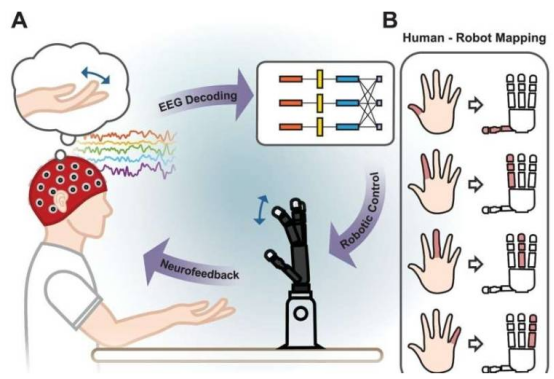
Using deep learning decoding strategies and network fine-tuning mechanisms, the team successfully enabled subjects to control robotic fingers via thought to perform two- and three-finger coordinated tasks. The system operates in both motor execution and motor imagery modes, offering a new rehabilitation aid for patients with limb dysfunction.
"Improving hand function is critical for people with disabilities," said Professor He Bin. "Even small advancements can significantly enhance quality of life. However, decoding individual finger movements from non-invasive EEG signals has long been a major challenge."
While invasive BCIs offer high precision, they require surgical electrode implantation, posing infection risks and complex maintenance. In contrast, EEG-based BCIs are non-surgical, safer, and more convenient. The team had previously achieved breakthroughs in drone flight and robotic arm control; this finger-level control now pushes applications to new heights.
The technology holds promise for finer daily tasks, such as typing. Professor He noted: "This research enhances the clinical value of non-invasive BCIs, enabling them to serve a broader population—from basic communication to complex motor control."