
Using the Australia Telescope Compact Array (ATCA), astronomers conducted a large-scale radio survey of the star-forming region known as the Chamaeleon cloud complex. The observations revealed five young stars, potentially shedding further light on the complex's properties. The findings were detailed in a paper published on June 19 on the arXiv preprint server.
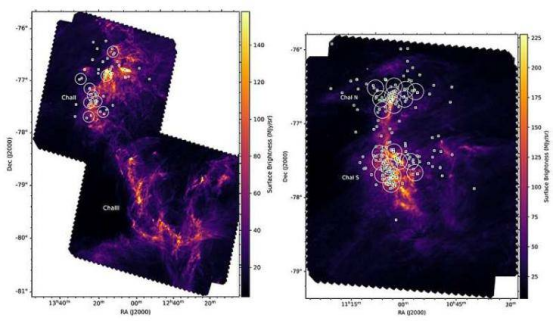
Star-forming regions are considered crucial for better understanding stellar formation and evolution. Observations of these areas are essential for expanding catalogs of known stars, protostars, young stellar objects (YSOs), and clumps, enabling comprehensive studies to deepen insights into the early stages of the stellar lifecycle.
The Chamaeleon cloud complex is a prominent star-forming region in the southern sky, located approximately 620 light-years from Earth. It consists of three main dark clouds: Cha I, Cha II, and Cha III.
Previous studies have identified ~250 pre-main-sequence (PMS) stars in Cha I and fewer than 100 stellar members in Cha II. The ages of Cha I and Cha II are estimated at ~2 million years, while Cha III appears to be in an earlier evolutionary stage, with no evidence of star formation yet.
Led by Ernesto García Valencia from the University of Sonora, Mexico, the team used ATCA for high-resolution radio observations of the complex to search for new stars. As a result, they detected radio emission from five young stars.
According to the paper, three of the detected stars are relatively evolved, low-mass T Tauri stars. One is a protostar, and another has been confirmed as a Herbig Ae/Be star. The astronomers noted that, except for the protostar, the radio emission mechanism in these stars is likely non-thermal.
The Valencia team further examined the detected radio sources using the Australian Long Baseline Array (LBA). LBA observations revealed that one source, designated J11061540-7721567, may be a close binary system with an orbital period of ~40 years, a total mass of ~1.0 solar mass, and a semi-major axis of 12 AU.
Additionally, ATCA observations tentatively detected five more young stars in the Chamaeleon complex. However, further observations are needed to confirm these objects.
In conclusion, the authors summarized the efficiency of using ATCA to detect new sources in Chamaeleon:
"With 201 young stars in the surveyed region, the detection rate ranges from 2.5% to 5%. This is slightly lower than in other star-forming regions," the scientists concluded.