
A research team from the Institute for Superconducting and Electronic Materials (ISEM) at the University of Wollongong has recently solved a 40-year-old puzzle in the quantum field, paving the way for the development of next-generation electronic devices with zero energy loss. The study, co-led by Distinguished Professor Xiaolin Wang and Dr. M Nadeem, with contributions from PhD student Syeda Amina Shabbir and Dr. Frank Fei Yun, was published in the journal Advanced Materials. By introducing entropy engineering, the team successfully achieved the quantum anomalous Hall (QAH) effect, a breakthrough design concept poised to reshape global energy utilization patterns.
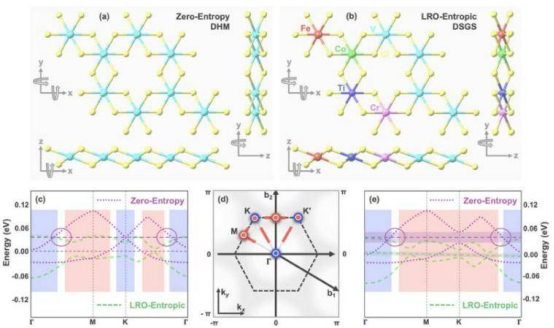
The research focused on regulating the quantum behavior of single-atom-thick magnetic materials. The team innovatively mixed four metal atoms, using random atomic arrangements to reshape the electronic structure and form a topological bandgap. This structure allows current to flow undisturbed along the material's edges, achieving zero-energy-loss transmission—described by Professor Wang as an "electricity superhighway." Entropy engineering provides a new tool for designing high-performance quantum materials by controlling internal randomness in the material. Dr. Nadeem noted, "Entropy-driven design not only optimizes the electronic band structure but also ensures the stability of edge-state conduction, which is crucial for practical quantum applications."
The achievement holds broad application prospects: from addressing overheating issues in mobile phones and computers, to building faster medical imaging systems; from advancing the practical use of quantum computers, to developing energy storage devices capable of holding charge for weeks. Additionally, the research promotes the development of a new material class known as spin gapless semiconductors. Professor Wang emphasized, "This breakthrough marks a major theoretical advancement in energy-efficient, scalable quantum devices, opening new directions for novel quantum physics and device research." The team is exploring the application of entropy engineering to more two-dimensional quantum material designs to accelerate technology translation.