
Water is widely used as a heat transfer medium. Now, in the Optimus project, researchers at Fraunhofer ISE are working with industrial partners to develop high-storage-density phase-change material (PCM) emulsions for applications in buildings, industry, heat pumps, and automotive battery cooling.
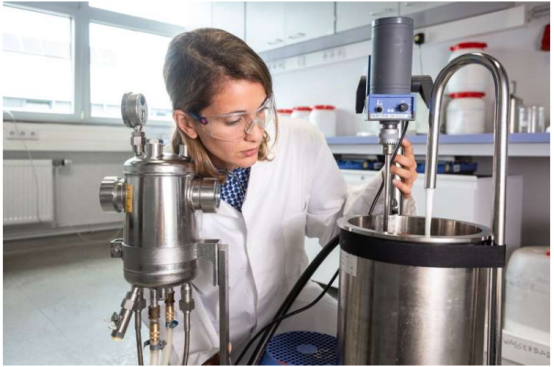
PCM emulsions are combinations of paraffin with water or water-glycol mixtures, with glycol added to prevent freezing, primarily for transport applications. The researchers disperse or emulsify paraffin in water or water-glycol mixtures; surfactants stabilize the ultra-fine paraffin droplets in the liquid, giving the emulsion thermal and mechanical stability and allowing it to exploit the high energy density of paraffin during phase change.
Stefan Gschwander, research scientist at Fraunhofer Institute for Solar Energy Systems ISE, explains that by emulsifying paraffin in water, the mixture remains liquid in all phase states and can be pumped through pipes as a heat transfer fluid in heating and cooling networks. During phase change, even without temperature change, PCM absorbs or releases large amounts of heat, achieving twice the storage density of water at the same volume.
Besides high storage density, PCM emulsions offer many advantages. Their high heat storage capacity enables more space-saving system designs and provides high thermal capacity even at small temperature differences. Gschwander says PCM is particularly suitable for applications with very small temperature swings, such as building cooling or air conditioning—this is its real advantage over conventional systems.
In the project, partners are developing PCM emulsions with melting temperature ranges of 12°C to 18°C, 20°C to 28°C, and 45°C to 50°C for applications including building air conditioning, industrial facilities, battery cooling, and heat pumps.
All developed emulsions have been thermo-mechanically tested in a hydraulic test loop equipped with centrifugal pumps, valves, diaphragm expansion vessels, and plate heat exchangers and can withstand up to 100,000 cycles. The researchers first developed, characterized, and tested the PCM emulsions at laboratory scale (5L), then scaled up to pilot scale (100L).
Next, in collaboration with industrial partner H&R Wax & Specialties GmbH, production will be scaled to cubic-meter level for larger batches and validated in applications such as indoor air conditioning or process cooling in cold storage.
The PCM emulsions will initially be used in two demonstration projects: one storing waste heat from a court building's server room during active heating and transferring it via the emulsion into the air supply for building heating; the other cooling injection molding machines and releasing stored peak-load heat into cooler outdoor air at night. Currently, the researchers are optimizing formulations to further improve stability and storage density.