
Researchers at the National University of Singapore (NUS) have made an exciting advance in quantum metrology, the field that exploits quantum effects to achieve measurement precision far beyond classical limits. Their newly developed protocol promises to benefit emerging technologies such as navigation and ultra-weak signal sensing.
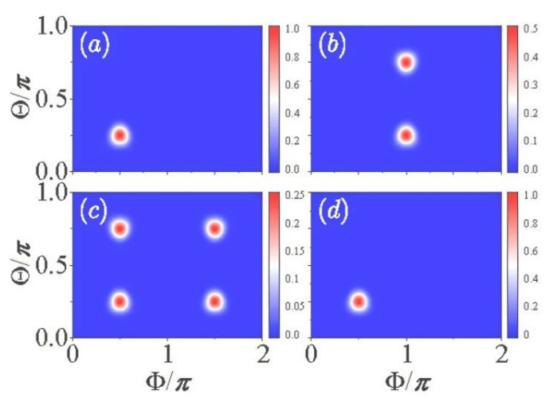
Quantum metrology leverages the unique properties of quantum systems to surpass the standard quantum limit (SQL) and reach the ultimate Heisenberg limit (HL), typically requiring highly entangled states such as Greenberger-Horne-Zeilinger (GHZ) states. However, generating, maintaining, and measuring these states is extremely challenging because they are highly susceptible to environmental noise and readout errors, the primary barrier to practical applications.
Led by Professor Jiangbin Gong from the Department of Physics at the NUS Faculty of Science, the team has developed a novel strategy that removes these obstacles. Their approach exploits quantum resonant dynamics in periodically driven spin systems, a widely studied model known as the quantum kicked top.
Instead of starting with fragile highly entangled states, their protocol begins with a robust and easily prepared SU(2) spin coherent state. Through precisely designed periodic interactions, this simple initial state naturally evolves into a strongly entangled state that encodes quantum information. Under special resonance conditions, the system returns to its original coherent state via quantum recurrence, enabling straightforward preparation and robust readout.
The results were published on 11 June 2025 in Physical Review Letters.
Professor Gong said: "This round-trip evolution means we can start and end with stable, experiment-friendly states while still harnessing the quantum-enhanced sensitivity normally associated with much more challenging entangled states."
The team demonstrated that their protocol attains Heisenberg-limited measurement precision. The quantum Fisher information (QFI), which determines the best achievable precision, scales as the square of the number of particles (spins) and sensing time.
Unlike earlier approaches, this optimal scaling is sustained over longer times and remains robust even in the presence of Markovian noise, a common form of environmental decoherence in quantum systems. Even under such noise, the protocol maintains near-Heisenberg scaling with spin number, marking a major step toward practical quantum metrology.
One of the method's main advantages is its experimental feasibility. The protocol can be implemented using existing quantum hardware, including trapped-ion or cold-atom platforms, by simply tuning operational parameters, without requiring specialized equipment or complex state preparation.
"This work shows that ultra-precise quantum measurements can be achieved without the usual difficulties. By avoiding complicated state preparation and increasing noise resilience, our approach opens new possibilities for practical and scalable quantum sensing," Professor Gong added.
This advance represents a conceptual leap in quantum metrology, offering an experimentally viable and noise-resilient route to Heisenberg-limited precision. By exploiting quantum resonant dynamics of simple initial states, the protocol overcomes long-standing barriers in state preparation and readout, paving the way for real-world applications of next-generation quantum sensing technologies.