
NASA's James Webb Space Telescope has recently turned its gaze toward the Bullet Cluster, located in the constellation Carina approximately 3.8 billion light-years from Earth, delivering unprecedented high-resolution images. These images reveal far more extremely faint and distant galaxies while enabling researchers to map the contents of this colliding galaxy cluster in greater detail than ever before. Using Webb's sharp near-infrared observations, the team has precisely measured the mass of the Bullet Cluster from core to outskirts, producing the largest gravitational lensing dataset to date.
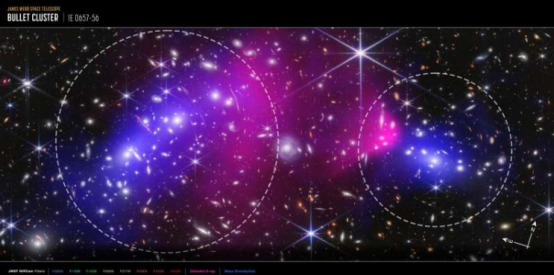
"Webb's images have dramatically improved our measurements, including the precise location of dark matter," said Kyle Finner, assistant scientist at Caltech's IPAC. The Bullet Cluster consists of two gravitationally bound massive galaxy clusters that act as gravitational lenses, magnifying the light of background galaxies and allowing researchers to infer the distribution of dark matter. The team measured thousands of galaxies in the Webb images, accurately "weighing" both the visible and invisible mass within the cluster and carefully mapping the collective light emitted by stars.
The new composite image combines data from Webb's Near-Infrared Camera with observations from the Chandra X-ray Observatory: pink regions represent hot gas, while blue regions show the team's precise measurements of dark matter distribution. The study confirms that even in a highly dynamic environment, the light from galaxies within the cluster remains a reliable tracer of dark matter. Webb's observations also indicate that dark matter shows no significant signs of self-interaction—it remains aligned with the galaxies and has not been dragged away. These new findings place stronger constraints on the behavior of dark matter particles. The research team further discovered that the Bullet Cluster may have formed from multiple cluster collisions billions of years ago, with its complex mass distribution suggesting a history of numerous mergers and interactions.