
A research team led by Professor Changduk Yang at Ulsan National Institute of Science and Technology (UNIST) in South Korea has published groundbreaking findings in Energy & Environmental Science, using a camphor derivative to significantly improve the film quality of perovskite solar cells. This breakthrough has increased cell efficiency to 25.2% while dramatically extending device lifespan.
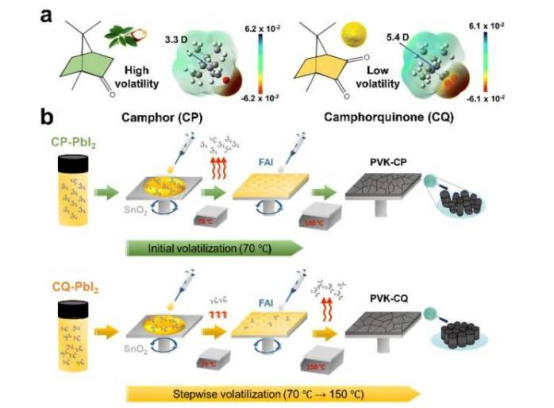
The team employed camphorquinone (CQ) as an additive, whose unique stepwise sublimation property plays a critical role during crystal growth. First author Jeewon Park explained: "CQ precisely controls the timing of crystal growth without leaving any residue in the final film." Experimental results showed that solar cells using CQ-enhanced films achieved a 9.6% relative efficiency improvement over the control group, reaching a power conversion efficiency of 25.2%.
Under simulated real-world operating conditions, the new solar cells demonstrated outstanding stability. After 1,000 hours of maximum power point tracking, the devices retained more than 90% of their initial efficiency, delivering a lifespan more than twice that of conventional devices. Professor Changduk Yang stated: "Using a natural, environmentally friendly material to address stability issues opens a new pathway for sustainable energy technology."
This research not only elevates the performance metrics of perovskite solar cells but also simplifies the manufacturing process and reduces production costs. The researchers believe this technology will accelerate the commercialization of perovskite solar cells and drive the advancement of clean energy technologies.