
A new study suggests that celestial objects known as "dark dwarf stars" may be hidden at the centre of the Milky Way and could provide crucial clues to the nature of dark matter. A research team from the UK and Hawaii has published a paper in the Journal of Cosmology and Astroparticle Physics, offering the first detailed description of these objects and proposing methods to confirm their existence using instruments such as the James Webb Space Telescope.
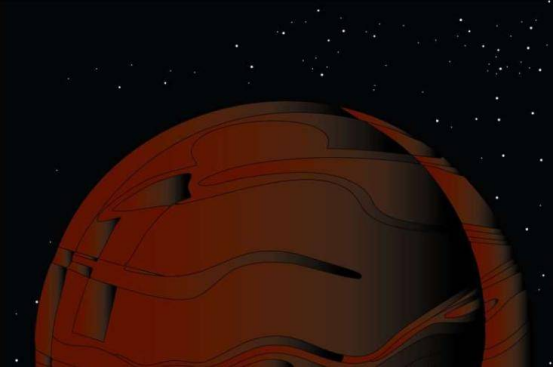
The team has named these objects "dark dwarf stars" — not because they are dark themselves, but because of their special connection to dark matter. Dark matter is one of the central unsolved problems in cosmology and astrophysics: scientists believe it constitutes 25% of the universe's mass, emits no light, and can only be detected through gravitational effects. Professor Saxton explained: "Dark matter particles can interact gravitationally, become captured inside stars, accumulate there, and then annihilate with each other, releasing energy that heats the star."
Dark dwarf stars are low-mass objects that are not massive enough to trigger nuclear fusion and normally emit only very faint light. However, if located in regions rich in dark matter — such as the galactic centre — they could collect dark matter and transform into dark dwarf stars. Saxton noted: "The existence of dark dwarf stars would imply that dark matter must consist of weakly interacting massive particles (WIMPs) or any heavy particles capable of strong self-interaction to produce observable effects."
To identify dark dwarf stars, the team has proposed a unique signature: lithium-7. In ordinary stars, lithium-7 is rapidly burned away, so detecting it in objects resembling dark dwarf stars could serve as evidence of their existence. Additionally, instruments like the James Webb Space Telescope may already be capable of detecting these extremely cold objects. Saxton added that observing entire populations of such objects and statistically determining whether a subpopulation of dark dwarf stars provides a better description is another viable approach.