
A research team led by Dr. Xu Mingkai from the Institute of Applied Ecology, Chinese Academy of Sciences in Nanjing, has achieved a major breakthrough by identifying a highly efficient microbial consortium, designated AT1, that can completely degrade the widely used and persistent herbicide acetochlor. The findings have been published in the Journal of Environmental Management.
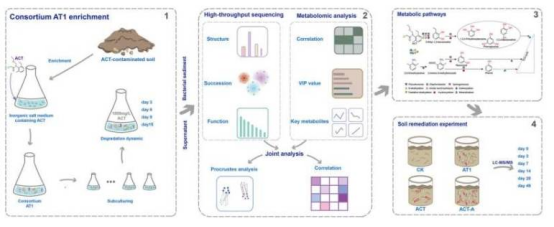
Acetochlor, an amide herbicide commonly applied for weed control, poses serious environmental risks due to its long persistence and toxicity to non-target organisms. Conventional remediation methods are difficult to sustain. Bioremediation, particularly approaches that utilize microorganisms to break down pollutants, has gained attention with advances in synthetic microbial community technology.
The research team enriched a microbial consortium named AT1 from acetochlor-contaminated farmland. Under optimized conditions, this consortium almost completely degraded acetochlor at concentrations up to 1000mg/L within 12 days, outperforming previously reported strains or systems.
High-throughput 16SrRNA gene sequencing revealed that microbial diversity within AT1 decreased during acetochlor degradation, with significant changes in community structure and function. Microbiome-metabolome analysis uncovered a novel acetochlor degradation pathway driven by synergistic metabolic interactions among different microbes: Pseudomonas initiates N-dealkylation, Diaphorobacter catalyzes amide bond hydrolysis, and Sphingomonas promotes carboxylation and hydroxylation of the aromatic ring. These microorganisms collectively break down acetochlor into smaller intermediates such as 2,6-dimethylaniline, resorcinol, and phenol, which are further mineralized and enter the tricarboxylic acid (TCA) cycle.
Furthermore, the research team validated the potential of AT1 in microcosm experiments, confirming its ability to effectively reduce acetochlor residues in contaminated soil. This study not only enriches scientific understanding of amide herbicide degradation but also provides a practical tool for developing green bioremediation technologies to address non-point source pollution in agricultural environments. By harnessing the complementary metabolic capabilities of multiple microbial species, the research represents an important step forward in sustainable pollution control and highlights the growing importance of microbial engineering in managing chemical residues while safeguarding the environment and food safety.