
On July 9, the Chinese Academy of Sciences held a press conference to release a series of scientific results from the Chang'e-6 lunar samples. Four of these studies were published as cover articles in Nature on the same day, revealing for the first time the magmatic activity on the lunar far side, the ancient lunar magnetic field, the water content of the lunar far-side mantle, and the evolutionary characteristics of the lunar mantle, thus lifting the veil on the evolutionary history of the Moon's far side for humanity.
Chang'e-6 landed in the South Pole–Aitken Basin on the lunar far side, filling a major gap in the study of far-side lunar evolution. Obtaining samples from the South Pole–Aitken Basin has long been the top scientific priority in international lunar exploration, yet its location on the far side made the task extremely challenging.
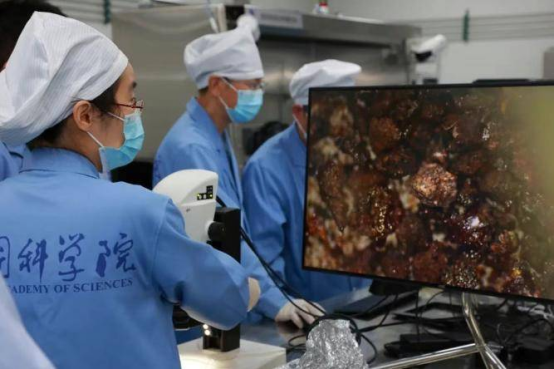
Academician Wu Fuyuan from the Institute of Geology and Geophysics, Chinese Academy of Sciences, stated that from an engineering perspective, China's first-ever sample return from the lunar far side is already historic. From a scientific standpoint, the research on the South Pole–Aitken Basin has yielded multiple groundbreaking advances, including:
First revelation that the lunar far side experienced two distinct periods of basaltic volcanism around 4.2 billion years ago and 2.8 billion years ago, demonstrating that the far side could sustain prolonged volcanic activity;
First acquisition of paleomagnetic data from the far side, revealing a possible rebound in lunar magnetic field strength around 2.8 billion years ago, indicating that the lunar dynamo was not monotonically decaying but exhibited fluctuations;
First measurement of water content in the far-side mantle, showing it is significantly lower than the near-side mantle, indicating a dichotomy in water distribution within the Moon;
First discovery that far-side basalts originated from an anomalously "depleted" mantle region, suggesting that the primitive lunar mantle itself was depleted or that the giant impact stripped away molten material from the mantle, highlighting the profound influence of large impact events on the evolution of the Moon's deep interior.
Wu Fuyuan noted that many secrets remain locked within the far-side samples returned by Chang'e-6, and three major mysteries—including whether they contain mantle material excavated by the South Pole–Aitken impact—are yet to be solved.