
Fusion energy promises to drive the transition away from fossil fuels, strengthen domestic energy security, and power artificial intelligence, with private industry already investing more than $8 billion in commercial fusion technology. However, discovering and qualifying cost-effective materials that can survive extreme conditions — such as 150-million-degree plasma and intense particle bombardment — for decades remains an urgent challenge.
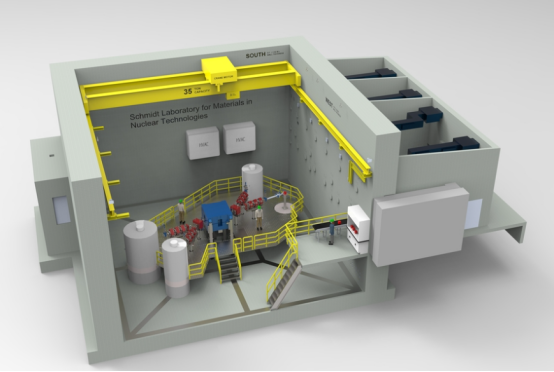
To address this, MIT's Plasma Science and Fusion Center (PSFC) has established the Schmidt Laboratory for Materials in Nuclear Technologies (LMNT), supported by a philanthropic consortium led by Eric and Wendy Schmidt. The lab aims to accelerate the discovery and selection of materials for a wide range of fusion power plant components.
Leveraging PSFC's expertise in fusion and materials science, repurposing existing research infrastructure, and collaborating closely with leading private fusion companies, LMNT will drive the rapid development of materials needed for fusion commercialization. It will also assist in developing and evaluating materials for nuclear power plants, next-generation particle physics experiments, and other scientific and industrial applications. LMNT director and Associate Professor of Nuclear Science and Engineering Zachary Hartwig says technologies are now needed that can quickly develop and test materials to support fusion commercialization, and LMNT's mission is to explore the science and ultimately help select the materials that will be used to build fusion power plants in the coming years.
For decades, researchers have studied material behavior under fusion conditions by exposing samples to low-energy particle beams or placing them inside fission reactor cores, but these approaches have limitations. Low-energy beams only irradiate the thinnest surface layer, fission reactor irradiation does not accurately replicate fusion damage mechanisms, and fission irradiation is expensive, time-consuming, and requires specialized facilities.
To overcome these barriers, MIT and its partner institutions are exploring the use of high-energy proton beams to simulate material damage in a fusion environment. Proton beams can be tuned to match the expected damage levels in fusion power plants, penetrate deep into test samples, and rapidly damage dozens of material specimens, enabling testing to be completed in days. High-energy proton beams can be generated using cyclotrons commonly used in the healthcare industry, and LMNT will be built around an off-the-shelf, cost-effective, readily available, and highly reliable cyclotron.
LMNT will feature four experimental areas dedicated to materials science research around the cyclotron. The laboratory is being constructed inside PSFC's large shielded concrete vault — the former home of the Alcator C-Mod tokamak. Repurposing the existing space avoids major new construction and accelerates the research timeline. A senior PSFC team that has led multiple large-scale projects is overseeing LMNT's design, construction, and operation. The cyclotron is expected to be delivered by the end of 2025, with experimental operations beginning in early 2026.
PSFC Director Nuno Loureiro says LMNT marks the beginning of a new era in MIT fusion research, striving to tackle fusion technology challenges on a timescale commensurate with the urgency of the energy transition. Elsa Olivetti, Jerry McAfee Professor of Engineering and co-director of the MIT Climate Project, notes that the project integrates existing resources to address the critical resource missing in the fight against climate change — time — allowing MIT researchers to act immediately and advance research rapidly.
Beyond advancing research, LMNT will serve as an educational and training platform for students in the fusion field. Located on MIT's main campus, it will enable students to lead research projects and help manage facility operations, continuing PSFC's hands-on, large-experiment-focused teaching model. Department of Nuclear Science and Engineering head Benoit Forget says the new lab will provide students with unique research capabilities that will help shape the future of fusion and fission energy.
Philanthropic support enabled LMNT to go from concept to facility in just 18 months. Hartwig emphasizes that focused philanthropy combined with MIT's strengths has created a transformative new facility. PSFC is executing a major public-private partnership in fusion energy, demonstrating the university's pivotal role in accelerating the materials and technologies needed for fusion power. MIT Vice President for Research Ian Waitz says LMNT is helping turn fusion energy from a long-term dream into a near-term reality.