
An international research team has published a major breakthrough in Nature Electronics, successfully developing the world's first chip that integrates electronic-photonic-quantum systems. This breakthrough is fabricated using standard 45nm CMOS processes, achieving chip-level integration and stable control of quantum light sources, laying the foundation for large-scale application of quantum technology.
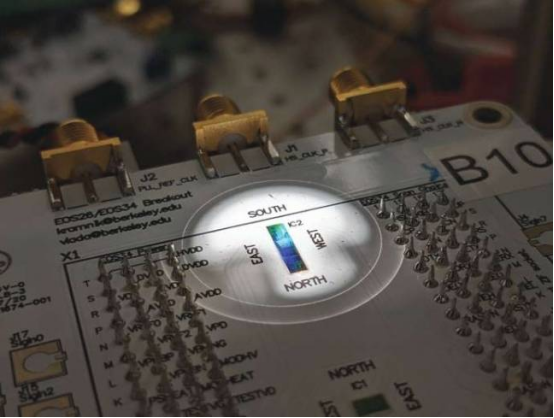
The chip was jointly developed by Boston University, UC Berkeley, and Northwestern University. Its core innovations include:
Integration of 12 parallel quantum light source arrays, with each unit smaller than 1mm²;
Use of micro-ring resonators to generate entangled photon pairs, with built-in photodiodes for real-time stability monitoring;
Innovative integration of temperature control systems and feedback circuits that automatically compensate for environmental interference;
Full compatibility with commercial semiconductor production lines, enabling mass production feasibility.
The research team solved the quantum system scaling challenge through three key technological breakthroughs: Boston University developed precision photonic device designs for highly efficient quantum light generation; UC Berkeley's integrated control system ensured operational stability; and Northwestern University's quantum measurement technology completed performance verification. Project leader Professor Miloš Popović stated: "This is the first real proof that complex quantum systems can be manufactured using commercial production lines."
This achievement marks a pivotal turning point for quantum technology from laboratory to industrialization. Photonic interconnect chips produced using the same process have already been commercialized by the spin-off company Ayar Labs, clearly demonstrating the industrialization path for quantum chips. The researchers point out that this scalable architecture is expected to drive rapid development in quantum communication, sensing, and computing technologies.