
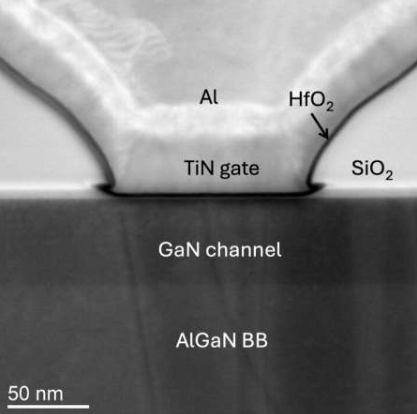
Researchers at imec have set a new benchmark in radio-frequency (RF) transistor performance for mobile applications. They demonstrated a silicon-based gallium nitride (GaN) MOSHEMT (metal-oxide-semiconductor high-electron-mobility transistor) that, as an enhancement-mode (E-mode) device operating at low supply voltage, delivers record-breaking efficiency and output power.
At the same time, imec also achieved a record-low contact resistance of 0.024Ω·mm, which is critical for further increasing output power in future designs.
These results mark a key step toward integrating GaN technology into next-generation mobile devices, particularly those targeting the 6G FR3 frequency band between 7 and 24GHz. The work was presented at the 2025 Symposium on VLSI Technology and Circuits held in Kyoto, Japan.
Today's mobile networks mostly operate below 6GHz, but meeting the data-rate demands of future 6G systems will require a shift to higher frequencies. In these bands, current mobile solutions based on gallium arsenide (GaAs) HBTs (heterojunction bipolar transistors) struggle to maintain performance.
Their efficiency and gain drop significantly above 10–15GHz, causing rapid battery drain and high power consumption in user equipment. GaN is widely regarded as a highly promising alternative due to its higher power density and breakdown voltage. While GaN-on-SiC transistors have demonstrated strong RF performance in high-frequency base stations, the high cost and limited wafer scalability of SiC remain barriers to adoption in the mobile market.
Silicon is a far more scalable and cost-effective platform, but building high-performance GaN transistors on it has long been challenging due to lattice and thermal mismatch between the two materials, which can degrade material quality and device reliability.
The challenge is even greater for enhancement-mode designs—preferred in mobile devices for fail-safe operation and low power consumption—because they typically require thinning of the transistor barrier and channel beneath the gate. This limits on-state current and increases off-state leakage, making it harder to achieve the power, efficiency, and gain required for 6G.
Imec has now demonstrated a silicon-based GaN enhancement-mode MOSHEMT that, at 13GHz and 5V, achieves a record 27.8dBm (1W/mm) output power and 66% power-added efficiency (PAE). The result was obtained on a single device with an 8-finger gate layout, providing the gate width needed for high output power without requiring power combining of multiple transistors.
This outstanding performance was enabled by combining gate recess technology (used to convert the device to E-mode) with an InAlN barrier layer (to compensate for performance loss caused by channel thinning).
In parallel with device development, imec achieved a record-low contact resistance of 0.024Ω·mm using a regrown n⁺ (In)GaN layer, thereby maximizing current flow while minimizing power loss. Although demonstrated in a separate module, this contact technology is fully compatible with the E-mode transistor architecture.
Simulations show that integrating this contact module can increase output power density by 70%, meeting the performance targets for 6G user equipment.
Alireza Alian, Principal Member of Technical Staff at imec, said: "Reducing contact resistance is essential for increasing output power while maintaining high efficiency."
"Our next step is to integrate this contact module into the E-mode transistor and verify the expected gains in power and efficiency, bringing the device closer to real-world 6G applications."